Pool Crack Repair in Killeen, Texas
Killeen Pool Resurfacing handles pool crack repair in Killeen, Texas: telling cracks in the finish from cracks in the concrete shell, then injecting, plugging or patching them with materials made for a structure that holds water. The work covers hairline cracks, leaking cracks and the rust-stained kind that point to the steel inside.
Where the crack sits matters first. A crack in the plaster is a finish problem; a crack through the shell is a structural one, and the American Shotcrete Association wants movement cracks investigated for their cause before a remedy is chosen. At a free estimate we'll look at the crack's width, length and position and whether it seems to be moving, and talk through the repair.
No charge · answered 24/7
Get free estimates
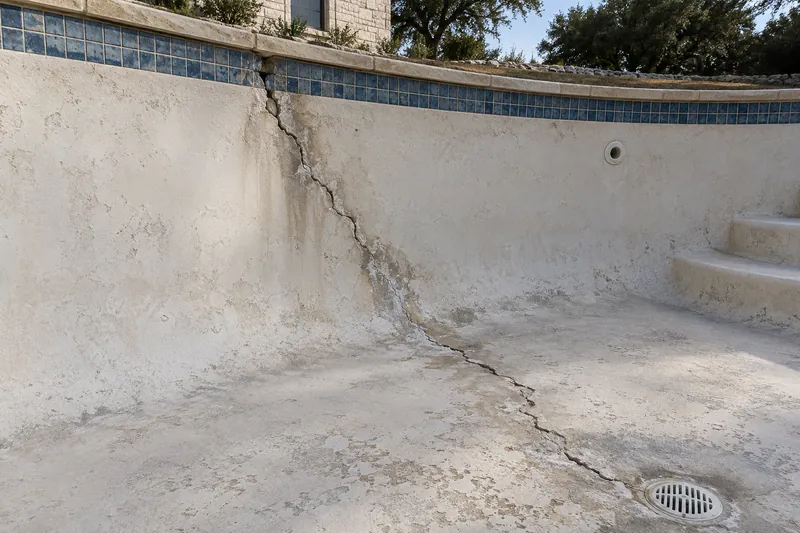
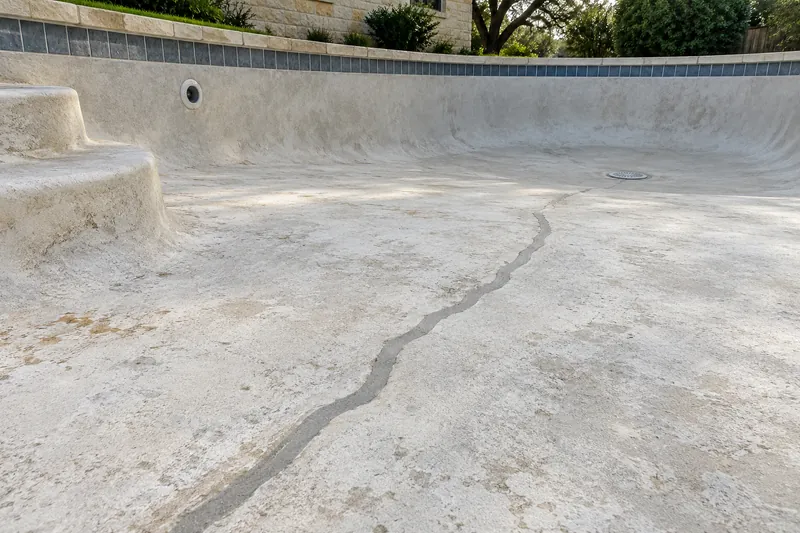
Finish cracks and structural cracks in a pool
Cracks in the finish
The National Plasterers Council reserves the term shrinkage crack for cracks that open while a finish is being applied or within twenty-four hours of its final set, and treats them as a different thing from a crack in the structural shell. Universal White Cement, a white cement maker, adds a clue for older finishes: circular or spider cracks centered on one patch of plaster point to delamination rather than a straight structural crack through the shell. Hollow, cracked plaster of that kind is covered under pool plaster repair.
Cracks in the shell
The shell is the structure the finish sits on: formed concrete or shotcrete, either wet-mix or the dry-mix kind known as gunite, sprayed over a steel reinforcing grid, in the Council's definition. Because shotcrete is only a way of placing concrete, the American Shotcrete Association says any method for repairing cracks in concrete applies to a shotcrete pool. Its guidance sorts cracks into two groups. Holes missed while the shell was shot, and some shrinkage, autogenous or plastic cracks, can often just be plugged or patched; cracks from structural movement, or from stress inside the structure, call for a proper investigation of what caused them and what will fix them.
Rust stains and thin cover over the steel
Rust bleeding through plaster is a warning about the steel. The Association says the shotcrete contractor is responsible for keeping proper concrete cover over the reinforcing steel, and that a shell shot with reduced cover has much less durability than its designer intended. An article in its magazine explains why: with too little cover, water can reach the steel and start corrosion that may spall the concrete off. The Association's technical director lists the questionable practices he hears about most often from pool owners and builders: reused rebound, no curing, too little velocity when the shotcrete is placed, uneven thickness and excessive porosity.
Cracks at apartment, HOA and other public pools
Texas counts apartment, condominium and HOA pools as public pools, and the CDC's Model Aquatic Health Code (not Texas law, only a model) sets out its own rules for cracks. By its definition, a crack is structural when the break weakens the vessel itself. Shell cracks are part of its daily inspection: they are repaired once they have changed enough to make leaks, trips or falls, cuts or cleaning trouble more likely, surface cracks under 1/8 inch wide are documented and watched for movement, and sharp edges are removed or repaired.
Call or request a free estimate any time, 24/7.
Get free estimates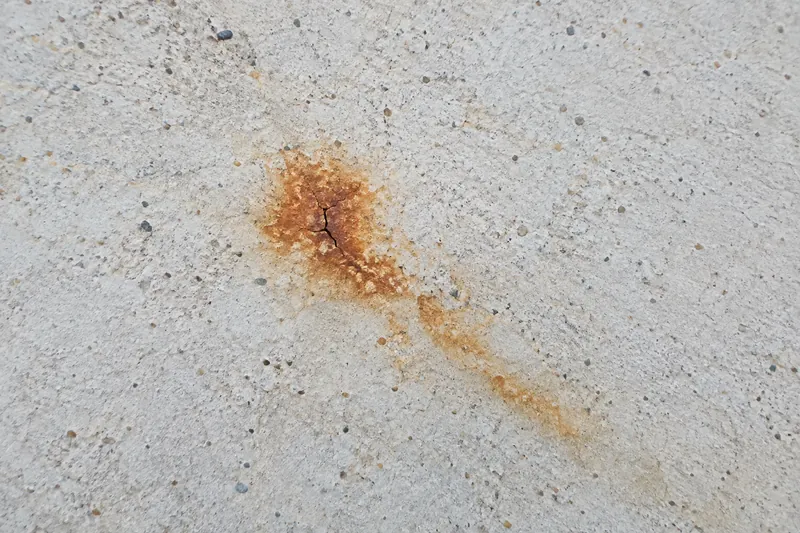
Pool crack repair methods and materials
Injected epoxy and polyurethane
For shrinkage cracks in a pool floor, the American Shotcrete Association notes that a wide variety of epoxies and polyurethanes are injected, with lower-viscosity materials for narrower cracks. A crack that will keep moving with temperature, or one that sits under water, calls for a filler that tolerates the movement; the Association warns off brittle products, says many injectable polyurethane grouts can do the job, and adds that a surface coating would need enough thickness and elasticity to bridge a moving crack. Prime Resins describes one such product, its Prime Flex 900 XLV: a low-viscosity hydrophilic polyurethane that reacts with water and expands into a closed-cell, watertight foam, injected under pressure into actively leaking joints and cracks, hairline ones included, and flexible enough to move with the concrete. Prime Resins, which makes both kinds, also says water-seeking hydrophilic resins soak deep into the micro-cracks of wet concrete while water-repelling hydrophobic resins won't penetrate them and can fail a few months after the job; that is one maker's position.
Weeping cracks and running water
Prime Resins starts the choice of product with one question: is the crack weeping, a hairline seep, or gushing? A weeping leak needs a low-viscosity resin that penetrates; a gushing one needs a quick reaction or set time. Hydraulic cements stop running water another way. QUIKRETE's Hydraulic Water-Stop Cement, a blend of portland and calcium aluminate cements for concrete and masonry, swimming pools included, reaches final set in less than 5 minutes, and a special white version is made for pool patching. Its directions call for cleaning loose material, dirt, algae and mildew off the area, enlarging small cracks and holes while avoiding V-shaped cuts, and pressing the cement in from the top down until it sets and the leaking stops, mixing no more than can be used in 2 to 3 minutes. Xypex describes its Patch'n Plug as a fast-setting hydraulic cement compound that stops flowing water in seconds and seals cracks, tie holes and other defects in concrete. Before its finish goes on, SGM requires every weeper, water pushed through the shell by hydrostatic pressure, to be stopped with hydraulic cement.
Patching holes and thickening walls
To patch a small hole in a shotcrete wall before plastering, the American Shotcrete Association describes pressure washing at 3,000 psi or more to remove dirt and laitance, hand-patching with a nonshrink hydraulic cement of at least 4,000 psi 28-day compressive strength, and roughening the patch so the plaster has something to grip. Building a cracked or thin wall up with extra shotcrete is a design change: the Association notes that the wall's thickness is part of the pool engineer's design, and that more thickness would need more reinforcing steel, to be checked with the pool's designer.
When an engineer and core samples come in
The Association steers structural questions to people who can see the pool. For cracking in a pool floor it recommends an engineer or injection specialist experienced in shotcrete and cracking evaluate the cracks before a repair is chosen, and asked about one spa remodel it pointed the owner to a local engineer familiar with pools and spas. Where spider-web cracking puts a shell's strength in doubt, it advises a qualified local engineering firm to plan, take and test cores under ASTM C42/C42M or ASTM C1604/C1604M. Under the 2021 International Swimming Pool and Spa Code, the structural design and materials of a residential inground pool follow the International Residential Code.
Call or request a free estimate any time, 24/7.
Get free estimates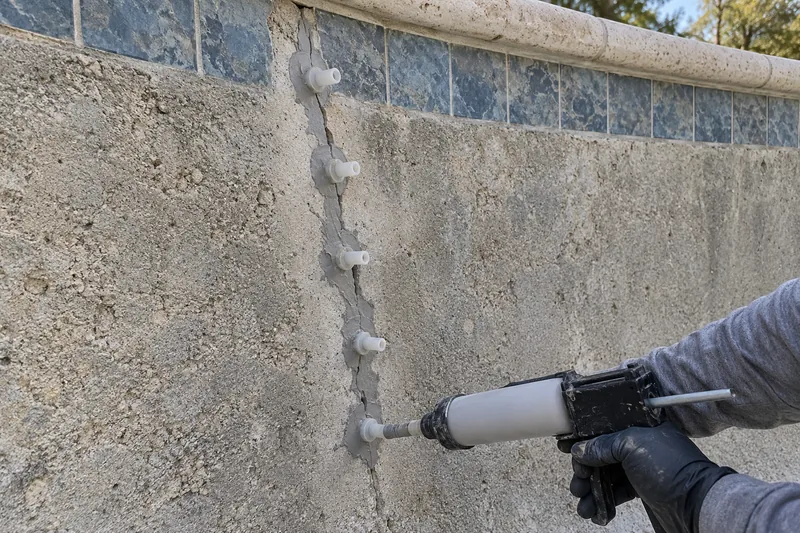
Cracks, leaks and a watertight shell
The American Shotcrete Association's position is that a quality shotcrete shell should be functionally watertight on its own, and that the plaster or tile put on afterward is not what makes a pool hold water. An article in its magazine reports the National Plasterers Council's view as the same: plaster is not a waterproofing coating or membrane and must go on a watertight shell, because water that gets through the plaster flows more readily through a porous one.
Cracks and leaks can feed each other. Anderson Manufacturing, a maker of leak-detection equipment, explains that extra water unsettles the ground around a leaking pool, making cracks and tile movement more likely, and the bond beam can crack or open up as the pool settles farther into the softened ground. A pool that is cracking and losing water at the same time needs pool leak detection as well as a crack repair. The EPA counts the pool-to-pipe connection among the places pools leak; a cracked or leaking skimmer body is covered under pool skimmer replacement.
Killeen's clay and limestone under a pool shell
Each soil fact here is for a named point in the city, from the Natural Resources Conservation Service's soil data for Bell County. At Ellison High School on East Elms Road the soil is San Saba clay, dark clay over hard limestone about 76 cm down, which NRCS rates very limited for houses without basements because of shrink-swell, and very limited for shallow digging because of hard bedrock and unstable excavation walls. At Lions Club Park and Chaparral High School it is Denton silty clay, whose top layer carries the highest linear extensibility of the Killeen points checked, 12. Shoemaker High School sits on Slidell silty clay, a very deep clay with no bedrock within the 203 cm (80 inches) described. Along the Andy K. Wells Hike & Bike Trail it is Purves silty clay, Killeen's most widespread soil, with hard limestone only about 36 cm (14 inches) down. At the Killeen ISD Administration Building it is Lewisville silty clay, where the 1977 soil survey notes that cuts and fills for building lots ran from a few inches to 1 or 2 feet.
The same 1977 survey says the Houston Black clay mapped mainly in Killeen and Temple cracks as much as 2 inches wide when dry, and that those cracks can crack a concrete sidewalk, a concrete floor or a brick wall, though today's map puts it under only about 0.4% of the city. NRCS rates all five of Killeen's main soils low for corrosion of concrete and four of them high for corrosion of uncoated steel. Beneath it all, the USGS state geologic map puts the city on the Walnut Clay: calcareous clay, chalky and marly limestone and shale, 125 to 175 feet thick.
Killeen Pool Resurfacing gives free estimates on cracked pools, from hairline cracks to rust-stained ones, by phone or through the form.
Call or request a free estimate any time, 24/7.
Get free estimatesPool crack repair questions
Can I repair cracks in my swimming pool underwater?
Some cracks can be sealed with water in or coming through them; how depends on the flow. Prime Resins matches a weeping hairline crack with a low-viscosity resin that penetrates, and a gushing one with a fast-setting product, and Xypex makes a hydraulic cement that stops flowing water in seconds. For a few small plaster cracks, a national cost report from 2026 notes that an underwater epoxy patch can sometimes do. Anything applied over a crack that keeps moving needs enough thickness and elasticity to bridge it, the American Shotcrete Association says, and a structural crack still needs its cause investigated first.
How much does pool crack repair cost per foot?
Some published figures do price it by the foot: national averages with no data year stated put most crack repair at $250 to $350 per foot, and a new inner shell, where one is needed, at $15,000 to $25,000. Others price by severity instead; typical Dallas-area pricing in 2025 runs $500 to $1,500 for minor structural cracks and $2,000 to $5,000 for moderate cracks with rebar exposed. The two measure the job differently, so one can't be converted into the other. These are published figures, not our prices.
Is a hairline crack in a pool a problem?
Not always, but it is worth watching. The American Shotcrete Association says certain shrinkage, autogenous or plastic cracks can often simply be plugged or patched, while cracks from structural movement need investigating. For public pools, the CDC's model code has surface cracks under 1/8 inch wide documented and watched for movement. If the hairline weeps water, Prime Resins treats it as a leak, sealed with a low-viscosity resin injected under pressure.
Will a repaired pool crack come back?
It can if the cause is left alone or the filler can't move. The American Shotcrete Association ties structural movement cracks to an investigation of cause and remedy, and warns against brittle products in cracks that will keep moving. Prime Resins says hydrophobic resins can fail a few months after a job in wet concrete. Where new shotcrete is placed, the Association recommends at least 7 days of curing, since skipping it in windy, hot or dry weather raises the risk of shrinkage and cracking.
Do I need a permit to repair a pool crack in Killeen?
Ask the City before the work starts. The 2024 International Swimming Pool and Spa Code that Killeen has adopted requires a permit to construct, alter or repair a pool, while exempting replastering or resurfacing an existing pool, and the City's own permit rule covers altering or repairing a structure. No City handout or web page names pool crack repair either way, so Killeen Building Inspections is the office that decides. And if the pool is in a subdivision beyond the city line, the City's permit rules don't reach it: unincorporated Bell County issues no building permits.
Request a free pool crack repair estimate
Killeen Pool Resurfacing answers calls and estimate requests about cracked pool shells and finishes 24/7, in Killeen and nearby towns.