Pool Replastering in Killeen, Texas
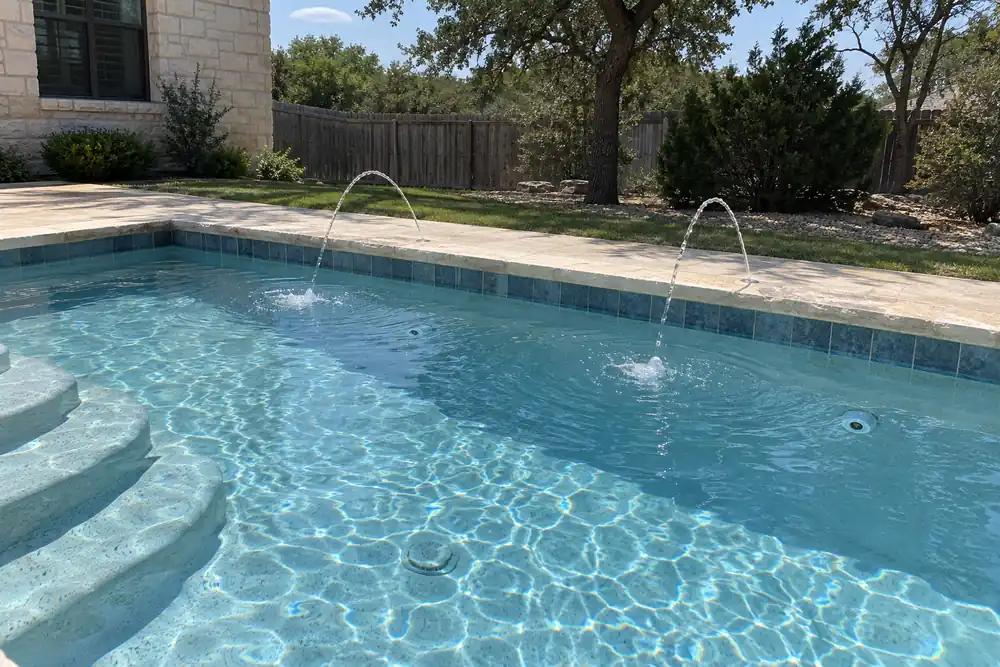
Killeen Pool Resurfacing offers pool replastering in Killeen, Texas, sounding out the old plaster, cutting back or bond-coating what stays, and troweling on a new white or colored finish at the 3/8 to 3/4 inch average thickness the National Plasterers Council sets for a cementitious pool finish. Replastering is the refinish for a gunite or shotcrete pool, the concrete shell sprayed over a steel reinforcing grid, and it covers standard white plaster, often called marcite, as well as colored plaster.
In Killeen the median owner-occupied home was built in 2003 and the median rental in 1991, according to the Census Bureau's 2020–2024 survey. Whatever the pool's age, the estimate is free: we'll talk through white or colored plaster, and whether the old finish is sound enough for a bond coat or should come off.
No charge · answered 24/7
Get free estimates
Signs a pool needs replastering, not a patch
Hollow and delaminated plaster
Universal White Cement, a white cement maker, treats delaminated plaster as a bond failure rather than a cosmetic flaw: the finish is separating from the shell or the bond coat, and sooner or later that turns into pop-offs, hollow areas and larger tear-outs. The signs it lists are raised, blister-like or volcano-shaped spots, patches near lights, returns, tile lines, steps and benches, and circular or spider cracks centered on one patch rather than a straight crack across the shell. Its field check is a tap test in a grid: sound plaster rings crisp and tight, delaminated plaster sounds dull or drum-like, and a drained pool gives the clearest reading.
When patching stops making sense
The same maker sorts the damage into three tiers. A few small, isolated hollow spots can sometimes be chipped out and patched; spreading or patterned hollow areas point to a systemic bond problem, where patching may only delay the inevitable; and widespread separation calls for a full replaster. A young finish that delaminates points to a deeper problem than an old one that has nearly run its course. Small, contained damage is a job for pool plaster repair instead.
Worn, etched and stained white plaster
In the National Plasterers Council's view, white plaster is relatively soft and more sensitive to water chemistry than newer products; as it ages, its appearance can move from slight shading or scaling through staining, etching and cracking, and in extreme cases to delamination. The Council's etching bulletin names proper water balance as the most critical care item for preventing etching, and its owner guidance warns that soft, low-calcium water is aggressive and can pull calcium out of plaster.
Call or request a free estimate any time, 24/7.
Get free estimates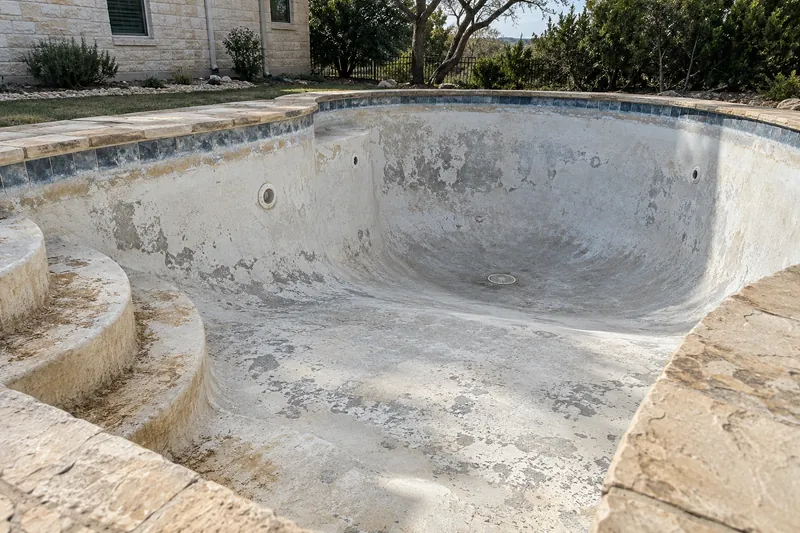
White and colored pool plaster
White marcite plaster
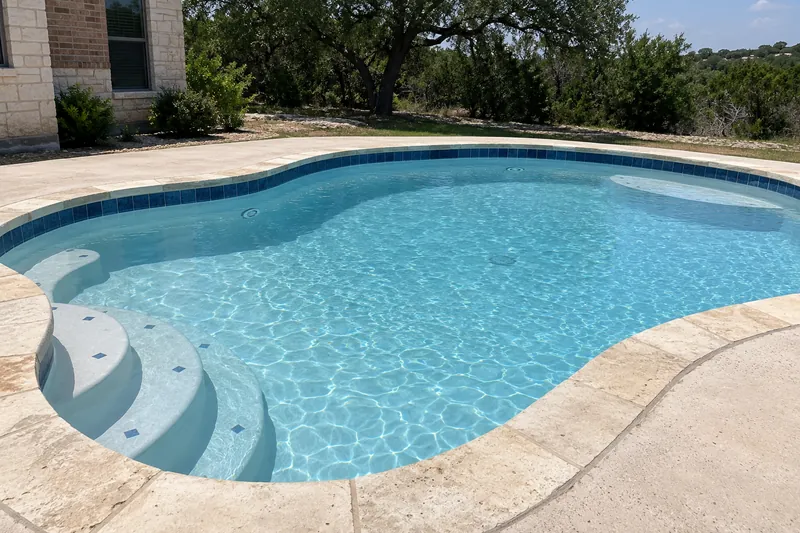
Made from nothing more than white cement, white marble aggregate and water, white plaster is the lowest-cost finish; under water it reads a brilliant, light blue, and many people know it as marcite. The white cement in pool plaster typically carries 0.4 percent iron oxide or less, against 2.6 percent in gray cement, according to a bulletin from the National Plasterers Council and the Portland Cement Association. A properly hard-troweled finish should feel no rougher than 220-grit sandpaper.
Colored and tinted plaster
Pigment makes everything normal in white plaster more visible, the Council warns: mottling can be more pronounced, and colored plaster can show pigment stains, streaks, uneven color and more noticeable crazing, none of it counted as a product defect. Faded color comes down to the finish materials, the application and the water chemistry rather than sunlight. Premix-Marbletite says white, blue or gray bases give the water a true blue look while green, tan, black or brown bases lean blue-green, and suggests checking a sample in 6 inches of water.
Admixtures and the quartz upgrade
Two kinds of admixture change how plaster behaves, the Council explains. Pozzolan-based products tie up calcium hydroxide, the weakest element in plaster, and are shown to lessen etching, cracking and mottling; silicone-based products make the plaster shed water. Both add cost, and neither is fool-proof. For a longer rating than white plaster, the Council rates quartz pool finishes as a 10 to 15 year surface.
Not sure which plaster suits the pool? Killeen Pool Resurfacing will talk it through at the free estimate.
Call or request a free estimate any time, 24/7.
Get free estimatesHow pool replastering is done, step by step
Drain the pool
Killeen keeps chlorinated water out of its storm drains and the street, so it should soak into the soil on the property; the curb is open only to water whose total residual chlorine has been brought under 0.10 mg/l. River Pools, a pool maker, advises leaving the draining to a professional.
Sound out and cut back hollow plaster
Every hollow or delaminated area comes out: SGM's manual saws 3 inches outside each hollow spot, removes the loose plaster and fills the holes with patching cement.
Undercut at tile and fittings
SGM's manual also undercuts the old plaster at all tile and fittings, 2 inches back and 3/8 inch deep.
Clean and etch the shell
Loose material, paint and old patching come off; algae is killed with a chlorine wash and oil with trisodium phosphate, the shell is etched with muriatic acid, and any water seeping through it is stopped with hydraulic cement.
Bond coat or strip to the shell
Over sound plaster, a bond coat such as SGM's Bond Kote is rolled on and cures at least 6 hours; Premix-Marbletite treats a bond coat as absolutely mandatory on any renovation. Pebble Technology International takes the other route in a remodel and strips the old surface off.
Trowel the new plaster
SGM's order is a scratch coat in the deep-end bowl first, then the walls from the shady side toward the sunny side, then a finish coat over the whole pool, 3/8 to 1/2 inch thick.
Fill and start up
White plaster without modifiers is filled as soon as possible after final set, with the hose at the deepest point and no break until mid-skimmer. On the Council's day 1, pH is set at 7.2 to 7.6 and alkalinity at 80 to 100 ppm, and the filter then runs without a break for seven days.
Call or request a free estimate any time, 24/7.
Get free estimates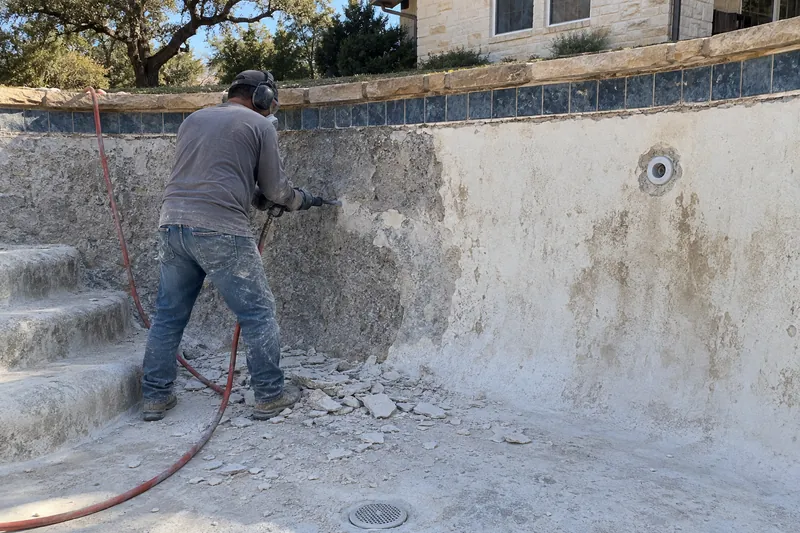
Killeen fill water, summer heat and refill rules
What WCID No. 1's water brings to new plaster
New plaster in Killeen is filled with water the City buys from Bell County WCID No. 1. When TCEQ sampled the District's Belton entry points on January 12, 2026, the water read 142 to 144 mg/L total hardness and 110 to 112 mg/L total alkalinity. Chloramine in the City's system held a 2.01 ppm average residual through 2025, and every February the system changes over to free chlorine. The National Plasterers Council treats fill-water testing as essential: low pH, calcium hardness or alkalinity can etch a new finish, high levels can scale it, and dissolved metals can stain it. It recommends fill water above 200 ppm calcium hardness, and its start-up raises calcium hardness in steps, to 80–100 ppm on day 1, 100–150 ppm on day 2 and at least 200 ppm from day 4.
Plastering in Killeen's heat and wind
In NOAA's 1991–2020 normals, Killeen sees 104.8 days a year reach 90°F or more. No standard limits the air temperature for plastering, the Council says, but hot weather calls for precautions: pre-soaking the shell with no standing water left, adding experienced plasterers, starting earlier in the morning, covering hoses and materials with white tarps, using a bond coat to cut absorption, and tenting the pool. The Council's analysis finds wind the dominant cause of plastic shrinkage cracking: on a 100°F day with little or no wind the critical water loss isn't reached, but sustained wind above 5 mph exceeds it.
Refill rules, refill cost and permits
Killeen's drought plan restricts pool filling once Stage 2 begins: a fill is then allowed on the address's watering days alone, between midnight and 10 a.m. or between 8 p.m. and midnight. Stage 1 was the posted stage on October 4, 2026, and it sets no pool limit; look at the City's Water Conservation page before the pool is drained. At the City's FY 2027 rates, 15,000 gallons through a home's 3/4-inch meter costs $63.90 for water and $48.84 for sewer, $112.74 in all. Replastering an existing pool is left out of the permit requirement in the pool code Killeen adopted; any plumbing, electrical or fence work done alongside it falls under separate permit rules, and Killeen Building Inspections can confirm what applies. Timing around heat and drought is covered in when to resurface a pool in Killeen.
Killeen Pool Resurfacing gives free replastering estimates by phone or through the form, 24/7.
Call or request a free estimate any time, 24/7.
Get free estimates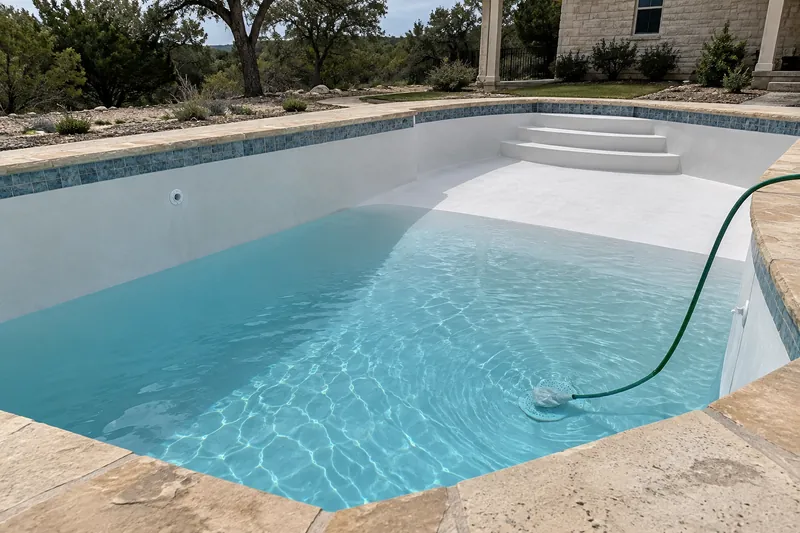
Questions about pool replastering
How much does pool replastering cost per square foot?
For Killeen, a 2021 cost report put basic white-plaster resurfacing at an average of $5.42 per square foot, within a range of $4.73 to $6.10, with draining, sandblasting, the plaster itself, an acid wash and the refill included; Temple's matching report came in at $4.72 to $6.09. Austin-area figures for 2026 give a flat price instead: typically $4,500 to $6,500 when the plaster is standard white, and $6,000 to $8,500 for a colored or upgraded blend. These are other companies' figures, not our prices; pool resurfacing cost in Killeen sets out the rest.
What is the most affordable way to resurface a pool?
Paint is the cheapest route: in national 2026 figures a paint or epoxy coating runs $1,500 to $5,000, while basic plaster runs $5,000 to $10,000. Kelley Technical Coatings expects 2 to 3 years of service from acrylic enamel and 5 to 8 from epoxy. Among cement-based finishes, CL Industries says plain plaster is the cheapest and has the shortest lifespan.
Can a plaster pool be patched?
Sometimes. Small, isolated hollow spots can be cut out 3 inches past the hollow area, the loose plaster removed and the hole filled with patching cement, as SGM's manual describes. Universal White Cement warns that once hollow areas spread or settle into a pattern, a patch may only put off the inevitable, and it puts areas actively popping off with sharp edges first in line.
Can I plaster a pool myself?
The National Plasterers Council says a pool finish goes on in one single application, which is why it takes experienced plasterers, and that the work is hand-crafted and free-hand troweled. The 2024 pool code Killeen adopted requires plastering to follow the APSP/NPC/ICC-12 plastering standard, which the Pool & Hot Tub Alliance, the International Code Council and the Council revised in April 2025.
How long does pool plaster last?
Figures vary by source. The National Plasterers Council's finish comparison gives white plaster 5 to 8 years and quartz 10 to 15, its FAQ says plaster can reach 20 years with proper care, and Universal White Cement expects 15 to 20 years from good materials, sound application and decent water care. The Council's conclusion is that materials, workmanship and balanced water all have to be present for a finish to last.
Request a free pool replastering estimate
Killeen Pool Resurfacing answers replastering calls and estimate requests 24/7, for Killeen and the towns around it.