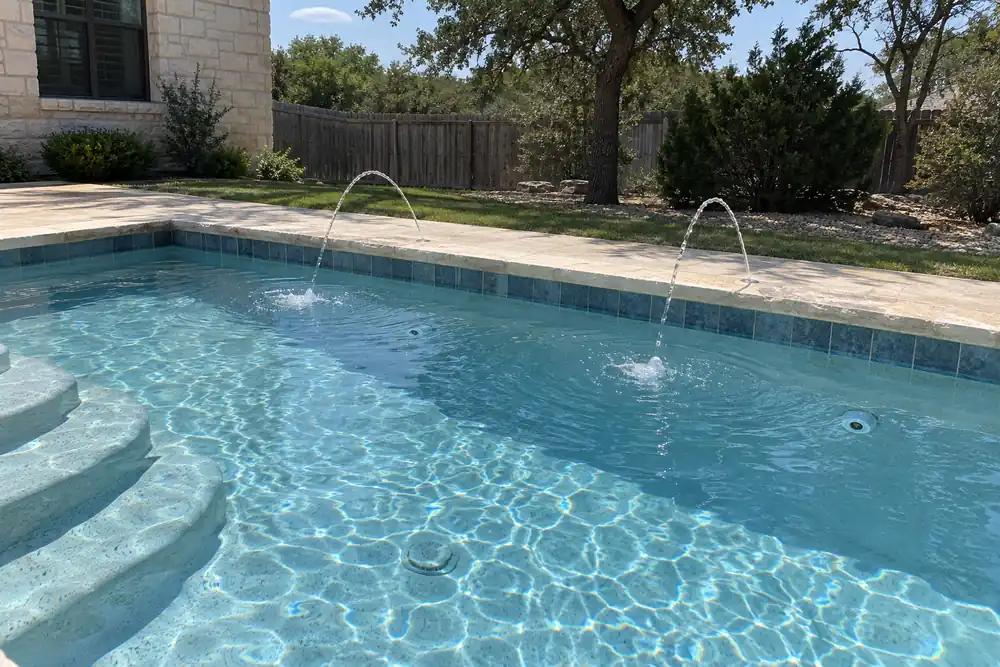
Quartz Pool Finishes in Killeen, Texas
Killeen Pool Resurfacing installs quartz pool finishes in Killeen, Texas: cement-based finishes with quartz aggregate in the mix, troweled hard and then exposed, which the National Plasterers Council rates as an affordable 10 to 15 year surface that can run from smooth to textured. Quartz is one of nature's hardest minerals and doesn't react with pool chemicals, the Council explains, and colored quartz is often added as an accent.
SGM's Diamond Brite, CL Industries' Krystalkrete, NPT's QuartzScapes and Pebble Technology International's PebbleQuartz are all quartz finishes. At a free estimate we'll go through color samples, the exposure method and the brushing a new quartz surface needs. The phone line and the estimate form stay open day and night.
No charge · answered 24/7
Get free estimates
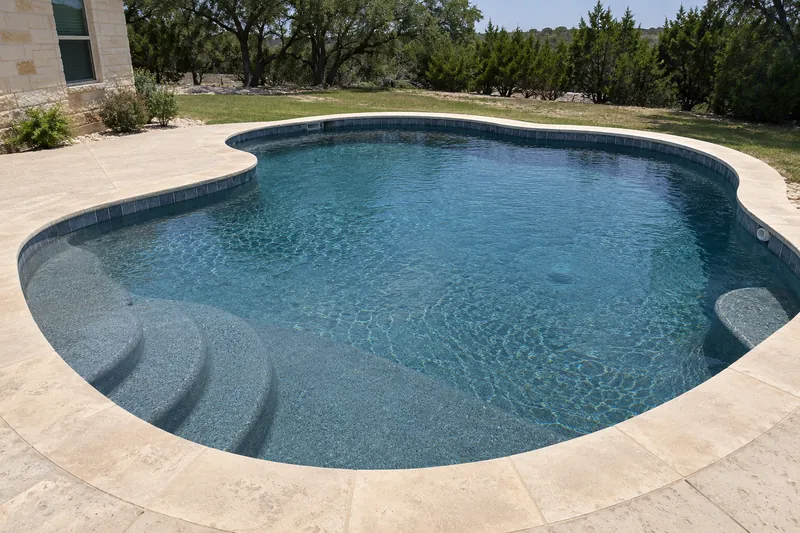
Quartz finish types and what goes into them
Quartz compared with marble plaster
Traditional white plaster uses white marble aggregate; quartz finishes replace it with quartz or blend the two. SGM explains why that matters: unlike marble, quartz aggregate is completely insoluble, even in highly corrosive acid, and polymer-modifying the cement raises hardness, improves bonding and cuts water penetration. NPT puts natural quartz at ten times harder and more durable than marble, which it says suits both commercial and residential pools. The National Plasterers Council agrees that colored ceramic quartz makes a much harder surface, far more resistant to changing water chemistry than standard plaster, while noting that it costs more and can still show surface problems when the water chemistry is extreme. SGM dates its own quartz finish to the early 1990s, after spot etching and other plaster problems had reached what it calls epidemic proportions across the United States in the late 1980s.
Diamond Brite and other quartz lines
SGM's Diamond Brite blends quartz aggregate, an insoluble coated quartz the maker calls Diamond Quartz, and polymer-modified cement. SGM makes it in Pompano Beach and Plant City, Florida, and in Dallas, Texas, and checks every batch of about 60 to 80 bags before it ships. NPT's QuartzScapes comes in 18 colors, and its lower-cost ColorScapes mixes colored quartz with white marble, white cement and NPT's Lobo modifier. CL Industries pitches Krystalkrete as an alternative to marcite with a nonporous, stain-resistant surface, and Pebble Technology International says its silica-based PebbleQuartz is much more durable than marble-based quartz finishes. Wet Edge Technologies calls its Luna Quartz entry-level and warns that this type of finish may show trowel marks and color shading. For a coarser, stone-textured surface, compare pebble pool finishes.
Color, shading and mottling
SGM is plain that all pool plasters can show shade variation, mottling, scale and efflorescence, that colored finishes are especially prone to them, and that Diamond Brite is no exception. Because it is made in batches from natural ingredients, shade varies from batch to batch; installers blend batches by ratio in every mix and record the batch numbers, without which SGM's warranty is void. SGM also tells installers to order 5% to 10% more bags than needed, since an area plastered later from another delivery can't be matched. Light mottling while the finish cures usually evens out within six months, it says, while persistent streaks, dark blotches or a chalky film usually point to start-up water chemistry.
Call or request a free estimate any time, 24/7.
Get free estimates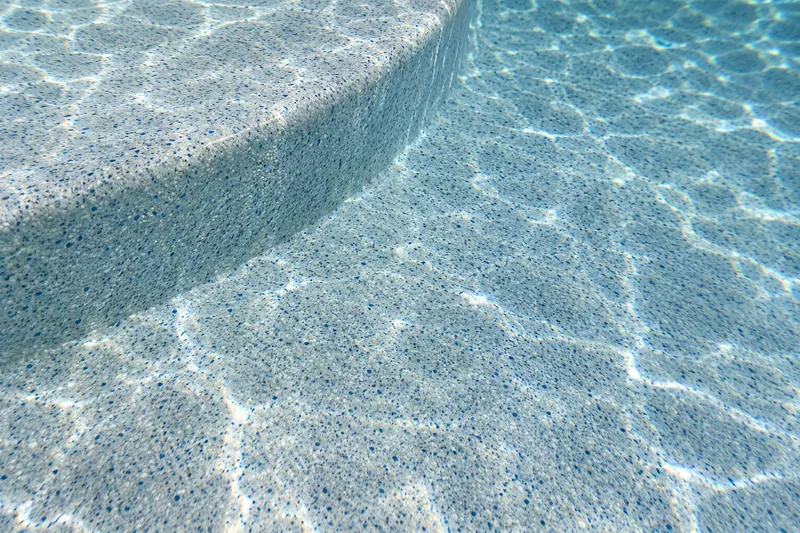
How a quartz finish is applied and exposed
Bond or strip the old surface
SGM's warranty terms require its Bond Kote system wherever its finishes go over an existing finish, and SGM won't cover them over any other bonding material. Where the old finish is first removed by sandblasting or chipping, Bond Kote may not be needed.
Mix each batch for 5 to 10 minutes
Too short a mix gives uneven setting and shade variation, and too long a mix weakens the plaster, SGM says. Well water, or water high in metals and minerals, discolors the finished surface.
Trowel it on at least 3/8 inch thick
Each 80 lb. bag of Diamond Brite covers about 22 to 25 square feet at a minimum of 3/8 inch, and CL Industries gets about 18 to 22 square feet per bag of Krystalkrete at 3/8 inch. SGM recommends slick troweling, which brings the cement paste up and takes it off with the trowel, and wants every spike hole from the finishers' shoes filled with aggregate, not paste.
Expose the quartz by water washing
Once the surface loses its sheen, crews in white cotton socks or foam shoes wash the cement paste off with soft brushes and water, SGM's preferred method for standard Diamond Brite. It takes one worker for every 300 square feet inside a window of about an hour, and a hose or bucket left on the surface can leave a shadow.
Or expose it with acid
SGM's Quartz Series isn't water-washed: once the plaster has set, a 25% muriatic acid solution goes on from the bowl up to the shallow end, walls and steps last, and soda ash neutralizes what's left. SGM calls this easier but less uniform. CL Industries brushes Krystalkrete with dilute muriatic acid and places sodium bicarbonate around the bowl so that area isn't over-exposed.
Fill and start up
On the first fill SGM adds a sequestering agent and brings pH to 7.2 to 7.6 and total alkalinity to 80 to 120 ppm, holding calcium hardness at 125 ppm or more for three days and then at 200 to 400 ppm. No chlorine goes in on day two; the pool is brushed twice a day for three days and daily for two weeks, with no wheeled vacuum for 14 days and no automatic cleaner or salt for 28.
SGM's online care guide gives a different brushing schedule, twice a day on days 1 to 4, once a day to day 14 and three times a week to day 28, and a lower cyanuric acid range of 30 to 50 ppm, so ask which one the installer is working to.
Call or request a free estimate any time, 24/7.
Get free estimates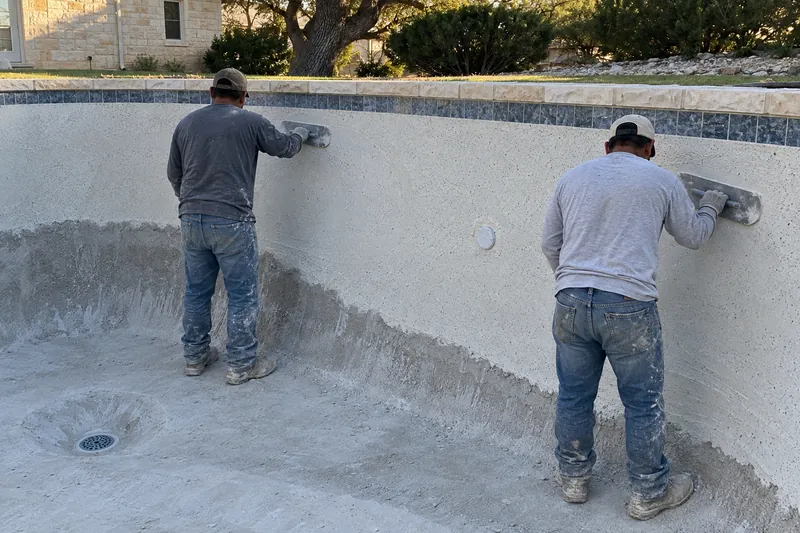
Quartz finishes in Killeen's heat, freezes and water
Temperature limits on placing quartz
SGM keeps materials and the work area above 50°F and under 100°F from 24 hours before Diamond Brite goes on until 72 hours after, and CL Industries applies Krystalkrete only above 40°F. At NOAA's Killeen station the 1991–2020 normal high is 95.7°F in July and 96.6°F in August, and 18.4 days a year reach 100°F or more, 9.1 of them in August; 2023 brought 75 such days. At the cold end, the same normals put 31.1 nights a year at 32°F or lower, most of them in January and December, and SGM's warranty excludes damage from freezing and thawing.
Killeen fill water and the start-up
Killeen's water is treated surface water from Belton Lake and Stillhouse Hollow Lake, bought from Bell County WCID No. 1, according to the City's 2025 water report. In TCEQ's samples from January 2024 to January 2026, total alkalinity in water leaving the District's Belton entry points ranged from 103 to 130 mg/L and total dissolved solids from 200 to 270 mg/L. SGM warns that hard or high-alkalinity mix water can make its plaster effloresce and form calcium scale, especially in dark colors such as Midnight Blue, Onyx, Tahoe Blue and French Gray. After the first 28 days, its warranty terms ask for a Langelier Saturation Index between 0.0 and +0.3, calcium hardness of 200 to 400 ppm, and monthly water tests documented by a company using a computerized system.
Draining a quartz pool later
SGM's advice is to drain a Diamond Brite pool only when it is absolutely necessary, and never in its first year, because the finish has to stay submerged: sun and air can crack and delaminate it, so a drained pool should be refilled within 24 hours. Killeen's drought plan bears on that. From Stage 2, a pool may be filled only on the address's two watering days a week (even-numbered addresses on Sundays and Thursdays, odd on Saturdays and Wednesdays), and only from midnight through 10 a.m. or from 8 p.m. until the day ends. Stage 1 was in force on October 4, 2026, by the City's posting, and it puts no limit on pools; look up the current stage before the water comes out. The City's pool handout keeps chlorinated pool water out of the street and storm drains and has it soak into the soil on the property.
Questions about timing a quartz job around the weather and the water rules? Killeen Pool Resurfacing answers them at the free estimate.
Call or request a free estimate any time, 24/7.
Get free estimatesQuestions about quartz pool finishes
How much does Diamond Brite pool resurfacing cost?
Diamond Brite is SGM's quartz finish, and published prices are for quartz finishes in general. Typical Austin-area pricing in 2026 puts a quartz finish at roughly $7,000 to $11,000. National averages reported in 2025 give $7 to $10 per square foot, or $7,000 to $10,000 for a 1,000-square-foot pool, and national averages reported in 2026 run $7 to $12 per square foot, with $5,000 to $6,500 budgeted for a sample 560-square-foot pool. These are other companies' figures, not our prices; the main finishes are set side by side in pool finishes compared.
How long does a quartz pool finish last?
In the National Plasterers Council's ratings, quartz is good for 10 to 15 years. SGM says Diamond Brite is designed to last 8 to 12 years, with many pools running longer when they're maintained consistently. SGM lists the signs that call for an installer: widespread etching of the surface, dark mottling that persists, calcium nodules, or any hint that the finish is separating from the shell.
Is a quartz finish better than plain plaster?
On the Council's ratings it lasts longer: white plaster is a 5 to 8 year surface and quartz a 10 to 15 year one, and the Council says colored ceramic quartz resists changing water chemistry far better than standard plaster. Plaster costs less. CL Industries calls plain plaster the cheapest finish with the shortest lifespan, and in typical Austin-area pricing for 2026 quartz runs roughly $7,000 to $11,000, against roughly $4,500 to $6,500 for standard white plaster. More on pool replastering.
Do quartz pool finishes come with a warranty?
The makers' warranties cover materials, with conditions. SGM's runs 1 year, or 10 years residential and 5 commercial when registered within 30 days, pro-rated and limited to materials for the failed area; it excludes workmanship, delamination, check cracking, color variation, staining, mottling and freeze-thaw damage. NPT gives QuartzScapes a 10-year standard limited warranty, or a lifetime limited warranty through an approved applicator, for material issues only. Registering PebbleQuartz within 30 days brings a 5-year materials warranty from Pebble Technology International and, under its terms, a 2-year workmanship warranty from the installer.
Can a quartz pool finish be acid washed?
Diamond Brite can be, several times over its life without permanent damage, SGM says, because quartz aggregate doesn't dissolve even in highly corrosive acid the way marble does. For everyday brushing SGM wants a nylon brush; a stainless steel brush belongs on exposed pebble or bare concrete and leaves marks on a Diamond Brite finish.
Request a free quartz pool finish estimate
Call or send the form any time: Killeen Pool Resurfacing gives free estimates on quartz finishes across Killeen and the towns nearby.