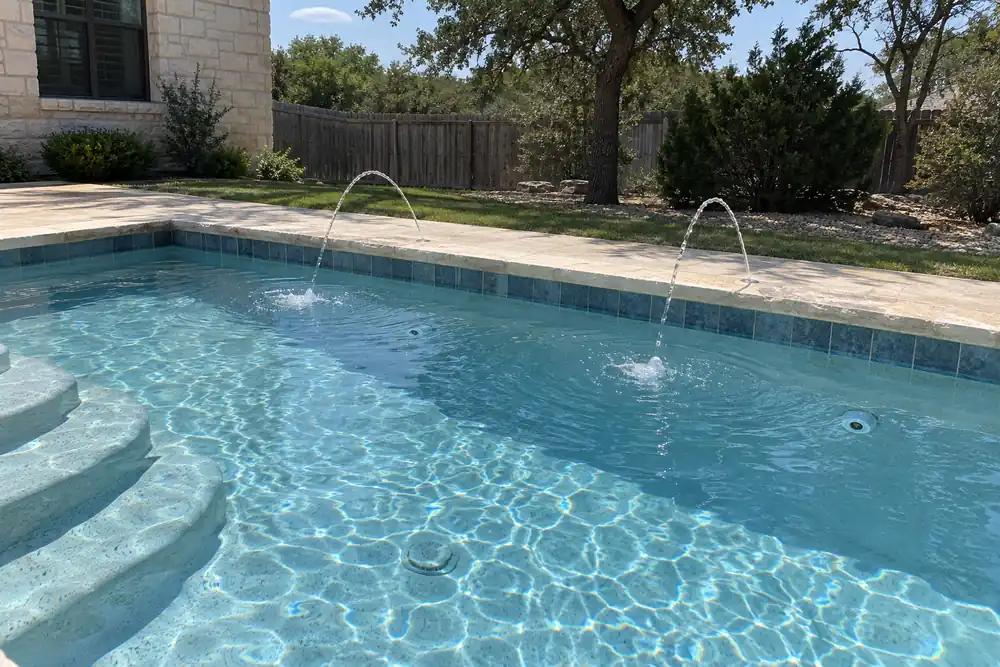
Pool Deck Resurfacing and Repair in Killeen, Texas
Killeen Pool Resurfacing offers pool deck resurfacing in Killeen, Texas, from knockdown spray-texture coatings and cool-deck toppings to thin cement overlays, along with crack and joint repair on concrete, travertine and paver decks. SUNDEK describes its acrylic deck coating as about as thick as two stacked quarters, just under a quarter inch, and Mortex finishes its Kool Deck topping at 1/8 inch.
The ground under a Killeen deck moves. Five clay soils cover nearly two thirds of the city on the USDA's soil map, and the 1977 Bell County soil survey says the shrink-swell of the Denton clay under Killeen and Belton homes can cause cracking and shifting of structures. The estimate is free: we'll talk through the coating, the cracks and joints, and how water drains off the deck. Day or night, calls and estimate requests get an answer.
No charge · answered 24/7
Get free estimates
Pool deck coatings: spray texture, cool deck and overlays
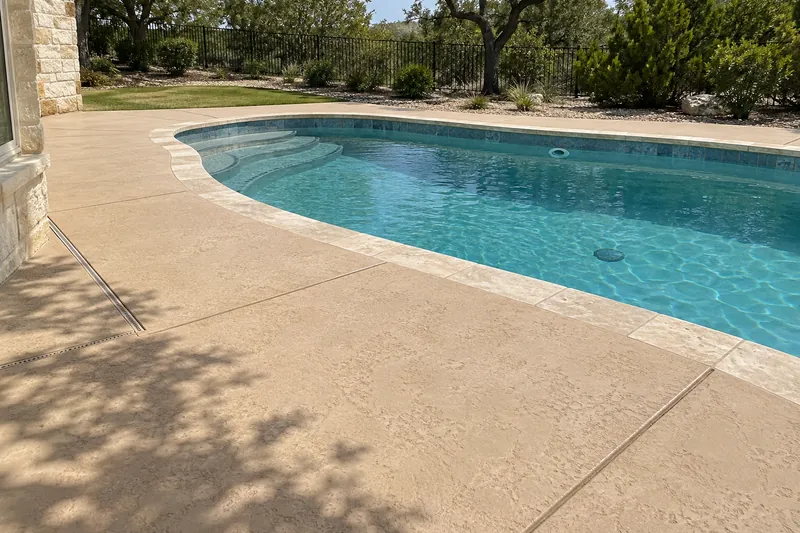
Knockdown spray-texture coatings
A spray-texture coating is sprayed onto the concrete and knocked down with the edge of a trowel, leaving a slip-resistant texture that is comfortable to walk on; SUNDEK then sprays two acrylic finish coats for the final color and protection. Its system goes down in 4 to 8 layers depending on the surface and pattern, and a typical installation takes about 2 to 8 clear, dry days. Sider-Crete, which makes a cement-based knockdown coating sealed with an acrylic, silicone-enhanced sealer, always recommends a knockdown texture for the most slip resistance and says its system is not a slip-proof product.
Cool deck (Kool Deck)
Kool Deck is a Mortex trademark: Mortex invented the Keystone Kool Deck topping in 1962, and once applied it makes a colored, textured cement surface as strong as the base concrete. Mortex says it significantly lowers the surface temperature of concrete and handles thermal expansion and contraction better than concrete, though its darker Designer Colors are warmer than the standard colors. Paint undoes that: Mortex says its own deck paint gives no cooling and leaves a Kool Deck surface hotter and slicker. Makers disagree about using it on old concrete: SUNDEK says Kool Deck is designed to bond to freshly poured concrete, while Mortex publishes instructions for existing concrete.
Thin cement overlays
QUIKRETE's Re-Cap Concrete Resurfacer is a polymer-modified portland cement product that restores worn or scaled concrete, from a feather edge of 1/16 inch up to 1/2 inch.
Killeen Pool Resurfacing will go over which coating suits the deck at the free estimate.
Call or request a free estimate any time, 24/7.
Get free estimates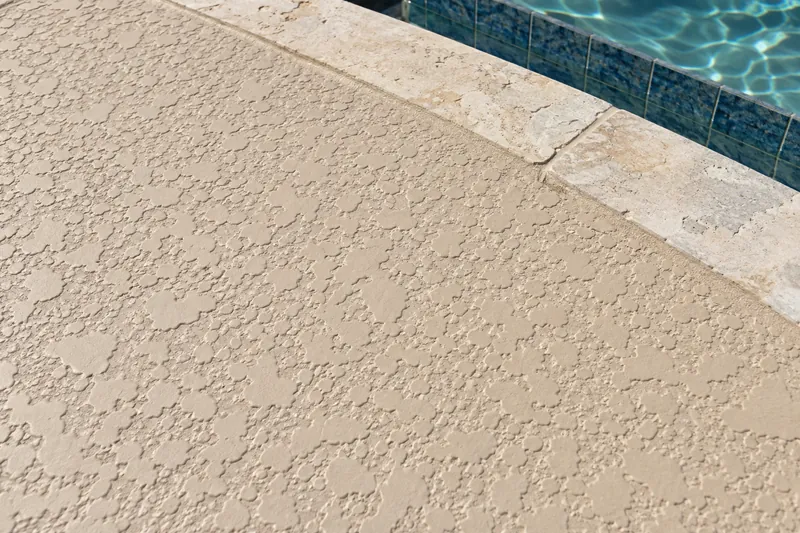
How a concrete pool deck is resurfaced
Check the slope and low spots
SUNDEK's specification calls for at least 1/4 inch of fall per foot and says a coating doesn't guarantee a drainage correction, though a low spot can sometimes be moved, or made twice as wide and half as deep so the sun dries it faster.
Strip and clean the concrete
Dirt, grease, oil and curing compounds come off, and old coatings may need mechanical removal so the new system bonds. QUIKRETE calls a 2500 PSI pressure wash essential to the bond; Mortex scarifies deteriorated concrete or old toppings first.
Repair cracks, keep joints open
SUNDEK fills most cracks with urethane but leaves hairline and shrinkage cracks alone; existing control joints are kept open, and worn-out expansion joints are replaced.
Protect the pool
Sider-Crete lays a thin plastic tarp on the pool water and tapes it around the edges so material doesn't fall in.
Etch, prime or bond
SUNDEK primes, then lays a base coat at least 1/8 inch thick. Mortex etches older concrete with 1 part muriatic acid to 1 part water, never on dry concrete, and scrubs on a thin coat of its PTA bonder. Each maker's rule is for its own product: Sider-Crete neutralizes an etch with a treatment such as TSP, while Mortex says TSP leaves a film that breaks the Kool Deck bond.
Texture the surface
SUNDEK sprays a stipple coat and a splatter coat and knocks the splatter down with a flexible pool trowel. Kool Deck is splashed on from a dash brush and troweled flat with a light hand until the deck is about 40 percent smooth and 60 percent void, which Mortex says prevents craze cracking.
Seal and cure
SUNDEK rolls or sprays two finish coats. Sider-Crete's sealer goes on 24 to 48 hours after the texture; Mortex keeps new Kool Deck under clear plastic for precisely two days and has it washed often for the next 28.
Call or request a free estimate any time, 24/7.
Get free estimates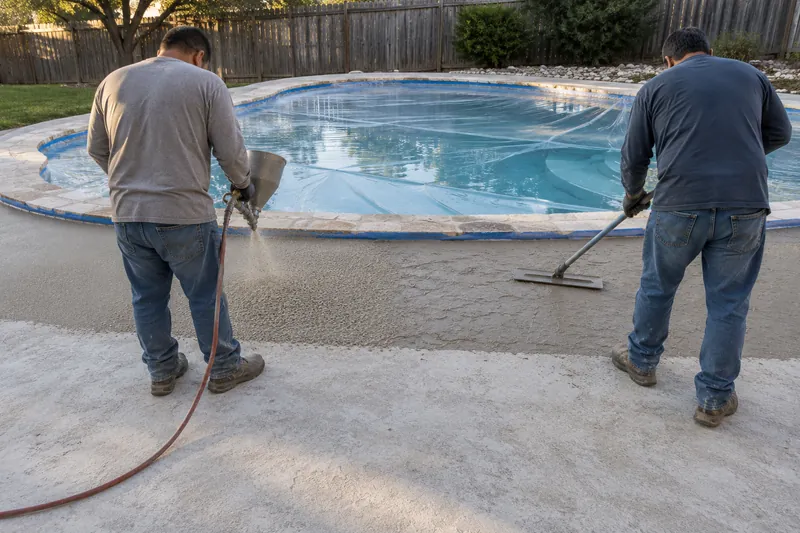
Pool deck repair: cracks, joints and settled slabs
Why decks crack on Killeen's clay
Concrete expands and contracts with moisture and temperature, the National Ready Mixed Concrete Association explains, and cracks form where design and construction don't allow for that movement, though most early random cracks are unsightly but rarely affect strength or service life. At the Census Bureau's center point for the city the soil is San Saba clay; when it dries, NRCS says, it opens cracks 1 to 3 inches across that reach 20 inches or more deep, and they stay open 90 to 150 days in most years, and NRCS rates 30.8 percent of Killeen's mapped area very limited for houses mainly because of shrink-swell.
Cracks under a new coating
QUIKRETE warns that reflective cracking can't be completely prevented, especially where a slab lacks adequate control joints or settles, and that old cracks can reappear when the base concrete moves. SUNDEK says treated cracks may recur, usually as a hairline largely hidden in the texture, and offers another route: grinding the cracks open into a deliberate scoreline pattern.
Deck joints and the coping joint
The 2021 International Swimming Pool and Spa Code calls for a joint wherever a deck meets existing concrete work, so relative movement can't damage the pool; Killeen has since adopted the 2024 edition. W. R. Meadows makes DECK-O-SEAL, a two-part polysulfide sealant for pool decks that stretches or compresses up to 25 percent once cured, laid over a foam backer rod at a 2:1 width-to-depth ratio, 1/4 to 1/2 inch deep. Its care bulletin cuts out sealant that is damaged but still bonded and reapplies it; if the bond has failed, the sealant comes out and the joint is cleaned first. A failed joint at the pool's edge is pool expansion joint repair, and work on the coping itself, the edge between the pool shell and the deck, is pool coping replacement.
Settled and rocking slabs
Prime Resins, a maker of slab-lifting foam, says structural polyurethane foam injected into the voids under settling or rocking slabs can stabilize them and lift them back without excavation, and that cement-based mudjacking can fracture or over-lift slabs. In one of its pool deck case studies, slabs heaved by tree roots and undermined by poor drainage were raised while the pool stayed open.
Call or request a free estimate any time, 24/7.
Get free estimates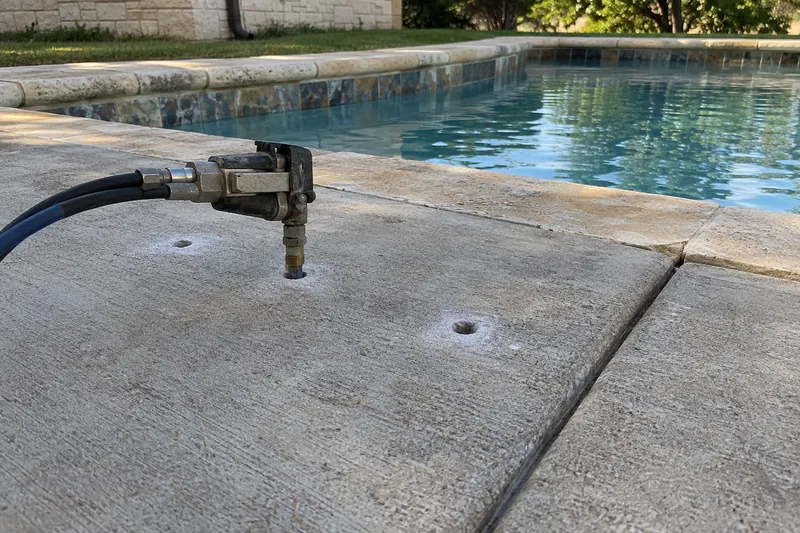
Travertine and paver pool decks
Travertine around a pool
Holes are normal in travertine: the Natural Stone Institute says voids left by trapped gases are a common characteristic of all true travertine, and most are now filled during fabrication with a cementitious or resin filler. New holes can open after installation when a small, concentrated load breaks the thin shell over a void, and filling them in place as they appear is acceptable and common practice; high-pressure spray nozzles and stiff brushes can pull filler and grout out.
Concrete pavers
The Interlocking Concrete Pavement Institute says high slip resistance and rapid drainage make concrete pavers a desirable surface around pools. Its pool details slope the pavers toward drains slotted at the bedding-sand level, put a urethane or neoprene sealant over backer rod between the last course and the coping so the pool wall and paving can move separately, and set finished pavers 1/8 to 1/4 inch above the edges to allow for minor settlement. Because pavers are modular, a settled spot can be fixed by lifting and relaying the same pavers.
Call or request a free estimate any time, 24/7.
Get free estimatesDeck work in Killeen's heat, freezes and storm-drain rules
Temperature limits on deck products
Sider-Crete warns that hot concrete may make its material set too quickly. QUIKRETE's resurfacer goes on with the air and concrete between 50°F and 90°F, and Mortex wants 50 degrees and rising, not over 90 for Keystone Kool Deck or 95 for Kool Deck Elite, with no rain or frost predicted. NOAA's 1991–2020 normals for its Killeen station count 104.8 days a year at 90°F or above and 31.1 nights at or below freezing; in half of years the last 32°F night of spring comes by March 14 and the first of autumn by November 17.
Slope and standing water in the code
The same 2021 code caps the slope of a non-wood pool deck at 1/2 inch per foot, except ramps, and wants it to drain so no more than 1/8 inch of water stands 20 minutes after water stops being added. Its minimum slopes are 1/8 inch per foot for textured, hand-finished concrete and 1/4 inch for exposed aggregate.
Wash water and permits
Killeen's stormwater ordinance keeps ready-mixed concrete, mortar and the wash-out from equipment used to carry or apply it out of the storm drain system, which includes streets, curbs and gutters, along with pool water carrying harmful amounts of chlorine, muriatic acid or other pool chemicals. The City's code requires a permit to construct, alter or repair a structure, and its pool permit form lists a deck among a pool's accessories, so ask Killeen Building Inspections before deck work starts.
Call or request a free estimate any time, 24/7.
Get free estimatesPool deck resurfacing questions
Is travertine a good choice for a pool deck?
The Natural Stone Institute lists travertine among the natural stones that are good options for paving, and says surfaces can be finished for slip resistance. It is a calcareous stone, mostly calcium carbonate like limestone and marble, so acids can dull or etch it: the Institute recommends mild, non-acidic cleaners and, around a pool, a flush of clear water and a mild bleach solution for algae or moss. Siliceous stones such as granite, quartzite and sandstone are generally harder and more resistant to abrasion and chemicals.
What is the best material for a pool deck in Texas?
The makers and industry bodies weigh it differently rather than naming one. Mortex says Kool Deck significantly lowers the surface temperature of concrete; the Interlocking Concrete Pavement Institute points to the slip resistance and fast drainage of concrete pavers; and the Natural Stone Institute counts travertine among good paving stones but warns that acids etch it. With the Killeen station averaging 104.8 days a year at 90°F or above, heat, grip and upkeep are the points to weigh at the estimate.
How much does pool deck resurfacing cost?
Typical Killeen-area pricing reported in 2020 put basic pool deck resurfacing at $3 to $5 per square foot, against $6 to $10 to pour a new surface before decorative options. Typical Austin-area pricing in 2026 starts at $3 to $6 per square foot installed for a spray-texture coating and $5 to $8 for a classic texture with a color coat, and puts most 300 to 600 square foot residential decks at $1,500 to $5,000 for standard resurfacing. These are other companies' published figures, not our prices.
Can a new coating go over a painted pool deck?
Most makers say no. SUNDEK says the paint has to come off so its coating can bond to the concrete, and QUIKRETE's resurfacer goes only on bare concrete, never on painted or sealed surfaces. Sider-Crete removes paint by water blasting, sandblasting or wire brushing, though it allows recoating an existing cement-based deck coating that is unpainted and unsealed. Tuff Coat is the exception for its own coating: old paint in good condition is sanded and primed, and paint in poor condition must come off.
How soon can you walk on a resurfaced pool deck?
It depends on the product. SUNDEK keeps foot traffic off its coating for 24 hours and vehicles for 72; QUIKRETE's resurfacer takes foot traffic after 8 hours; and Sider-Crete's sealer needs 24 hours before light foot traffic and a week before patio furniture, hard-soled shoes and heavy use. Mortex's two Kool Deck sheets differ: its installation instructions allow light walking after 3 days, normal walking after 14 and heavy patio furniture after 28, while its care sheet restricts even light use for a week.
Request a free pool deck estimate
Killeen Pool Resurfacing answers pool deck calls and estimate requests around the clock, for Killeen and the towns nearby.