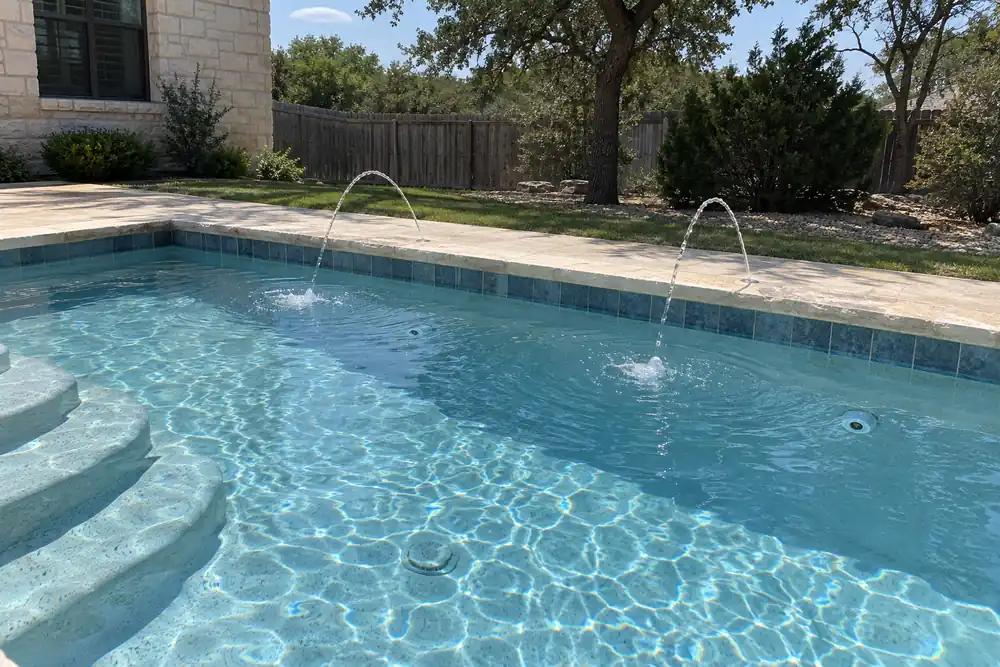
Pool Expansion Joint Repair in Killeen, Texas
Killeen Pool Resurfacing handles pool expansion joint repair in Killeen, Texas, cutting damaged or debonded sealant out of the joint between the coping and the deck and refilling it with a flexible sealant over a foam backer rod. In the 2021 International Swimming Pool and Spa Code, that joint has two jobs where coping meets a concrete deck: keeping water out, and keeping the deck's expected movement off the coping and the mortar bed beneath it.
The ground moves as well: the 1977 Bell County soil survey defines shrink-swell as how much a soil shrinks as it dries and swells when it gets wet, and says the shrinking and swelling does much damage to building foundations, roads and other structures. Joint repair often sits alongside pool coping replacement or pool deck resurfacing, and the estimate for any of them is free.
No charge · answered 24/7
Get free estimates
What a pool expansion joint does
A joint that lets the deck move on its own
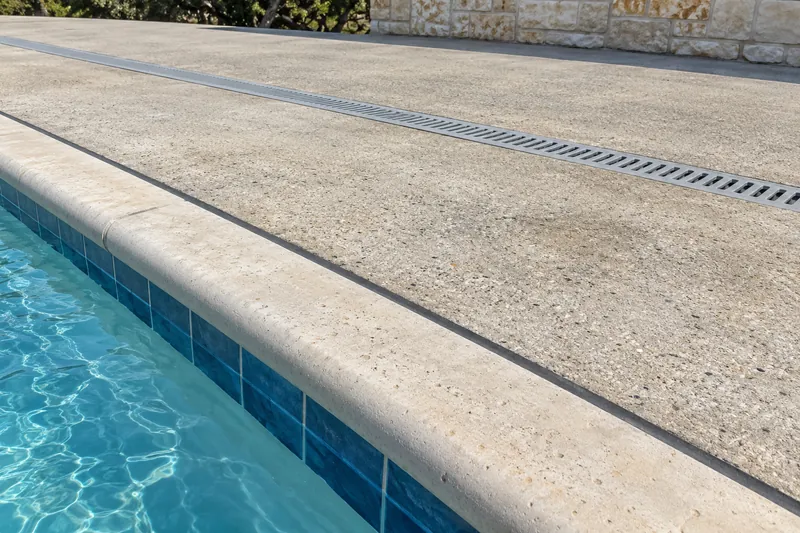
The National Ready Mixed Concrete Association explains that isolation joints, often called expansion joints, separate a slab from walls, footings, stairs and other fixed points so each can move independently. Around a pool, the flexible joint between the deck and the coping has to run the full depth of the deck, so no part of the slab can bear on the coping or the pool structure, and it needs upkeep to keep working; no steel should tie the bond beam to the deck. Where the coping is poured or precast, the vertical gap beside it typically holds a foam backer rod under a flexible mastic, while the horizontal joint beneath a cantilevered deck is usually left open.
Control joints in the deck
The deck has joints of its own. NRMCA spaces contraction joints no more than 24 to 36 times the slab's thickness, with 15 feet as the recommended maximum. Mortex makes a PVC Control Joint for pool decks that encourages the concrete to crack in a planned place, is virtually unaffected by chlorine and pool chemicals, and has side fins that keep water from running freely to the soil; its Control Joint Replacement Top fits over existing joints to repair them or change their color.
What the codes ask for
Beyond the watertight coping joint, the 2021 code limits the open gap between a pool deck and an adjoining deck or walkway to 3/4 inch, joint material included, and the height difference between the pool deck and the next sidewalk to 1/4 inch. Public pools have a stricter model: the CDC's Model Aquatic Health Code calls for a continuous watertight expansion joint between the perimeter deck and the coping, watertight joints between deck pours, and open deck joints no wider than 3/16 inch.
Call or request a free estimate any time, 24/7.
Get free estimatesPool joint sealants and how they are rated
How far a sealant can stretch
Sika's data sheet for Sikaflex-1c SL, a one-part self-leveling polyurethane, rates it for plus or minus 25 percent movement and sets the design rule that expansion and contraction shouldn't exceed 25 percent of the average joint width. Its two-part Sikaflex-2c SL is rated for plus or minus 50 percent, double that, and because it cures chemically rather than skinning over from the top, it can fill non-moving joints deeper than 1/2 inch. W. R. Meadows' DECK-O-SEAL, made for pool decks, is a two-part pourable polysulfide that resists weathering, UV, moisture and pool chemicals.
Joint shape and the backer rod
Sika designs its joints at a 2:1 width-to-depth ratio, with 1/4 to 1/2 inch of sealant, and 1/2 inch where a horizontal joint carries traffic. A closed-cell backer rod or bond-breaker tape goes in the bottom first so the sealant bonds only to the two joint faces and can stretch across the gap instead of also gripping the floor of the joint. W. R. Meadows doesn't use DECK-O-SEAL in joints narrower than 1/4 inch and wants new concrete fully cured, citing 28 days as the industry standard. Read the other way, those design limits show where a joint goes wrong: movement beyond the sealant's rating, or no bond breaker underneath.
Joints at or below the waterline
DECK-O-SEAL can't be used underwater; W. R. Meadows sends joints below the waterline to its DECK-O-SEAL 125 or Gun Grade products. Sika requires a primer when Sikaflex-1c SL will be fully immersed and a week's cure before the water comes up, while the two-part product usually needs no primer except for immersion after cure and a 3-day cure before it. Sika also sets a maximum chlorine exposure of 5 ppm for these sealants.
Call or request a free estimate any time, 24/7.
Get free estimates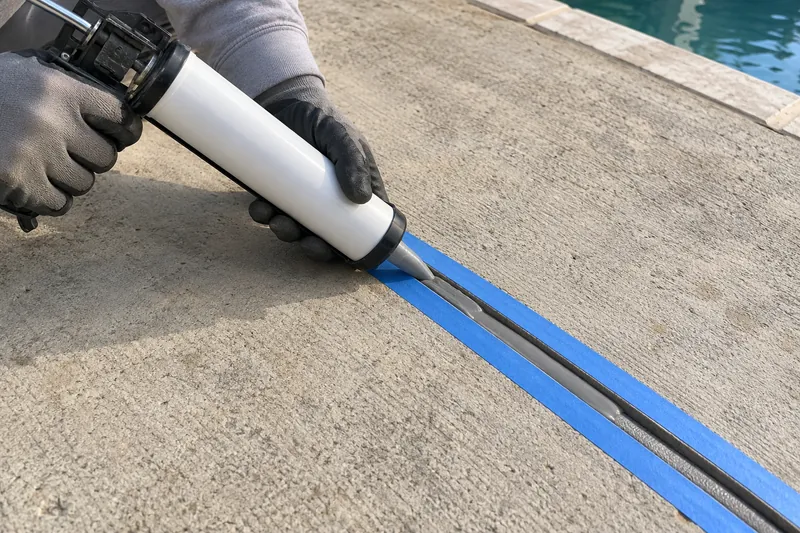
How to replace a pool expansion joint
Cut out the old sealant
W. R. Meadows' care bulletin cuts along both sides of the old sealant with a linoleum knife or razor, pulls it out, and wire-brushes or grinds off what's left. Where the sealant is damaged but still bonded, only the damaged section comes out.
Clean and roughen the joint walls
Sika wants the joint walls sound, clean, dry, frost-free and free of oil, grease and curing compound, and says a mechanically roughened surface improves the bond; W. R. Meadows wipes them with alcohol just before the new sealant goes in.
Set the backer rod
Closed-cell backer rod or bond-breaker tape sets the depth and keeps the sealant off the bottom of the joint, aiming for the 2:1 width-to-depth shape.
Prime where water will stand
Sika requires a primer for Sikaflex-1c SL in joints that will be fully under water, and says most substrates need priming for its two-part product only when the joint will be immersed after cure.
Mix and pour
W. R. Meadows mixes DECK-O-SEAL for at least 10 minutes; it is pourable and self-leveling, so it flows flat into the joint.
Let it cure on the maker's schedule
DECK-O-SEAL goes on between 40°F and 122°F, sets firm and rubbery within 24 hours at 77°F, longer when it's cooler, and needs 24 hours before rain. It isn't painted over.
Call or request a free estimate any time, 24/7.
Get free estimates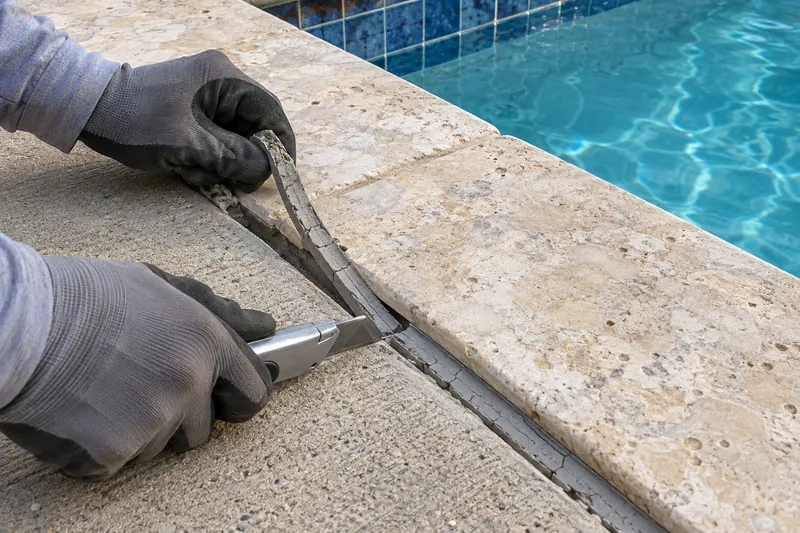
Expansion joints on Killeen's clay and in its rain
Clay under the deck
Purves silty clay is the most widespread soil in Killeen on NRCS's map, a shallow soil formed in layered limestone and marl. The 1977 survey places its urban-land form mostly in Belton, Fort Hood and Killeen, lists shallow depth to limestone, shrink-swell, corrosivity and clay texture as the features that affect building on it, and says the more sloping areas there are cut and shaped for building sites.
Rain on joint day
NOAA's 1991–2020 normal at its Killeen station is 34.75 inches of rain a year, and a volunteer gauge about 1.4 miles from the city's center point gives an estimated 35.96 inches from 6 to 10 years of data. DECK-O-SEAL needs 24 hours before rain and sets more slowly in cool weather, so a dry forecast matters on joint day.
Killeen Pool Resurfacing checks the joint, the coping and the deck around it at the free estimate.
Call or request a free estimate any time, 24/7.
Get free estimates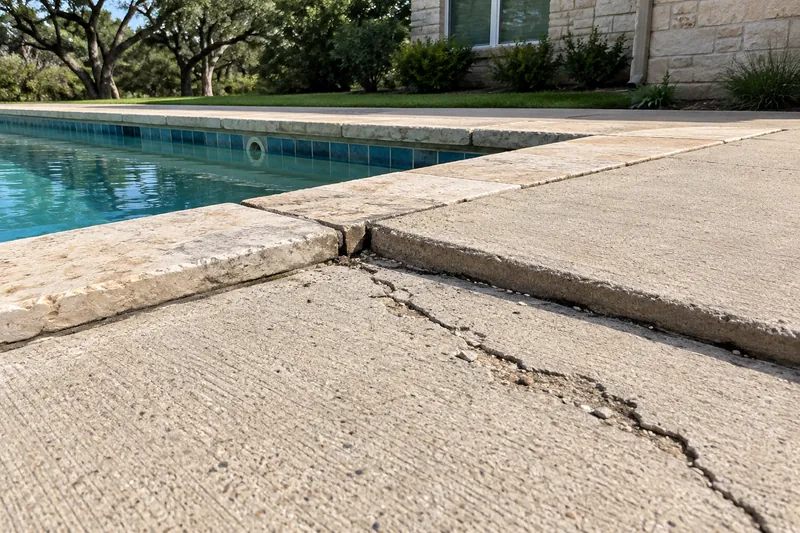
Pool expansion joint repair questions
Is it okay to fill expansion joints in concrete?
Yes, with a flexible filler that leaves the joint free to move. Sika's method is a sealant bonded only to the two sides of the joint, over a backer rod or bond-breaker tape. At the coping, Unilock lists grout or flexible sealant to allow for expansion and keep water out, and Belgard puts foam expansion material between coping and deck pavers. The point is that no part of the deck can push on the coping or the pool, which is why the flexible joint runs the full depth of the deck.
How much does pool expansion joint repair cost?
Typical Dallas-Fort Worth-area pricing in 2026 starts at $7 per linear foot, with most residential pools between $500 and $1,200 for a full joint replacement and a $500 minimum; another Dallas-Fort Worth price list gives $7 to $10 per linear foot depending on joint width, depth, condition and access, with most pools done in one visit. National figures, with no data year stated, run $5 to $8 per linear foot including prep, backer rod, caulking and finishing, for joints usually 1/2 to 1 inch wide. These are published figures, not our prices.
Can pool expansion joint sealant be painted over?
Not DECK-O-SEAL: W. R. Meadows says it shouldn't be painted. Its care bulletin also notes that heavy shock treatments can leave a temporary white chalking on the sealant.
How soon can the pool deck get wet after joint repair?
It depends on the sealant. DECK-O-SEAL needs 24 hours before rain and is firm and rubbery within 24 hours at 77°F. Sikaflex-1c SL is tack-free in 1 to 2 hours and fully cured in 3 to 5 days at 73°F and 50 percent humidity, with a week's cure before it is fully under water; the two-part Sikaflex-2c SL is tack-free in 6 to 8 hours and needs 3 days before immersion.
Can part of a pool expansion joint be repaired?
Yes, if the rest is still bonded. W. R. Meadows' repair guidance cuts out only the damaged section where the sealant still holds to the joint walls, and reapplies sealant there. Where the bond itself has failed, the old sealant comes out, the joint is cleaned, and new sealant goes in.
Request a free pool expansion joint repair estimate
Killeen Pool Resurfacing answers calls and estimate requests about pool joints 24/7, in Killeen and nearby towns.