Fiberglass Pool Resurfacing and Repair in Killeen, Texas
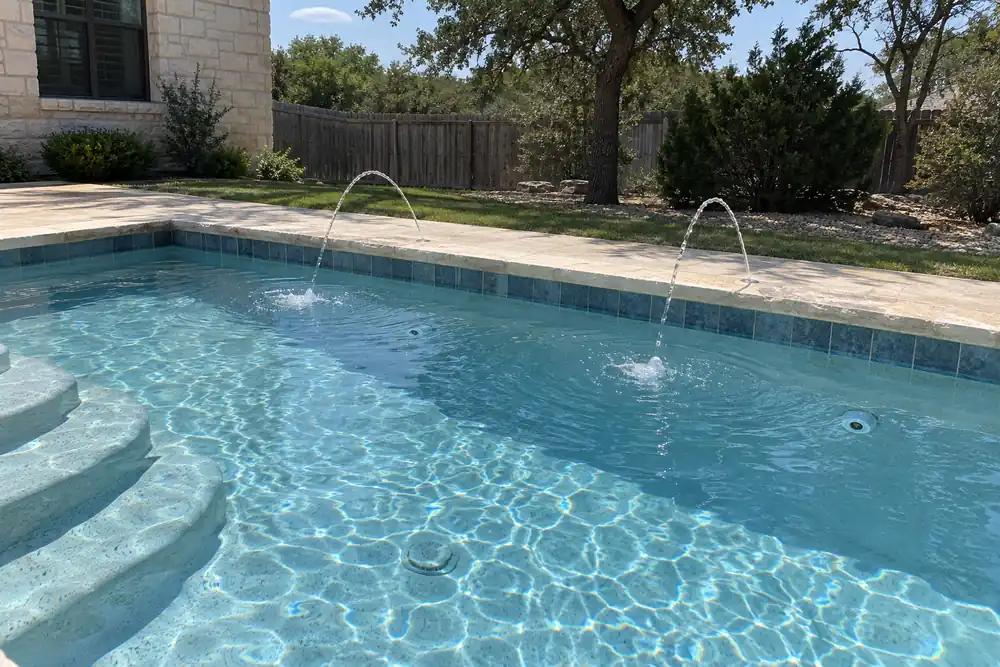
Killeen Pool Resurfacing handles fiberglass pool resurfacing and repair in Killeen, Texas, from spider cracks, blisters and stains in the gelcoat to a new coating over the whole shell. Gelcoat is the smooth, glossy surface of a fiberglass pool, a colored resin sprayed onto the shell when the pool is made; River Pools, a fiberglass pool maker, applies it in three passes to a total of 25 to 30 mils, because too thin a coat can blister and too thick a coat can crack.
Latham's care manual says gelcoat is seven to eight times thicker than a normal coat of paint, so most scratches stay superficial. At a free estimate we'll talk through whether a patch, a coating or epoxy paint suits the pool, and what draining it would mean for the maker's warranty.
No charge · answered 24/7
Get free estimates
Signs a fiberglass pool needs resurfacing or repair
Fading, chalking and a rough surface
Sun fading on gelcoat is typically even and gradual, River Pools says, and most owners won't notice it. Neglect is what wears gelcoat down: the same maker says skipped cleaning and poor water chemistry can leave it needing repair or replacement, and Tallman Pools, another maker, lists discoloration, chalking, fading, etching and scale as what incorrect chemistry does to the surface. ecoFINISH, which makes a refinishing coating, describes the end point as a surface gone chalky, discolored and rough to the touch as the gelcoat breaks down.
Stains, black spots and scale
Tallman Pools reads stains by color. Organic stains from berries, dirt, pollen or algae show green, brown or tan; iron leaves orange, brown or tan; copper green, blue or teal; and manganese brown, black or purple. Black spots can also be cobalt, which Tallman says is not really a stain but a reaction, where water passes through the gelcoat and reacts with the resin beneath. White scale is tested with a drop of muriatic acid: calcium carbonate foams, while calcium silicate shows no reaction and is best left to a fiberglass technician. Tallman allows only stain removers made for fiberglass, and no sanding, polishing or buffing unless a fiberglass pool professional directs it.
Spider cracks and osmotic blisters
Barrier Reef Pools, a fiberglass pool maker, says spider cracks run along the gel coating rather than through the structure, and form when a point of pressure goes past the gelcoat's flexibility, most often during transport; it names improper installation, including an uneven base, as the most common reason a fiberglass pool cracks. Blisters are a separate problem. River Pools explains that water passes through the gelcoat, meets contaminants and forms a larger molecule that can't leave the way it came, pushing outward until the gelcoat blisters and separates from the laminate behind it. Barrier Reef ties this to chemical imbalance eroding the protective surface, and River Pools stresses that osmotic blisters are cosmetic, not structural.
Call or request a free estimate any time, 24/7.
Get free estimates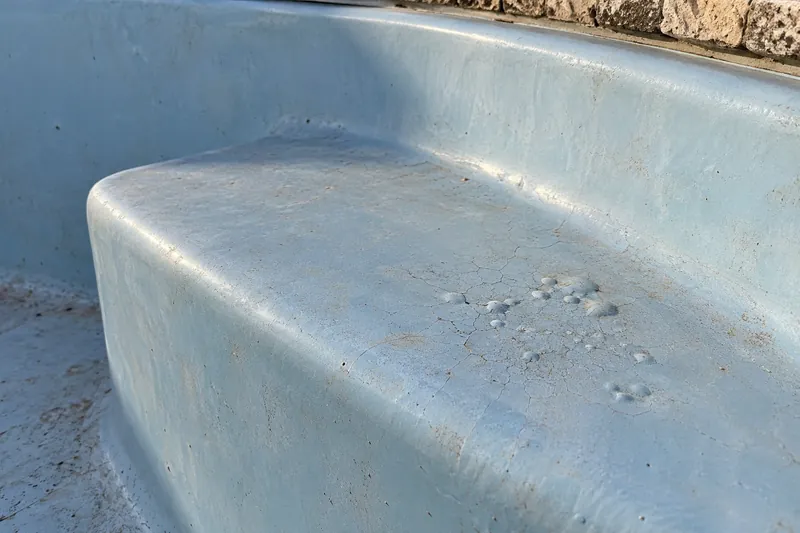
Fiberglass resurfacing: polymer coatings and epoxy paint
A worn fiberglass shell is refinished with a coating or with paint. Vinyl-lined pools are a different job, covered under pool liner replacement.
Thermo-polymer powder coatings
River Pools' standard recommendation for an in-ground fiberglass pool that needs refinishing is ecoFINISH, a polyethylene powder sprayed with a compressed-air gun and set with heat. The steps it describes: sandblast if paint or residue is stuck to the surface, clean and inspect, coat the whole pool in epoxy, spray the powder onto the tacky epoxy, cure it with heat, and build it up in a few layers. The coating dries almost immediately, so the pool can be refilled the same day, and ecoFINISH says pools with its coatings need no start-up process and can be heated straight after filling.
Epoxy pool paint on fiberglass
The paint makers who allow fiberglass specify epoxy. Insl-x recommends only its epoxy pool paint for fiberglass shells, not its waterborne acrylic; Ramuc recommends its Hi Build or HB31 epoxies; and Kelley Technical Coatings' Olympic line calls for two coats of POXOLON 2 or one coat of ZERON over GUNZITE primer. They disagree on preparation. Insl-x scuff-sands with 150 to 180 grit and lets the surface dry 24 hours; Ramuc abrades bare fiberglass to a #80 grit profile, and its Hi Build guide adds an acid wash with a 15 to 20 percent solution and a TSP rinse; Olympic sands in straight lines with coarse paper, no orbital sander, and says no acid washing is needed. ecoFINISH, which sells the competing coating, argues that paint bonds poorly to smooth, non-porous gelcoat. Paint on plaster and other masonry pools is covered under pool painting.
Call or request a free estimate any time, 24/7.
Get free estimates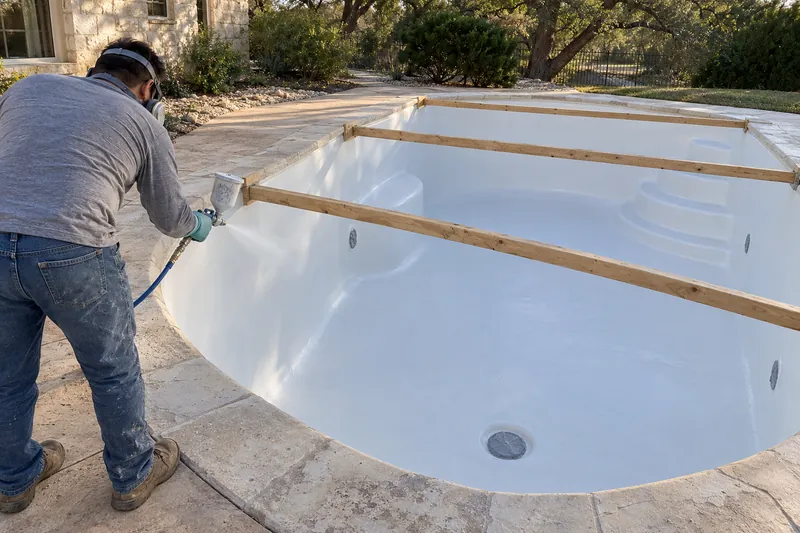
Fiberglass pool repair: patches, blisters and color match
Gelcoat putty for scratches, dings and cracks
FGCI, a resin maker, sets out the basic putty repair: clean and dry the area, rough up the gouge or crack so the putty grips, mix it with MEK-P catalyst at 1.5 percent, overfill the repair, let it cure and sand it flat. At 77 degrees it gels in roughly 10 to 15 minutes, a thin film sets up in 1 to 3 hours, and a full cure takes 12 to 24 hours. A perfect match isn't promised by the makers either: Latham's warranty treats a visible shade or color difference after a cosmetic repair as acceptable.
Opening and drying blisters
The most detailed blister repair comes from Gougeon Brothers, maker of WEST SYSTEM epoxy, in its guide to gelcoat blisters on fiberglass boats, which treats the gelcoat and laminate as a semi-permeable membrane: blister cavities are opened, damaged material is dug out, and the laminate is dried thoroughly, which the guide calls perhaps the most crucial step of the repair. It warns that blister fluid is acidic and frequently under as much as 200 psi of pressure, so eye protection and protective clothing are worn when blisters are opened.
Call or request a free estimate any time, 24/7.
Get free estimatesDraining a fiberglass pool safely in Killeen
Check the warranty terms first
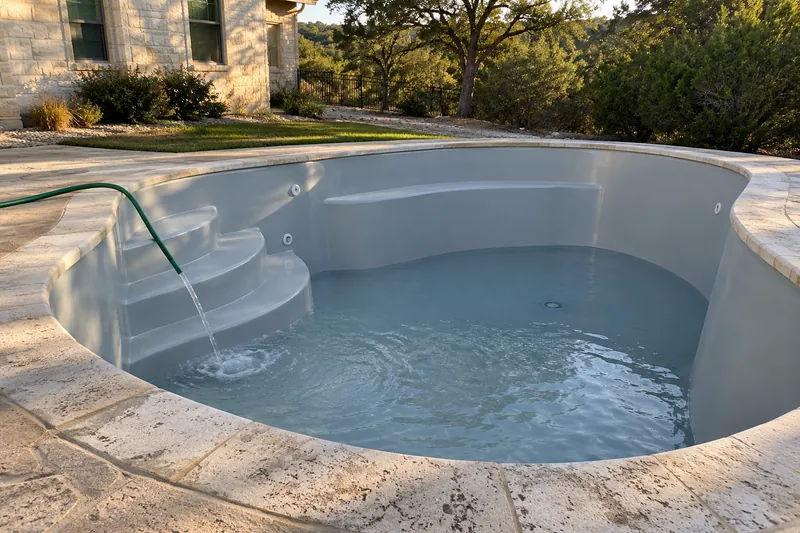
Latham's manual says draining voids its warranty, and Tallman Pools wants its written authorization before any drain. River Pools says only authorized fiberglass pool professionals should drain a pool, and that most makers require an authorized dealer to do it.
Wait for a dry spell
River Pools starts by making sure the weather will stay dry for the whole job. In NOAA's 1991–2020 normals for Killeen, May is the wettest month at 4.70 inches and August the driest at 1.64.
Check for groundwater
Tallman Pools has owners check the groundwater inspection port before any service that lowers the water, and pump any water found there slowly, stopping if sediment appears.
Brace the walls
River Pools typically sets 3 braces across the pool, 18 to 24 inches down the side walls, because the walls can push in and the floor can lift as the water comes out.
Drain to the City's rules
Killeen's pool handout sends chlorinated water into the soil on the property, never the street or a storm drain, and under the City's stormwater ordinance nothing runs to the curb until dechlorination has taken it below 0.10 mg/l total residual chlorine.
Refill as soon as the work allows
A powder coating can be refilled the same day, River Pools says. Once Killeen's drought plan is at Stage 2, refills are confined to the address's watering days and, on those days, to the stretch from 8 p.m. to midnight or from midnight to 10 a.m.; on October 4, 2026, Stage 1 was posted, with no pool limit.
Much of Killeen sits on clay that shrinks and swells: NRCS rates 30.8% of the city's mapped area very limited for houses with shrink-swell as the main reason, and its description of Slidell silty clay, the soil at City Hall, says water enters fast when the soil is dry and cracked and very slowly when it is moist. River Pools adds that sand backfill that becomes saturated can liquefy and press on the pool walls, and Tallman Pools warns that excess hydrostatic pressure around the shell can cause shifting, bulging or even failure.
Call or request a free estimate any time, 24/7.
Get free estimates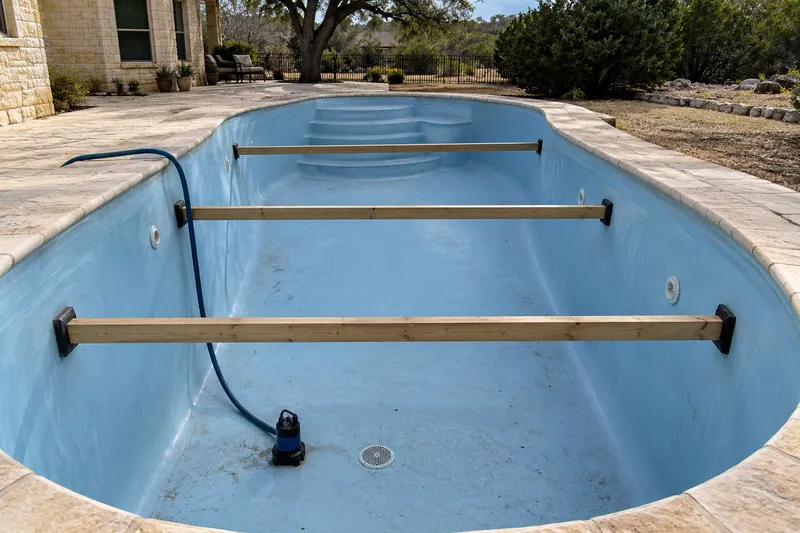
Gelcoat water care with Killeen water
Calcium targets differ by maker
Fiberglass makers don't agree on calcium. Latham's warranty lists calcium hardness of 250 to 350 ppm, with pH 7.2 to 7.6 and total alkalinity 80 to 120. River Pools wants calcium hardness below 120 ppm and pH at 7.2 to 7.4, warning that high pH plus high calcium damages the surface, and Tallman Pools sets 80 to 120 ppm, saying scale needs only a pH above 7.4 with calcium hardness above 120. River Pools calls calcium the root cause of most discoloration on fiberglass and recommends a chelating stain, metal and scale control product. The targets that count are the pool maker's own. For reference, TCEQ's January 12, 2026 samples of water leaving WCID No. 1's Belton entry points measured 142 to 144 mg/L total hardness, a different measure from the calcium hardness a pool test reports.
Chlorine, brushes and cleaners
Tallman Pools bans calcium hypochlorite, dichlor granular chlorine and trichlor tablets in its pools and allows shocking only with liquid chlorine or a non-chlorine oxidizer, and River Pools also steers owners away from cal-hypo. Latham's older manual does allow calcium hypochlorite as long as it is dissolved first. Brushing is weekly with a soft nylon brush only, Tallman says. Latham warns that abrasive cleaners, steel wool, metal scrapers, wire brushes and metal tools permanently damage gelcoat, and Tallman adds scouring pads, pressure washers, household cleaners, solvents and degreasers to the list.
Killeen Pool Resurfacing will go through the pool maker's care and warranty terms at the free estimate.
Call or request a free estimate any time, 24/7.
Get free estimatesFiberglass pool resurfacing and repair questions
How much does it cost to resurface a fiberglass pool?
Typical Texas pricing reported in 2025 puts fiberglass resurfacing at $5,000 to $15,000, broken down as $5,000 to $8,000 for basic gel coat resurfacing, $7,000 to $12,000 for an epoxy or polymer coating, $12,000 to $20,000 for full fiberglass layer replacement and $1,000 to $5,000 for structural repairs such as cracks and leaks, plus $300 to $700 for refill water and chemicals. National averages reported in 2026 run $3,500 to $10,000 for most residential pools, around $5,000 to $7,000 on average. Neither is our price; pricing a real job means seeing the pool.
What is the lifespan of a fiberglass pool?
The makers speak to the surface rather than the shell. River Pools says that in most cases a fiberglass pool will never need resurfacing, and that it is usually 20 or 30 years old before refinishing comes up. ecoFINISH, which sells a refinishing coating, puts the first signs of wear after 10 to 15 years of regular use. None of the makers gives a service life for a coating, paint or gelcoat applied to a pool already in the ground.
What is the disadvantage of a fiberglass pool?
For refinishing and repair, the drawbacks are draining and matching. A fiberglass pool drained without first relieving hydrostatic pressure will buckle and crack, Latham warns, and River Pools says most makers require an authorized dealer to drain the pool or the warranty may be void. Re-gelcoating limits the color to light shades such as white, baby blue, tan and light grey, according to ecoFINISH, and River Pools says repairs on metallic or flake finishes are hard to match outside a factory. The makers also give conflicting calcium targets, from below 120 ppm to 250 to 350 ppm.
Can a fiberglass pool be re-gelcoated?
Small areas, yes; the whole pool, rarely. River Pools says gelcoat can be used for smaller repairs but isn't suitable for resurfacing an entire pool that is already in the ground, because it takes a long cure at a steady temperature and a precision that can't be matched outdoors. ecoFINISH adds that a gel-coat cure keeps the pool empty for over a week, against an immediate fill with its coating. The usual whole-pool routes are a polymer coating or epoxy paint.
Does a fiberglass pool warranty cover blisters and cracks?
Blisters often, cracks and fading usually not. River Pools says a maker's surface warranty should specifically cover osmotic blisters: Latham covers them for as long as the original buyer owns the pool, Glimmerglass for ten years and Barrier Reef for 15. Latham excludes fading, staining, discoloration and cracking, hairline cracks included, and says spider cracks, crazing and chips in the top beam under the coping aren't grounds for a claim. Rainforest Pools excludes hairline cracks, blistering, yellowing and roughness caused by water chemistry. In a warranty repair, Latham's terms leave draining, bracing and removing groundwater to the owner.
Request a free fiberglass pool resurfacing estimate
Killeen Pool Resurfacing takes calls and estimate requests about fiberglass refinishing and gelcoat repair 24/7, in Killeen and the surrounding towns.