Pool Tile Replacement and Repair in Killeen, Texas
Killeen Pool Resurfacing takes on pool tile replacement and repair in Killeen, Texas: cutting out cracked or loose tiles, regrouting failed joints and replacing the band at the water's surface that the National Plasterers Council calls the perimeter tile. The work runs from a single tile to a full waterline.
Tile and finish work often go together. Pebble Technology International lists loose tiles among the problems that start a project, and says the finish and the waterline tile are usually redone at the same time in a pool remodeling project. At a free estimate we'll look at whether the pool needs a few tiles, a regrout or a new band, and which tile suits it.
No charge · answered 24/7
Get free estimates
Pool tile, mortar and grout made for submerged use
Impervious, vitreous and glass tile
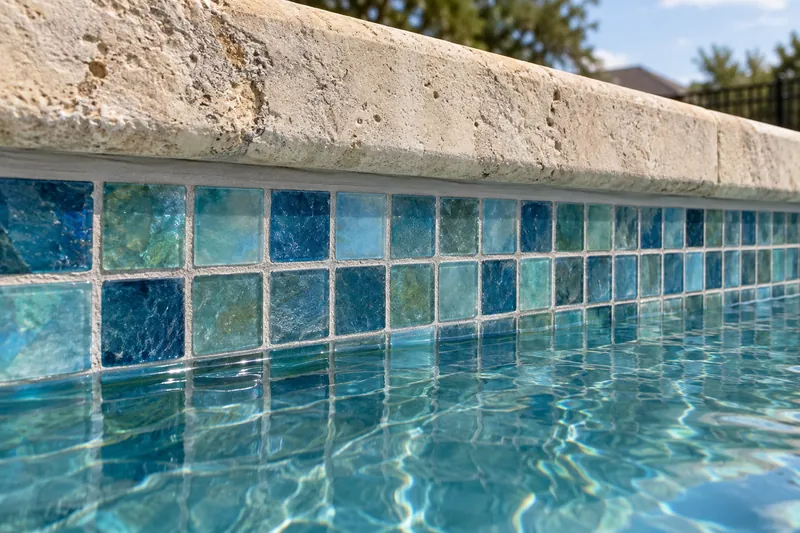
Pool tile has to soak up very little water. LATICRETE, a maker of tile-setting materials, uses only impervious tile, under 0.5 percent absorption, or vitreous tile, under 3.0 percent, because tile that absorbs more than 3 percent may expand permanently from moisture. Glass tile made for submerged use looks very good but typically costs more and takes more installation experience, LATICRETE says. For mosaics it recommends paper face-mounted sheets and urges caution with back-mounted sheets, whose bond can be very low once soaked; the glass-tile maker Interstyle accepts face-mounted or dot-mounted glass but not mesh-backed sheets. Glass also chips and cracks more readily than porcelain, so keeping spare tiles for later repairs is advised.
Setting mortar, grout and the standards behind them
Pool tile goes on mortars rated for continuous submersion; LATICRETE says latex-fortified mortars improve adhesion and flexibility, and it recommends epoxy adhesives to rule out deterioration from chemical attack. MAPEI's pool specification, published with Daltile, follows the Tile Council of North America's pool method P602: a cement bond coat to ANSI A118.4 or better, epoxy grout to ANSI A118.3, cement grout to ANSI A118.6 or better, movement joints to TCNA EJ171, and a flexible sealant meeting ASTM C920. The 2021 International Swimming Pool and Spa Code points to ANSI A108, A118 and A136.1 for tile in pool shells. Epoxy grouts contain no portland cement and aren't affected by pool water treatment, LATICRETE says, while cement grouts break down in submerged work more often. Oceanside Glass & Tile finds sanded cement grout fine on its tile, though LATICRETE and Interstyle say sand can scratch glass.
Glass tile takes extra steps
Interstyle makes back-buttering mandatory for glass in pools, so water can't collect in voids behind the tile and cause bond failure or white efflorescence through the grout, and LATICRETE calls for at least 95 percent mortar coverage once the tile is beaten in. Oceanside lists bright-white thin-sets made for translucent glass and stresses flattening the trowel marks, and LATICRETE warns that transparent glass can show shadowing if the glass maker's instructions aren't followed. Because glass expands and contracts a good deal with temperature, Interstyle calls movement joints non-negotiable: 100 percent silicone sealant, never hard grout.
Call or request a free estimate any time, 24/7.
Get free estimates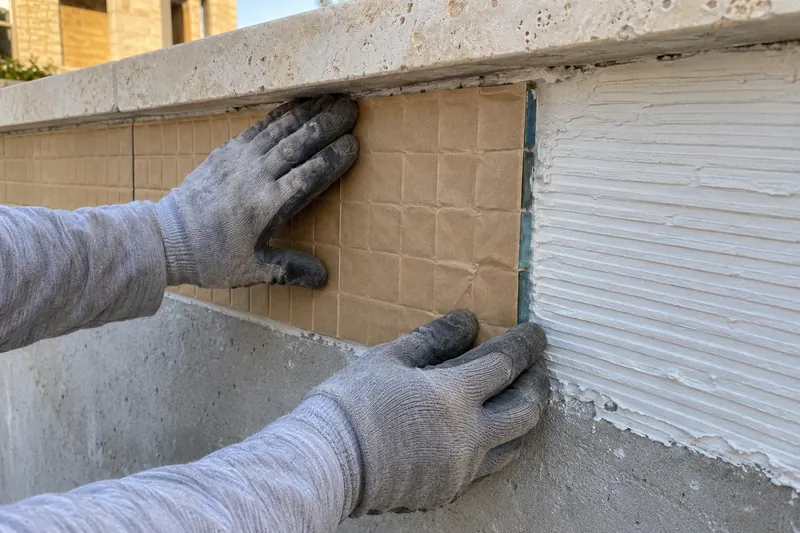
Why pool tile cracks, loosens or stains
Movement at the deck, coping and shell
Waterline tile meets parts of the pool that move. Oceanside requires a flexible sealant rated for submerged use, not grout, between the tile and the coping or deck, at inside corners and over joints in the shell, with movement joints at most every 8 feet for glass and 12 feet for porcelain or ceramic; LATICRETE asks for joints every 8 to 12 feet in each direction. Where coping meets a concrete deck, the 2021 code requires a watertight isolation joint, so that the coping and the mortar bed under it are spared the deck's movement. Without a working flexible joint there, the deck's expansion and contraction often dislodges coping and tile and leaves horizontal cracks along the waterline. The ground moves too: the 1977 Bell County soil survey says shrink-swell in Killeen's Denton clays can crack and shift structures, and when NRCS's San Saba clay dries, its cracks open 1 to 3 inches wide and reach 20 inches or more deep. Joint and edge repairs are covered under pool coping replacement.
Water chemistry, scale and metal stains
LATICRETE keeps a tiled pool's water at pH 7.2 to 8.0. Above that, mineral deposits build up on tile and grout at the waterline and can form beneath the tile, pressing it loose; below it, cement grout etches and the mortar under the tile starts to fail. Calcium hardness under 200 to 250 ppm lets the water pull calcium out of cement-based grout and mortar, and iron and copper from the source water drop out of solution at normal pH and stain tile, grout and fittings. A white scale line on sound tile is a cleaning job, covered under pool tile cleaning.
Hollow, loose and missing tiles
A hollow-sounding or loose tile has delaminated, which the National Plasterers Council defines as a material separating from itself or from what it is bonded to. LATICRETE advises working out why a repair is needed before making it, inspecting tiled surfaces regularly, and it names poor preparation and cleaning as a primary cause of failure in the waterproofing and leveling mortars under pool tile. The American Shotcrete Association adds that salts building up behind tile, which it calls sub-efflorescence, can break down the binder and debond the tile.
Call or request a free estimate any time, 24/7.
Get free estimates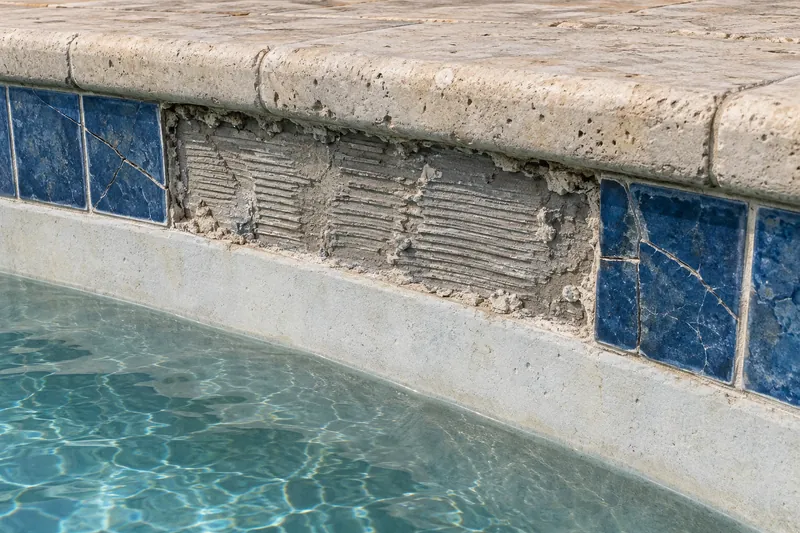
How waterline tile is replaced, step by step
Lower the water slowly
LATICRETE empties a tiled pool at about 2 feet per 24 hours, so water pressure from behind can't push tile or leveling mortar loose. For waterline work, the water usually comes down only below the tile line.
Cut out the damaged tile
Cracked or loose tiles are cut out around their edges with an angle grinder or circular saw fitted with a dust attachment, taking care not to damage any waterproofing membrane underneath.
Grind back and clean the shell
The old thin-set is ground off to the top of the concrete, and the surface must be free of dust, curing compounds, sealers and anything else that could act as a bond breaker, with no standing water. LATICRETE avoids acid cleaning where other methods will do, because leftover chlorides can weaken the bond.
Set the new tile
New tile goes into mortar rated for continuous submersion, glass tile back-buttered, each piece beaten or twisted in for full bedding.
Seal the movement joints
Joints at the coping or deck, at inside corners and over shell joints get a flexible sealant rated for submerged use, not grout.
Grout without acid
On a regrout, the old joints are cleared down to sound grout or bedding mortar with a pressure washer or a diamond saw, vacuumed, rinsed and left to dry. LATICRETE keeps every acid-based cleaner off its grouts during installation, during the cure and before the pool is filled.
Cure, then refill at about 2 feet a day
LATICRETE wants at least 10 days at 70°F before filling for epoxy grout, and 14 days at 70°F where the grout is latex-fortified cement; Oceanside asks 21 days for all submerged tile unless the setting-material maker says otherwise. MAPEI fills at 24 to 30 inches a day and raises heated water no faster than about 2°F an hour.
Call or request a free estimate any time, 24/7.
Get free estimates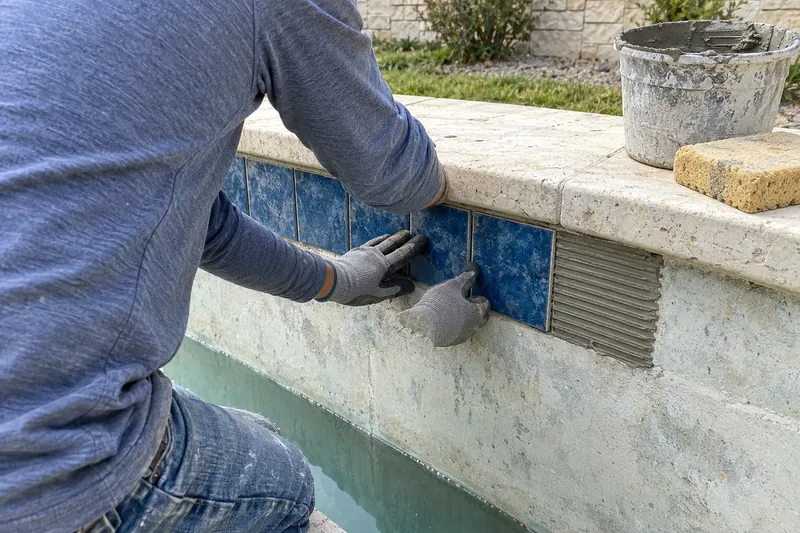
Tile work in Killeen's heat, cold and refill rules
Working temperatures
MAPEI's specification keeps the surface and the air between 50°F and 95°F while tile is set and for at least 7 days after, and Oceanside puts the ideal range for most thin-sets and grouts at 50°F to 90°F, with outdoor tile shielded from direct sun, heat, wind and rain while it cures. Killeen's weather runs past both ends of that window: the 1991–2020 normals at NOAA's station in the city give 104.8 days a year at 90°F or higher and 31.1 nights at 32°F or lower, and the median dates for the last spring freeze and the first autumn freeze are March 14 and November 17. Lightstreams, a glass tile maker, adds that clear glass lets sunlight heat the thin-set while it cures, so tiled areas are shaded with tarps, screens or umbrellas.
Refilling after tile work
LATICRETE warns against filling when very cold water would hit a shell heated by days of sun, and its maintenance guide keeps the fill water within 10°F of the shell. It also says keeping a pool full protects the tile bond from water pressure held in the shell and in the ground behind it. If Killeen is at Stage 2 or 3 of its drought plan when the cure ends, the refill has to wait for one of the address's watering days and run either after 8 p.m. or before 10 a.m. on that day; the City listed Stage 1, with no pool limit, on October 4, 2026.
Killeen Pool Resurfacing gives free estimates on tile repairs and new waterline bands, by phone or through the form.
Call or request a free estimate any time, 24/7.
Get free estimatesPool tile replacement questions
How much does it cost to replace pool tile?
Typical Dallas-Fort Worth-area pricing in 2026 runs $15 to $30 per linear foot for waterline tile repair; with 80 to 120 feet of waterline in a typical pool, a full waterline replacement comes to $1,200 to $3,600, and a full retile of most residential pools $3,000 to $8,000 or more. National averages reported in 2026 give $15 to $60 per linear foot, or $1,200 to $6,000 for most residential waterlines, and $20 to $60 per square foot for a full interior retile. Done during a replaster, waterline tile adds $5 to $15 per linear foot in a national 2026 budget, or $300 to $900 for a 60-foot perimeter. These are published figures, not our prices.
How much do swimming pool tiles cost?
By material, typical Dallas-Fort Worth-area pricing in 2026 puts porcelain at $5 to $25 per square foot, natural stone at $15 to $40 and glass mosaic at $10 to $50. Pool tile installation or replacement runs $20 to $50 per square foot in national averages reported in 2026, depending on the pool's size, the tile chosen, the layout and whether only the waterline or the whole surface is tiled.
How can I repair a cracked pool tile?
Find out why it cracked first; LATICRETE's repair sheet puts that before any repair, so the cause can be corrected and later repairs reduced. The usual fix is to lower the water below the tile line, cut the cracked tile out around its edges, grind the old thin-set back to the concrete, and set a new tile in an adhesive rated for continuous submersion. Glass tiles chip and crack more easily than porcelain, which is why spare tiles are worth keeping.
Should you fix the missing tiles on the pool?
Yes, and find out why they came off. LATICRETE asks for regular inspections of every tiled surface and for the cause of a failure to be corrected before repairs are made. It says mineral deposits can form beneath tiles and push them loose when the water runs high in pH, and Interstyle warns that water collecting in voids behind tile leads to bond failure. A missing tile is replaced like a cracked one: old thin-set ground back to the concrete, and new tile set in submersion-rated adhesive.
Can new pool tile be laid over old tile?
Sometimes. LATICRETE says new tile can go over existing pool tile with a suitable thin-set, but only if the pool is in good condition and the old tile is well bonded. Its steps: scrub and rinse the old tile, repair or patch any loose, missing or damaged tiles, put on a thin skim coat, then comb on more mortar and beat or twist the new tile in for full bedding.
Request a free pool tile replacement estimate
Killeen Pool Resurfacing answers calls and estimate requests about pool tile 24/7, in Killeen and nearby towns.