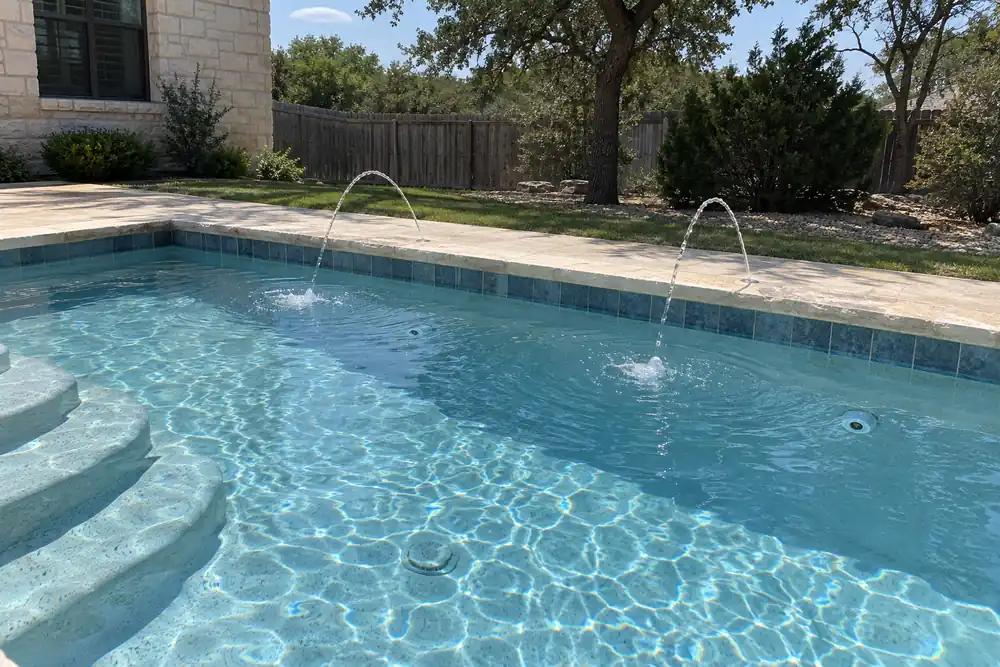
Pool Tile Cleaning and Calcium Removal in Killeen, Texas
Killeen Pool Resurfacing handles pool tile cleaning and calcium removal in Killeen, Texas: taking the white scale band off waterline tile by low-pressure blasting or by hand, with the water lowered rather than drained.
Cleaning is for tile that is still sound. Cracked, loose or missing tile is a pool tile replacement job, and stains on the plaster below the tile line are covered under pool acid wash. At a free estimate we'll look at the deposit, the tile and the grout and talk through which method suits them.
No charge · answered 24/7
Get free estimates
What the white line on pool tile is
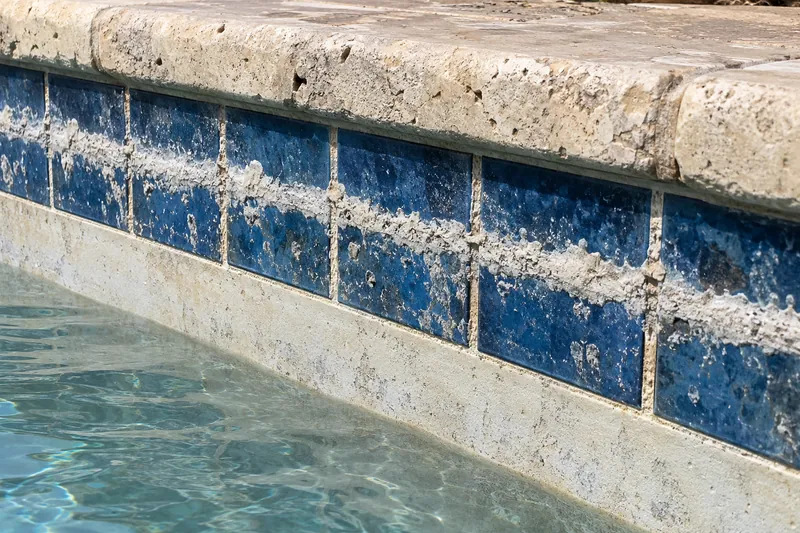
The National Plasterers Council defines scale as minerals or metals that come out of the pool water and stick to tile and other surfaces, leaving unsightly stains and roughness, and it names calcium carbonate as a major part of it. The evaporation line is a common kind, says Orenda, a pool chemical maker: water evaporates from the tile face and its calcium stays put, and as the pool loses water, what remains grows more saturated with calcium. Lunada Bay Tile, a tile maker, notes that the waterline is where evaporation is highest and that minerals are left behind each time water dries on tile.
Hardness alone usually isn't the trigger, Orenda adds; it takes other factors, such as high pH, warm water or carbonate alkalinity, to drive calcium carbonate out of solution, even from very hard tap water. LATICRETE, a maker of tile-setting materials, describes the balance at work: water oversaturated with minerals sheds them as scale, undersaturated water dissolves whatever it touches, and water that has been balanced can drift out of balance within 24 hours.
The saturation index and Killeen's fill water
The Pool & Hot Tub Alliance uses the Langelier Saturation Index (LSI) to predict whether pool water will deposit calcium carbonate scale or dissolve it from surfaces, working from the water's pH, temperature, total dissolved solids, alkalinity and calcium hardness. Above zero, the water may form scale; below zero, it may attack the calcium in cement-based materials. The Alliance gives -0.3 to +0.5 as the range for proper balance and says a slightly positive reading may be preferred, because a thin scale layer does less harm than corrosion. Others draw the scaling line elsewhere: Orenda calls anything above +0.30 scale-forming, while Oceanside Glass & Tile calls 0.0 to 0.5 acceptable and says readings above 0.5 can bring cloudy water and faster scaling. The index shows a tendency, not an amount, the Alliance adds; water can read very high and still not scale, and sequestering agents can hold scaling back. For tile, Lunada Bay Tile asks for calcium hardness of 200 to 400 ppm and pH of 7.2 to 7.8.
Killeen's fill water arrives with its own numbers. Killeen doesn't treat its own water; it buys it from Bell County WCID No. 1, and TCEQ's samples of water leaving the District's Belton entry points from January 2024 to January 2026 ran 200 to 270 mg/L total dissolved solids, 103 to 130 mg/L total alkalinity and 40 to 52.7 mg/L calcium; neither the City's nor the District's water reports print a pH. Evaporation then concentrates what the water carries, as Orenda's example shows, and in the Texas Water Development Board's one-degree block that contains Killeen, lake evaporation totaled 64.18 inches in 2015 and 43.85 inches in 2019, the highest and lowest years from 2015 to 2025. The guide to Killeen water and pool plaster sets out what that water does to a finish.
How calcium comes off pool tile
Low-pressure bead and salt blasting
Kramer Industries, a maker of blasting media and equipment, describes the set-up: the water comes down to about 6 inches below the tiles, glass beads are shot at the tile at low pressure, and the spent beads sink to the pool floor, where the pool's cleaning equipment can pick them up. It says glass beads won't harm the tile or its glaze. The tile makers are more cautious. Oceanside Glass & Tile rates glass bead as the aggressive end of the media range and baking soda as the mild end, says baking soda or a media of similar hardness, such as the mineral salt kieserite, removes scale while staying safe for tile, glass tile included, and wants every method tested on an inconspicuous spot first. Lunada Bay Tile advises against mechanical abrading or blasting of glass or ceramic tile at all. Blasting crews describe the salt popping as it strikes the tile, which is what frees the calcium, and machines that vacuum the deposits back as they come off, followed by a hand wipe-down. Kramer adds that operators wear gloves, goggles and protective clothing, and that everyone, pets included, is out of the pool and off the deck before blasting starts.
By hand, without acid
Oceanside's maintenance guide removes calcium with an acid-free calcium remover scrubbed in with a nylon bristle brush, and rules out pumice stones and wire brushes, which can damage tile, as well as abrasive or acidic cleaners. The maker of the Pumie scouring stick says not to use it on glass, fiberglass or other plastics, and warns that some decorative tile and colored porcelain is fragile enough to be damaged by abrasive cleaning, so a small area is tested first. Orenda lists grinding or bead blasting as the physical options for tile lines and does not recommend putting acid directly on the scale. The tile makers go further: Oceanside says products containing hydrofluoric, hydrochloric, muriatic or phosphoric acid must not touch its tile, because certain acids damage glaze and iridescent glass, and Lunada Bay Tile tells owners never to put muriatic acid directly on glass or ceramic tile.
Call or request a free estimate any time, 24/7.
Get free estimates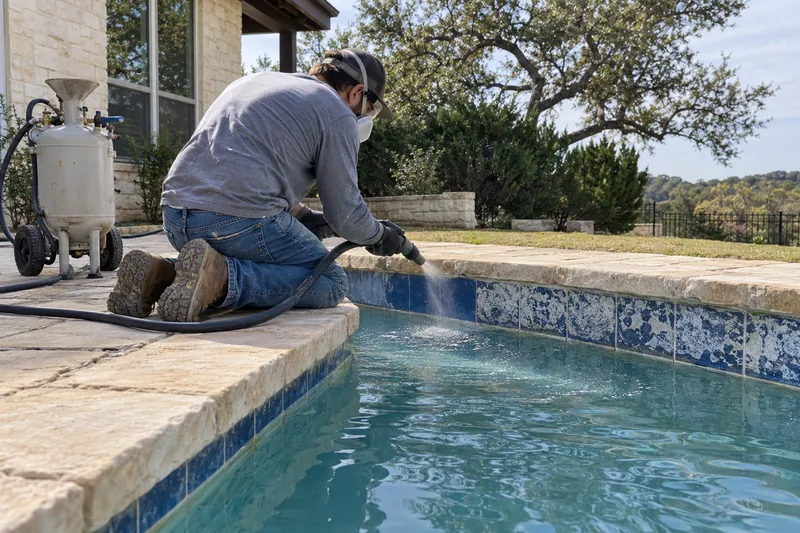
Keeping the waterline tile clean
Lunada Bay Tile recommends brushing the tile weekly with a soft brush or non-abrasive pad to keep minerals from building up along the waterline. Because minerals are left behind each time water dries on tile, it also asks for overflow features such as perimeter overflows to run continuously, at least from sunrise to sunset, rather than cycling on and off.
Killeen Pool Resurfacing gives free estimates on calcium removal and tile cleaning, by phone or through the form.
Call or request a free estimate any time, 24/7.
Get free estimates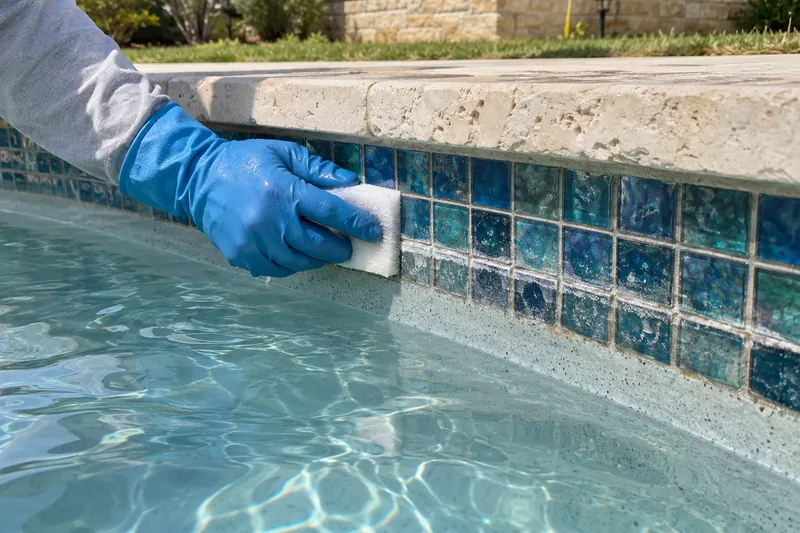
Pool tile cleaning questions
How can I clean my pool tiles?
Gently, and without acid. For routine care, Lunada Bay Tile brushes weekly with a soft brush or non-abrasive pad. For calcium that has already built up, Oceanside Glass & Tile scrubs in an acid-free calcium remover with a nylon brush and rules out pumice stones, wire brushes and abrasive or acidic cleaners. Heavier scale can be blasted off with a mild media such as baking soda or kieserite after a test on a hidden spot, though the tile makers disagree on how aggressive a media is safe, and one of them advises against blasting at all.
How much does pool tile cleaning cost?
National averages reported in 2025 put typical pricing at $6 to $10 per linear foot, with job minimums of $400 to $1,000: light cleaning with chemicals and hand tools can come in under $6 a foot, media blasting for moderate deposits often runs $6 to $8, and heavy scale can reach $8 to $12. Another national source, with no data year stated, gives an industry range of $3 to $8 per linear foot depending on the method, the severity and the market, or $240 to $640 for a pool with 80 feet of waterline. These are published figures, not our prices.
Does the pool have to be drained to clean the tile?
No. Kramer Industries lowers the water to about 6 inches below the tiles before blasting, and blasting crews describe bringing it down just below the calcium line rather than emptying the pool. Afterward, they say, the water is cloudy and the level is down until the filter clears it.
Why does the calcium line keep coming back?
Because the water keeps depositing it. Orenda says scale usually returns unless the water's saturation index is corrected, and explains that as a pool loses water to evaporation, what remains grows more saturated with calcium. LATICRETE adds that balanced water can fall out of balance within 24 hours.
Should pool tile grout be sealed?
For new tile, the makers favor it. Lunada Bay Tile advises sealing a new tile installation after it is set and before the pool is filled, to cut later maintenance, and calls the sealer sacrificial, meaning it has to be reapplied from time to time. Oceanside Glass & Tile says sealers benefit cement-based grout, natural stone and masonry such as coping. National averages reported in 2025 list grout sealing as an optional add-on at $2 to $3 per foot.
Request a free pool tile cleaning estimate
Killeen Pool Resurfacing answers calls and estimate requests about calcium and scale on pool tile 24/7, in Killeen and nearby towns.