How Killeen's Water Affects Pool Plaster and Tile
Killeen Pool Resurfacing explains how Killeen's water affects pool plaster and tile in Killeen, Texas: what Bell County WCID No. 1's treated lake water carries, how its numbers sit against the National Plasterers Council's targets, and how heat and evaporation concentrate it in a pool.
Killeen doesn't treat its own water, and neither the City's water reports nor the District's print hardness, dissolved solids, alkalinity or pH. The chemistry figures below therefore come from the Texas Commission on Environmental Quality's sample records for water leaving the District's plants, each with its date. They describe the water as it leaves a plant, not as it reaches any one tap.
Where Killeen's water comes from
Two lakes and one supplier
The City's code says Killeen gets all of its treated water through its agreement with Bell County Water Control and Improvement District No. 1. The contract provides 32.0 million gallons a day, while the City's average demand is 15.1 million gallons a day, about 105 gallons per person. The City's 2025 drinking water report names two sources, Belton Lake on the Leon River and Stillhouse Hollow Lake on the Lampasas River, where the City's 2024 report and its Water & Sewer page name Belton alone. The District has no groundwater; it contracts all of its raw water from the Brazos River Authority.
Four plant entry points
Stillhouse Hollow's share is recent. The District's Stillhouse Water Treatment Plant opened in 2021, built for Killeen's growth, and Killeen holds 10.0 of its 17.0 million gallons a day of capacity. TCEQ's records show treated water entering the District's system at four points: three at 5121 Water Works Road in Belton, labelled Plants 1, 2 and 4, and a fourth at 10461 Cedar Knob Church Road in Salado. No official page says which plant's water reaches which part of Killeen, so the figures below give both.
What Killeen's fill water carries
TCEQ's samples of January 12, 2026, at the three Belton entry points, read:
Hardness, calcium and alkalinity by entry point
The Salado entry point runs higher. On the same day it read 176 mg/L total hardness, 46 mg/L calcium, 14.8 mg/L magnesium, 124 mg/L total alkalinity and 277 mg/L dissolved solids. Over the samples from January 2024 to January 2026, total hardness ranged from 140 to 165 mg/L at Belton and from 176 to 206 mg/L at Salado, and dissolved solids from 200 to 270 mg/L at Belton and from 277 to 390 mg/L at Salado. Salado's chloride has fallen with each sample, from 117 mg/L in January 2024 to 76 in March 2025 and 64 in January 2026.
Chloramine, and free chlorine each February
Killeen's water is disinfected with chloramine. The City's reports give a yearly average residual of 2.35 ppm for 2021, 1.8 for 2022, 2.1 for 2023, 1.93 for 2024 and 2.01 for 2025, when readings ran from 0.5 to 3.6 ppm against a maximum of 4. Leaving the District's plants in 2025, chloramine measured 3.68 mg/L. Each February the District stops adding ammonia and disinfects with free chlorine for routine maintenance; the 2026 switch lasted from February 1 to 28, and the City took part in the same switch in 2025.
What the water reports leave out
The City's reports call calcium, sodium and iron secondary constituents, regulated by the State of Texas rather than the EPA, which can change how water looks and tastes but are not health concerns. None of the City's reports from 2021 to 2025, nor the District's 2024 and 2025 reports, prints a hardness, dissolved-solids, alkalinity or pH value, and TCEQ's records hold no pH result for the District either. The pH of the fill water is something to measure on the day, not look up.
Call or request a free estimate any time, 24/7.
Get free estimatesHow water balance shows on pool plaster
The Council's targets after start-up
Once a new finish is past its first 28 days, the National Plasterers Council aims for free chlorine of 1 to 3 ppm, pH 7.2 to 7.6, carbonate alkalinity 80 to 120 ppm, calcium hardness 200 to 400 ppm, cyanuric acid 30 to 50 ppm and, in a pool without salt, dissolved solids of 300 to 1,800 ppm. Set those beside TCEQ's January 2026 reading of 110 to 112 mg/L total alkalinity at the Belton plants: the Council's day-1 start-up brings alkalinity to 80 to 100 ppm, lowering it with pre-diluted muriatic acid when it runs high. TCEQ lists total hardness and calcium, not the calcium hardness the Council's targets use, so its advice that fill water be above 200 ppm calcium hardness is checked with a test kit on the day, not from the records. At the other end, the Council says dissolved solids above roughly 1,500 ppm can start causing cloudy water and balance that won't hold, and the fix is to drain part of the water and refill with fresh.
Scale, etching and stains
The Council's etching bulletin ties each water problem to its mark on the finish: low calcium hardness dissolves calcium compounds and discolors, low pH dissolves material generally, cyanuric acid that runs high leaches the surface and fades pigment, and the plaster can discolor wherever salt, stabilizer, granular chlorine or shock is left sitting on it. Filling with soft water strips calcium from the top of a new finish. Too much goes the other way: scale shows as a white or light film that can dull or hide the color, and metals leave stains: blue, green or black from copper and manganese, red, orange or black from iron. Both can be held back with chelating or sequestering chemicals, but once started they have to continue, because every top-up of fill water brings in more metals and minerals. Stabilizer at 100 ppm or above may damage the surface permanently, the Council warns.
The saturation index
The Council keeps the Langelier Saturation Index between 0.0 and +0.3, above all in the first six months after start-up: below zero the water leaches, etches or discolors the plaster, and above it the water scales, stains with metals or discolors. The Pool & Hot Tub Alliance adds two cautions. The index shows a tendency, not how much scale will form, and water can be out of balance even when every reading is in its ideal range, for example with dissolved solids of 3,000 ppm or water colder than 60°F.
Starting new plaster on Killeen water
Testing the fill water is "no longer an option" in the National Plasterers Council's words, since water short of pH, calcium hardness or alkalinity can etch new plaster, water with too much of them can scale it, and copper, iron or manganese in it can stain it. It wants clean potable water, never water that has been softened or run through reverse osmosis, with pH, total alkalinity, calcium hardness and metals tested and recorded, and it notes that the steps of its start-up card may need adjusting for unusual fill water, such as water with extremely high or low calcium hardness, pH or alkalinity. The mix water counts as well as the fill: SGM says very hard or alkaline mix water makes plaster effloresce and form calcium scale.
Where fill water is high in alkalinity or hardness, some crews use what SGM calls an acid start-up, dropping total alkalinity to zero with muriatic acid after the fill; SGM itself says that used alone it gives the least desirable result and a streaked look. Research funded by the Independent Pool & Spa Service Association rated a bicarbonate start-up ideal, the Council's traditional start-up a close second and the acid start-up last, because it etched the surface microscopically; the Council kept its traditional method as simple enough for homeowners and technicians to follow. The first days matter most for color: the Council puts the greatest risk of white calcium deposits masking a colored finish in the first 3 days after the fill.
Killeen Pool Resurfacing will talk through the fill water and the start-up with you before a new finish goes on.
Call or request a free estimate any time, 24/7.
Get free estimatesHeat, evaporation and the tile line
Evaporation concentrates what the water carries
In drought years Killeen's evaporation far outruns its rain. Two drought years show the gap: the Texas Water Development Board's figures for the one-degree block around Killeen record 71.84 inches of evaporation and 19.66 of rain in 2011, and 63.23 against 22.03 in 2022. Orenda, a pool chemical maker, explains what that does to a pool: water leaves as vapor, its calcium stays behind, and the water left grows more saturated as the level drops. The Pool & Hot Tub Alliance's drought advice is to offset hardness that creeps up by lowering pH and alkalinity, and not to use calcium hypochlorite, which adds calcium. At Stage 2 or higher of the City's drought plan, the top-ups themselves are held to the address's watering days and hours.
The white line on the tile
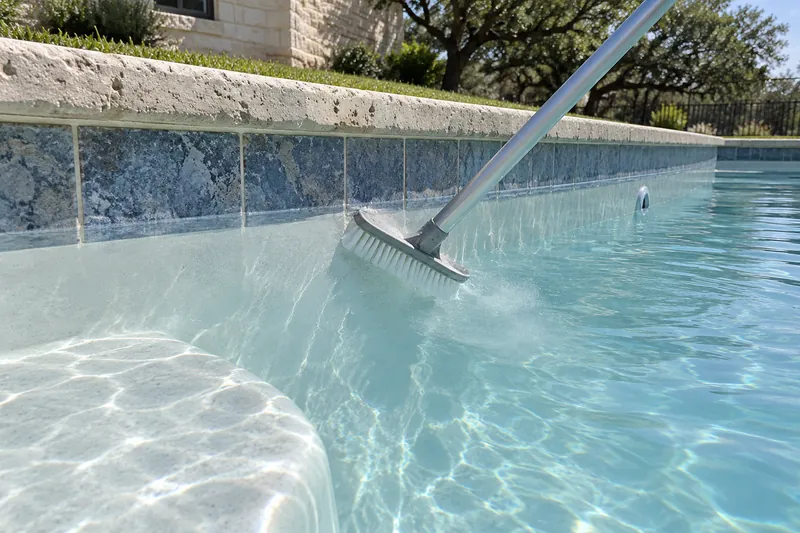
The waterline is where evaporation is highest, and the tile maker Lunada Bay Tile suggests a weekly brushing with a soft brush or a non-abrasive pad so minerals don't build up. Orenda warns that scale usually comes back unless the water's saturation index is corrected, and the Council adds that corrosive water can also destroy tile grout, metal light rings and heaters. Lunada Bay Tile says never to put muriatic acid straight onto glass or ceramic tile; how scale is taken off the tile band safely is covered under pool tile cleaning.
Stains on the plaster
For the plaster itself, the Council uses acid washing in three senses, from cleaning off efflorescence, dirt or stains to a diluted solution that lifts certain stains with little, if any, of the surface lost. Frequent drain-and-acid washes strip years off plaster, Universal White Cement warns, and Orenda describes one deposit that acid won't shift at all: calcium silica scale, rounded like kernels of rice, with no known chemical remover. When a wash is the right answer, the steps and Killeen's disposal rules are on the pool acid wash page.
Call or request a free estimate any time, 24/7.
Get free estimatesKilleen water and pool plaster questions
What are the current water issues in Killeen?
On supply, the lakes are high. The Brazos River Authority ended its Stage 1 drought watch for Lakes Belton and Stillhouse Hollow on June 12, 2026, saying they were full, and on October 4, 2026 Belton Lake was 97.8 percent full and Stillhouse Hollow 98.4 percent; the City's pages still showed Stage 1 that day, with no City notice ending it found. On treatment, the District ran with 39 percent of its plant capacity out of service for its Rehabilitation and Expansion Project during the late-January 2026 freeze, when usage from thawed broken lines almost reached the reduced capacity. On cost, the City's FY 2027 ordinance raised residential water rates from October 1, 2026.
Does a water softener help a plaster pool?
Not for filling one. The National Plasterers Council says never to fill with softened or reverse-osmosis water, because soft water low in calcium hardness leaches calcium from the top of a new finish, from severe discoloration to a weakened cement binder and a shorter life. New plaster sheds some calcium hydroxide as plaster dust anyway, which is normal, but soft water pulls out more than that excess. Where soft water is all there is, the Council's options include bypassing the softener or reverse-osmosis unit, using hydrant or trucked water, or dosing calcium chloride during the fill.
Is the white film on my plaster scale?
Look at what else it coats. Orenda notes that true scale settles on everything in the water, from tile and plastic fittings to ladders and lights, so a white deposit found only on the cement points to etching, mottling or plaster dust instead. Scale, as the National Plasterers Council describes it, is a white or light film on top of the finish that can dull or hide its color, while Universal White Cement describes etched plaster as soft, chalky or pitted to the touch.
How often should pool water be tested?
The National Plasterers Council suggests testing pH, total alkalinity and chlorine once or twice a week, and calcium hardness, stabilizer and dissolved solids once a month. For a new finish, the Pool & Hot Tub Alliance suggests testing twice a week after day 28 while the plaster finishes its secondary cure. Makers' warranties set their own terms: Pebble Technology International asks for testing at least once a week and printed reports kept for any claim, and SGM's warranty calls for monthly tests documented by a company using a computerized system.
Get a free pool plaster and tile estimate
Killeen Pool Resurfacing answers calls and estimate requests 24/7 and will look at your plaster, your tile line and the water it holds at a free estimate.