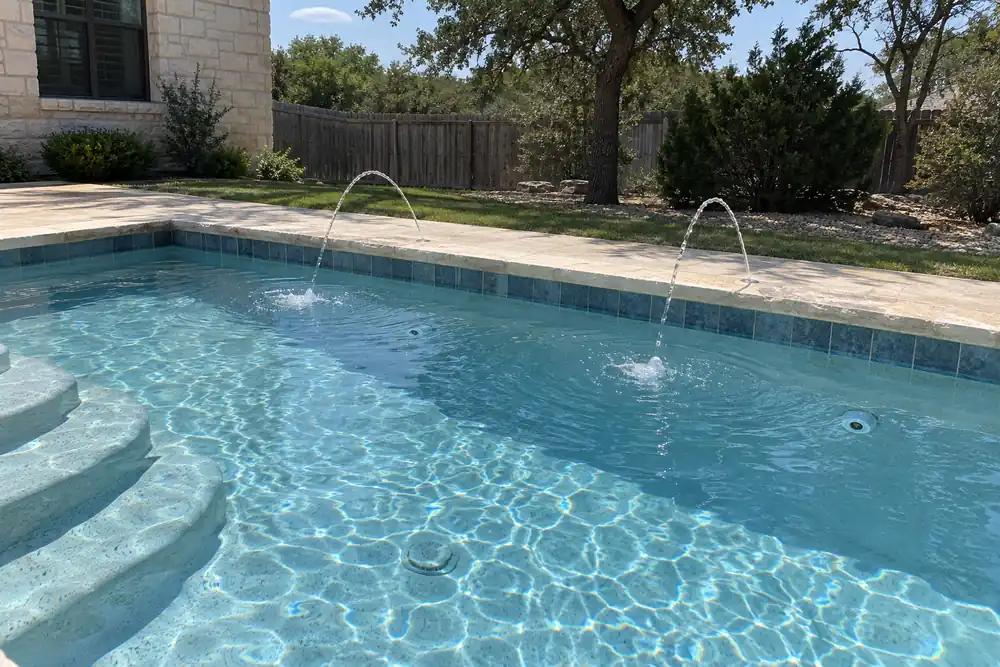
Pool Painting in Killeen, Texas
Killeen Pool Resurfacing offers pool painting in Killeen, Texas: epoxy, acrylic or rubber-based pool paint over a plaster, gunite or concrete pool that has been repaired, cleaned and prepared, rolled on in the two thin coats that Insl-x, Benjamin Moore's pool paint line, recommends instead of one heavy coat. Ramuc, a pool paint maker, calls paint a viable option once a plaster finish has aged, roughened and stained to the point that the owner is weighing a replaster.
In NOAA's 1991–2020 normals, the Killeen station reaches 90°F or above on 104.8 days a year, yet Insl-x's pool paints are applied between 50°F and 85°F, and Ramuc's EP epoxy between 50°F and 90°F, so the weather sets the schedule. The estimate is free: we'll talk through which paint suits the pool, or whether a new plaster finish suits it better.
No charge · answered 24/7
Get free estimates
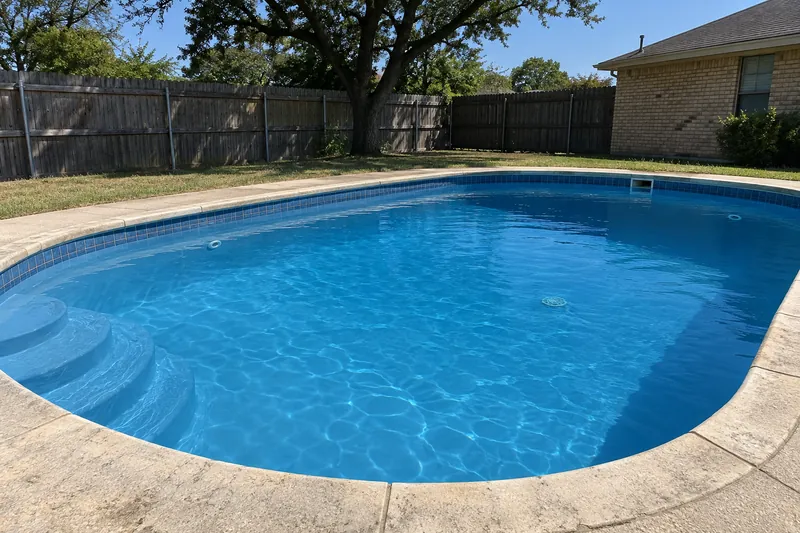
Epoxy, acrylic and rubber pool paint
Epoxy pool paint
Insl-x describes its epoxy as a two-component polyamide coating for concrete, marcite, gunite, fiberglass and steel pools, resistant to common pool chemicals including chlorine. Kelley Technical Coatings' Olympic line rates epoxy at 5 to 8 years of service. Each year an epoxy erodes slightly, Kelley Technical Coatings says, and it should not be recoated until it is so thin it is almost transparent. Public pools, which tend to run higher chlorine levels, are better served by epoxy or chlorinated rubber paints because of their higher chemical resistance, according to Insl-x.
Acrylic and waterborne paint
Olympic's acrylic enamel is water-reducible, so it can go straight onto a damp surface with no drying-out time after cleaning. Insl-x's waterborne acrylic can be applied over most types of pool coatings in good condition, as well as bare concrete or plaster. The trade-off is a shorter life: Olympic gives acrylic enamel 2 to 3 years of service, and Ramuc rates its DS Acrylic at up to 2 years.
Rubber-based paint
Insl-x makes its rubber-based paint for new or old concrete pools: a low-sheen finish for fresh or salt water and chlorinated pools, not recommended for fiberglass. Its chlorinated rubber line is not available in many areas of the country because of VOC (solvent emission) restrictions, and Ramuc suggests moving from traditional chlorinated rubber to newer synthetic rubber paints. Olympic gives synthetic or chlorinated rubber 2 to 3 years of service.
Which pools can be painted
Ramuc says rubber, epoxy or acrylic pool paint can go on any unpainted masonry pool, though a steel pool needs a metal primer first. Kelley Technical Coatings says its ZERON epoxy may be used to refinish rough, stained or worn-out white plaster. A fiberglass shell takes epoxy only, as the questions below set out, and refinishing the gelcoat itself is covered under fiberglass pool resurfacing.
Call or request a free estimate any time, 24/7.
Get free estimatesBefore painting: the old surface decides the job
Aged plaster and new concrete
Ramuc says its coatings are not a repair for weak surfaces, so hollow or weak, crumbling plaster is found first, for example with a ball-peen hammer, and repaired before any paint goes on. Universal White Cement, a white cement maker, says widespread separation of plaster from the shell calls for a full replaster, which makes it a job for pool replastering rather than paint. New work has the opposite problem: Insl-x says fresh concrete or plaster must cure until its surface pH is 9 or less, or for at least 30 to 60 days, before it is painted.
Matching the paint already on the pool
Olympic identifies an old coating with a chip test: a chip that dissolves in denatured alcohol is water-based acrylic, one that dissolves only in full-strength solvent or xylol is chlorinated rubber, and one that dissolves in nothing is epoxy. The makers then limit what goes over it. Insl-x puts its epoxy only over another solvent-based epoxy, its chlorinated rubber only over chlorinated rubber, and its synthetic rubber only over chlorinated rubber or another rubber-based paint. Olympic recommends recoating with the same type; an old rubber coating can be converted to epoxy only after a FUSION PLUS conversion coat, and its epoxy bulletin says never to recoat a rubber-base coating with an epoxy.
When old paint has to come off
Insl-x says complete removal should be considered when the old paint is blistering and peeling, or when more than four older layers are present. Kelley Technical Coatings goes further: never recoat a pool that is scaling, peeling or blistering; a few small scaling spots can be sanded and primed, otherwise the coating has to come off completely. Scraping, sanding or removing old paint may release lead dust, Insl-x warns, which calls for a NIOSH-approved respirator and cleanup with a HEPA vacuum and a wet mop.
Not sure what is on the pool now? Killeen Pool Resurfacing will go over the old coating at the free estimate.
Call or request a free estimate any time, 24/7.
Get free estimates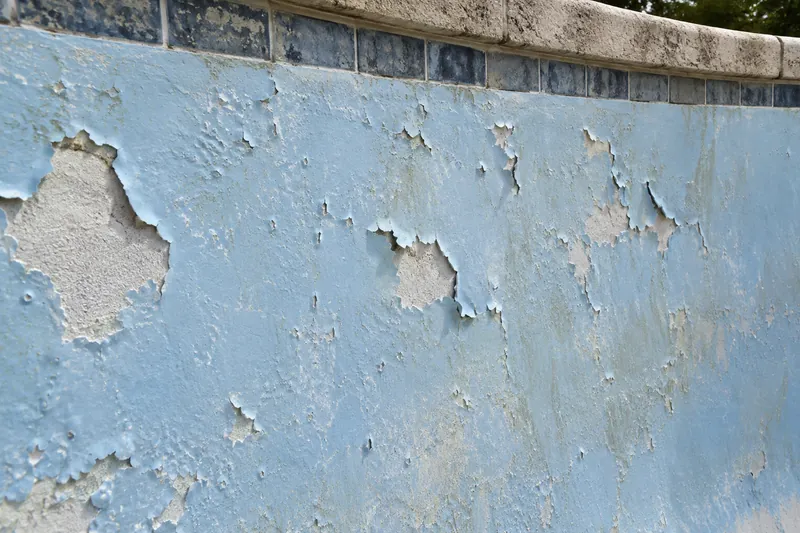
How a pool is painted, step by step
Drain the pool
Killeen's rules send the old water into the yard, not the street or a storm drain; water may go to the curb only after it is dechlorinated to under 0.10 mg/l total residual chlorine.
Repair the shell
Hollow or crumbling plaster is repaired first. Ramuc fills joints and cracks with hydraulic cement or a polyurethane sealant, never a silicone product, which spoils paint adhesion.
Wash, and scuff-sand a painted pool
Olympic washes with trisodium phosphate, never a soap-type detergent, whose film ruins adhesion. On a previously painted pool, Insl-x scrubs off chalk, scum, oil and suntan lotion, scuff-sands with 150 to 180 grit, rinses and lets the surface dry 24 hours.
Etch bare plaster
Insl-x etches unpainted plaster with a 10 percent muriatic acid solution until it stops reacting, triple-rinses it and lets it dry 3 days; Olympic's properly etched surface feels like fine sandpaper. On a painted pool the makers disagree: Insl-x says never acid-etch it, Olympic recommends an acid wash anyway.
Let it dry, and test
Ramuc waits for 5 dry, sunny days, then tapes 2-by-2-foot sheets of clear plastic to the deep-end wall, the floor and other areas. Condensation under the plastic within about 4 hours means the surface needs another 24 hours before a retest.
Prime where the maker calls for it
Olympic primes bare plaster before its epoxy finish coats, with GUNZITE on rough surfaces and POXOPRIME II on smooth ones. Ramuc says its EP Hi Build epoxy is self-priming and takes no other primer.
Roll on two thin coats
Insl-x calls for two thin coats with a short-nap roller, because over-application can make pool paint fail early. Its epoxy and waterborne paints can be recoated in about 4 to 6 hours at 70 to 80°F, its rubber paints after 24 hours.
Cure before filling
Olympic ties its epoxy cure to temperature: 3 days at 75 to 85°F, 4 at 70 to 75°F, 5 at 65 to 70°F and 6 at 60 to 65°F. Insl-x waits at least 7 days after the final coat, never covers a curing pool with a tarp or solar blanket, which traps solvent, and pumps out any rain as soon as possible; Ramuc adds a dry day for each day of rain.
Painted steps, shallow areas and wading pools can become slipping hazards, Kelley Technical Coatings warns, unless silica sand is sifted very lightly onto the coating while it is still wet.
Call or request a free estimate any time, 24/7.
Get free estimates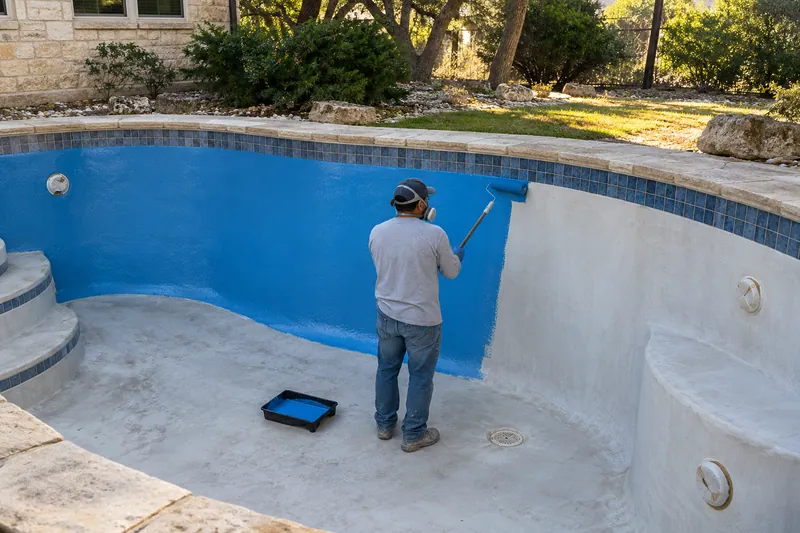
Painting a pool in Killeen's heat and refill rules
Working around Killeen's summer heat
Insl-x's way around direct sun is to paint the east wall in the morning while it casts a shadow and the west wall in the late afternoon. Ramuc adds that overnight temperatures must stay at 50°F or above while its epoxy cures, or the paint won't cure correctly and the top feels oily. The Killeen station's NOAA normals put July's normal high at 95.7°F, August's at 96.6°F and January's normal low at 36.1°F.
Refill water and permits
From Stage 2, Killeen's drought plan lets a pool be filled on the address's designated watering days only, in the hours from midnight until 10 a.m. or from 8 p.m. until midnight. The City's pages showed Stage 1 on October 4, 2026, a stage with no pool limit; confirm the current stage before the water comes out. A home's sewer charge is capped once use reaches 10,000 gallons a month, so a 20,000-gallon refill through a 3/4-inch meter comes to $136.14 at the City's FY 2027 rates, water and sewer together, when it is the only water used that month. Killeen's adopted pool code takes replastering and resurfacing of an existing pool out of its permit requirement without mentioning painting at all; plumbing, electrical and fence work come under permit rules of their own, so check with Killeen Building Inspections before work starts.
Call or request a free estimate any time, 24/7.
Get free estimatesQuestions about pool painting
What are the steps involved in painting a fiberglass pool?
Fiberglass takes epoxy. Of Insl-x's paints, only the epoxy is recommended for fiberglass shells, not the waterborne or rubber-based lines; Ramuc recommends its Hi Build or HB31 epoxies; and Olympic's specification is POXOLON 2 in two coats, or ZERON in one coat over GUNZITE primer. The makers prepare the gelcoat differently: Insl-x cleans it, scuff-sands it with 150 to 180 grit, rinses it and gives it 24 hours to dry; bare fiberglass gets a #80 grit profile from Ramuc; and Olympic sands in straight lines with coarse sandpaper, never an orbital sander, with no acid wash. Latham's fiberglass manual warns that draining its pools voids the warranty unless a dealer handles it.
How much does it cost to paint a pool?
National averages reported in September 2026 put the starting cost of painting a pool at $1.89 to $2.23 per square foot, while for the whole job, national 2026 figures give $1,500 to $5,000 for a paint or epoxy coating. These are published averages, not our prices; pool size and access change the material and labor, so a real price comes from seeing the pool.
How long does pool paint last?
Insl-x says it's impossible to predict a pool paint's life, but that owners should expect 3 to 5 years before repainting, depending on conditions: the number of coats, the climate, how strongly the pool is chlorinated, its chemical balance, direct sun, the color chosen, how much the pool is used and how often it's cleaned. Ramuc says paint life depends on preparation and application.
Why does pool paint blister?
Ramuc lists the causes: a roller nap thicker than 3/8 inch, which draws air into the film; paint applied too thick; painting a damp surface; painting in direct sun, which can raise vapor or heat blisters; filling the pool before the paint has cured; and incompatible paints. It names improper surface preparation as the number one cause of blistering and other performance issues. Olympic adds that water trapped under a rubber-base film eventually blisters as the vapor tries to escape.
Why does pool paint fade or turn chalky?
All pool paints eventually fade in chlorine, Insl-x says, and after a refill it adds shock through a chlorinator or the skimmer so concentrated chlorine doesn't touch the new paint. Ramuc says every epoxy film chalks over time as UV light and water chemistry break down its top surface, which it calls a natural degradation. Two other problems look like fading or chalking: filling the pool before the paint has fully cured leaves a blush over the surface, and calcium hypochlorite shock can leave a white, bleached look.
Request a free pool painting estimate
Killeen Pool Resurfacing gives free pool painting estimates by phone or through the form, any hour of the day, for Killeen and nearby towns.