Pool Acid Wash and Stain Removal in Killeen, Texas
Killeen Pool Resurfacing handles pool acid washes and stain removal in Killeen, Texas: draining the pool, washing the finish with diluted acid to lift stains and mineral film, then neutralizing the runoff and disposing of it under the City's rules.
Each wash takes a thin layer of the finish with it, so it isn't the answer to every mark. Some stains come from metals in the water, some white deposits shrug off acid altogether, and etching or faded pigment calls for pool plaster repair instead. At a free estimate we'll look at the stains and the finish and talk through whether a wash, a stain treatment or a repair fits.
No charge · answered 24/7
Get free estimates
What an acid wash does to a pool finish
Three meanings of acid wash
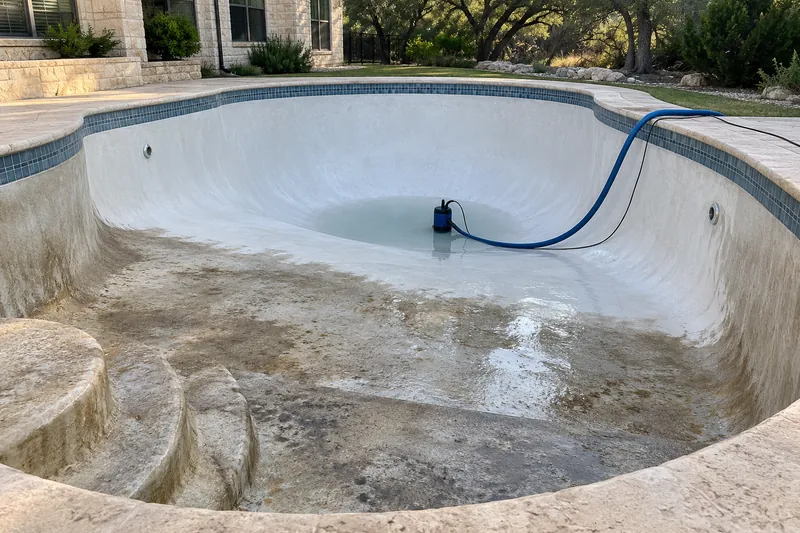
The National Plasterers Council uses the term in three ways. The first is cleaning a finish by dissolving material on its surface to remove efflorescence, dirt or other stains. The second is etching a new cement-based finish to expose its aggregate or sand, which is how exposed-aggregate finishes are made. The third is a low-strength, diluted acid solution that removes certain stains, dirt or marks with little, if any, of the surface compromised.
How much finish each wash removes
A national cost report from 2026 estimates the loss at roughly 1/16 inch of plaster per wash, and since plaster must stay above about 3/8 inch thick to remain structurally sound, it counts three to four washes as the realistic limit before a replaster. Universal White Cement, a white cement maker, puts the warning plainly: frequent drain-and-acid washes may make a pool look whiter for a while but strip years off the plaster. The finish matters too. SGM, the maker of Diamond Brite, says washing traditional limestone-based plaster with acid brought only temporary relief and hastened its erosion, whereas its quartz-based finish, it says, tolerates several washes in its lifetime with no permanent harm, so the finish maker's guidance is the one to follow.
Call or request a free estimate any time, 24/7.
Get free estimatesStains an acid wash can and can't remove
Surface film and organic staining
National figures from 2026 describe the job as stripping a thin layer of stained plaster with diluted muriatic acid to expose clean plaster beneath, removing organic staining and mineral film that chemistry can't touch. Scale is one such film: the National Plasterers Council describes it as a white or light-colored layer that can dull a finish's color or hide it completely.
Deposits acid won't touch
Not every white deposit dissolves. Orenda, a pool chemical maker, says calcium silica scale sometimes forms on cement-based surfaces, often looks rounded, almost like kernels of rice, appears to be immune to muriatic acid, and has no chemical remover it knows of.
Waterline tile is a separate job
The tile band is cleaned another way, because tile makers keep acid off their tile: Oceanside Glass & Tile warns that certain acids damage tile glaze and iridescent glass. Scale on the waterline tile is covered under pool tile cleaning.
How a pool acid wash is done
Let the chemicals fade, then drain
Water bound for the landscape is left 48 to 72 hours with no chemicals added, as the EPA's pool guide advises, and local discharge rules are checked before any of it goes to a sewer or onto the property.
Shield the tile
Oceanside Glass & Tile doesn't allow muriatic, hydrochloric, hydrofluoric or phosphoric acid to touch its tile, even during pool finishing work, and any splash is neutralized at once with baking soda and water.
Wash from the deep end up
SGM's procedure for its finish starts in the deep bowl and works up toward the shallow end to avoid streaks, leaves the walls and steps for last, and never lets solution puddle in the bowl; an acid-wash additive cuts fumes and evens the coverage, and proper safety equipment is worn throughout.
Neutralize the runoff and the finish
SGM pumps the runoff away continuously with a sump pump once it has been diluted and neutralized, and treats acid left on the finish with soda ash and water to avoid discoloration.
Dispose of the wash by local rules
SGM's manual leaves disposal to local requirements, and in Killeen those rules name muriatic acid directly (below).
Refill when the drought stage allows
When the City last showed its stage, on October 4, 2026, it was Stage 1, which sets no pool limit; Stage 2 or higher would hold the refill to the address's assigned watering days and their night and morning hours.
Call or request a free estimate any time, 24/7.
Get free estimates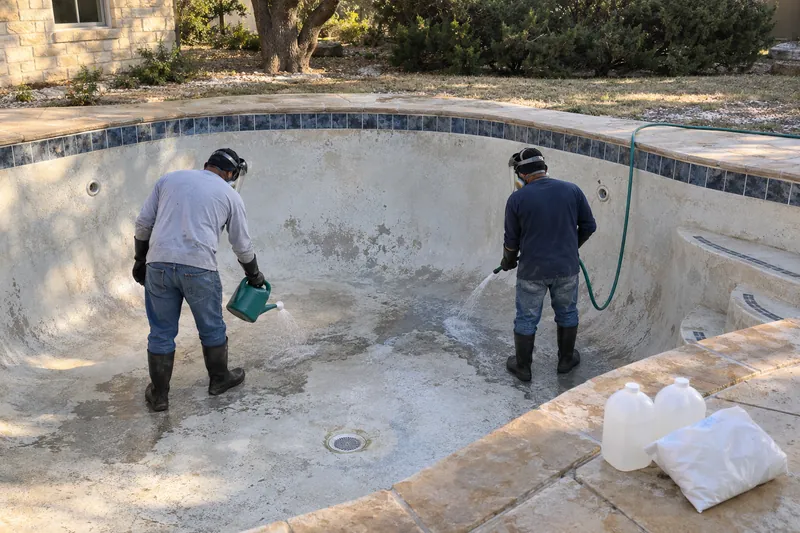
Where acid wash water can go in Killeen
Acid wash water is runoff the City's rules name directly. Killeen's stormwater ordinance allows nothing but stormwater into the storm drain system, which it defines to include streets, curbs, gutters, inlets, ditches and drainage channels. Pool water is defensible there only once it has been dechlorinated below 0.10 mg/l total residual chlorine and carries no harmful quantity of chlorine, muriatic acid or other pool-cleaning chemical, and filter backwash is barred outright. Breaking those rules is a Class C misdemeanor; fines can reach $2,000 where the provisions govern public health and sanitation, and each day a violation continues counts as a separate offense.
On the property itself, the City's pool handout wants drained water to soak into the soil on the same lot, with only dechlorinated water allowed to reach the curb and gutter. Texas's reuse rules add a waiting period that fits this job exactly: TCEQ says pool backwash and drain water cannot be reused within five days of adding shock or acid treatment chemicals, and reused water must never pond, run across property lines or run onto paved surfaces. The 2024 pool code Killeen adopted lists the sanitary or storm sewer as outlets, but it says it doesn't override local law, and the City's sewer rule bars unpolluted drainage without the director's written approval, so ask the City before sending wash water to a sewer clean-out. How Killeen's water treats a finish over time is covered in Killeen water and pool plaster.
Killeen Pool Resurfacing gives free estimates on acid washes and stained finishes, by phone or through the form.
Call or request a free estimate any time, 24/7.
Get free estimates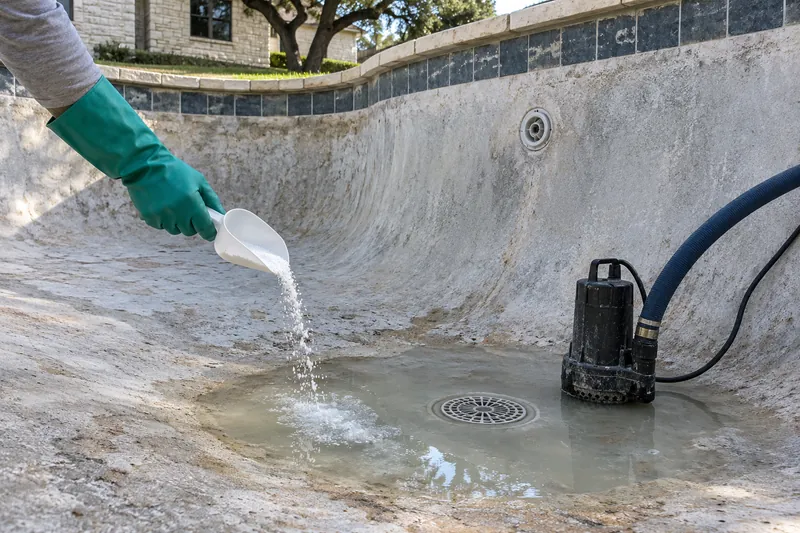
Pool acid wash questions
Can I acid wash my pool myself?
It carries real hazards. SGM's procedure calls for proper safety equipment at all times and an additive to cut the fumes, and Oceanside Glass & Tile warns that muriatic and similar acids can damage tile glaze and iridescent glass tile. River Pools, a fiberglass pool maker, advises owners not to drain a pool themselves and, where draining is truly needed, to have a professional do it. The disposal rules apply to anyone: Killeen's stormwater ordinance says no person may put pool water carrying a harmful quantity of muriatic acid into the storm drain system.
How much does it cost to acid wash a gunite pool?
Published national figures price it by surface area. National averages reported in 2025 put a professional acid wash at $0.50 to $0.75 per square foot, or $300 to $700 for most residential inground pools, averaging $450; national figures reported in 2026 give $0.60 to $0.70 per square foot, or $300 to $350 for a 500-square-foot pool, including draining and the acid scrub. For sales tax, the Texas Comptroller classes acid washing with testing, vacuuming and filter changes as swimming pool maintenance, which is taxed on homes as well as businesses; inside Killeen the combined rate is 8.25%. These are published figures, not our prices.
How can I remove stains from my swimming pool?
Match the treatment to the stain. Metals leave colored marks, the National Plasterers Council explains: copper and manganese blue, green or black, iron red, orange or black. Chelating or sequestering chemicals can keep metals and minerals from staining, but once started they have to be used continuously, because new fill water keeps bringing more in. Organic staining and mineral film are what an acid wash takes off, at the cost of a thin layer of plaster, and for abnormal discoloration on a drained plaster pool the Council developed torching, a slow heat treatment done over several days.
Can an acid wash remove algae stains?
It can. A national cost report from 2026 says an acid wash can restore a surface that is stained or has a light algae layer baked in, and national figures from 2026 describe it removing organic staining that chemistry can't. Each wash also removes some plaster, which is why Universal White Cement warns against frequent ones.
Does a pool have to be drained for an acid wash?
Yes. National cost figures describe an acid wash as draining the pool first and quote their prices plus draining and the refill, and SGM's method works across the empty bowl from the deep end up. The refill has a cost of its own: at the City's FY 2027 rates for a 3/4-inch meter inside Killeen, refilling 15,000 gallons as a home's only water use that month works out to $63.90 for water plus the capped sewer charge of $48.84, or $112.74 in all. The 15,000 gallons is an example, not a City figure.
Request a free pool acid wash estimate
Killeen Pool Resurfacing answers calls and estimate requests about stained pools and acid washes 24/7, in Killeen and nearby towns.