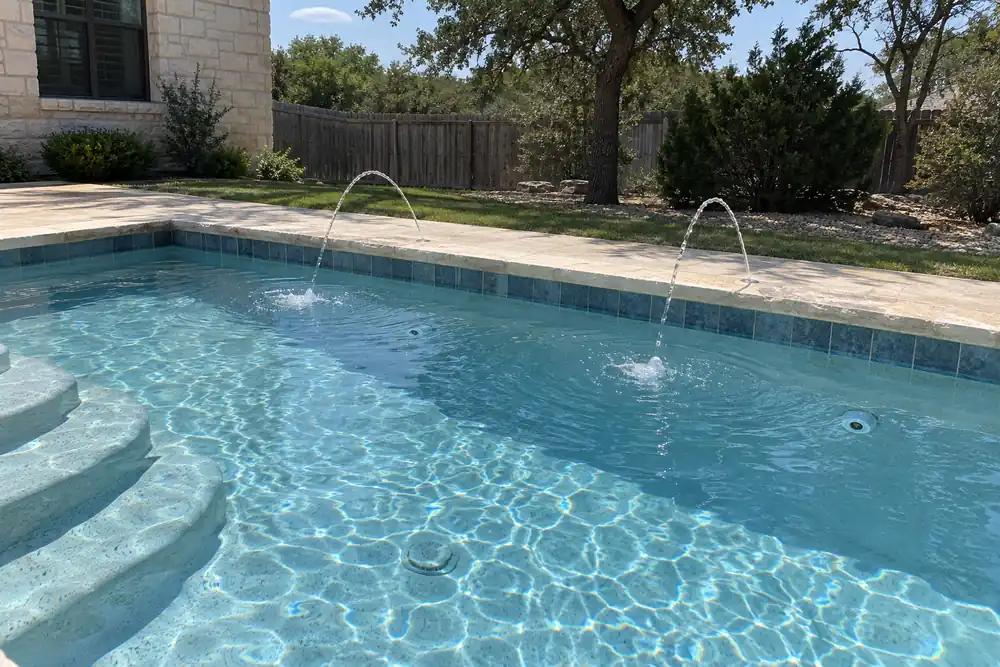
Pool Plaster Repair in Killeen, Texas
Killeen Pool Resurfacing handles pool plaster repair in Killeen, Texas: finding hollow and delaminated spots, cutting them out and patching them, and sorting out the etching and discoloration that change how a finish looks. The work runs from a single popped spot to the point where patching stops making sense.
The National Plasterers Council keeps two words apart: delamination, a material separating from itself or from the surface under it, and debonding, one material separating from another. Either way the finish is coming away, and how far it has spread decides the job, from a patch to full pool replastering. At a free estimate we'll sound the surface, look at the stains and talk through which it is.
No charge · answered 24/7
Get free estimates
What makes pool plaster go hollow
A bond that fails
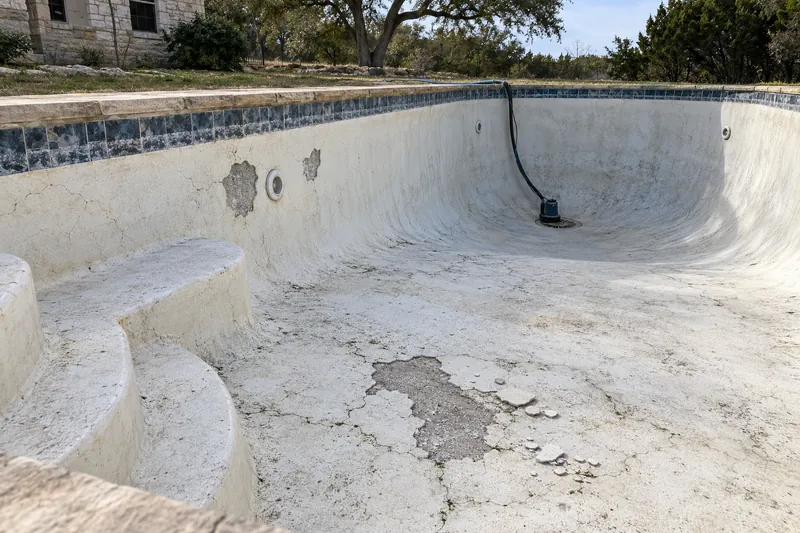
To Universal White Cement, a white cement maker, a hollow patch means the bond has failed: the plaster is pulling away from the shell or the bond coat, and left alone that ends in pop-offs and wider tear-outs. It calls delamination usually a process problem rather than a cement problem, and lists the usual causes. Dust, laitance, paint, loose old plaster, algae or scale left on the shell blocks the bond. So does a bond coat that is the wrong product, thinly spread or put on a dirty surface. Cold joints where a crew stopped and started again, over-troweling, and thin layers of new plaster stacked over a marginal old finish complete its list.
Look-alikes that aren't hollow
Not every rough or raised spot has lost its bond. The same maker separates four look-alikes. Surface spalling is the top cream layer breaking away, from water chemistry or freeze-thaw, while the plaster beneath stays bonded. Etched plaster feels soft, chalky or pitted. Scale is mineral buildup sitting on top of the finish. Calcium nodules are small volcano-shaped mounds that seep calcium and may or may not sit over a real void. Each one is repaired differently, which is why the surface is checked before anything is cut.
Call or request a free estimate any time, 24/7.
Get free estimates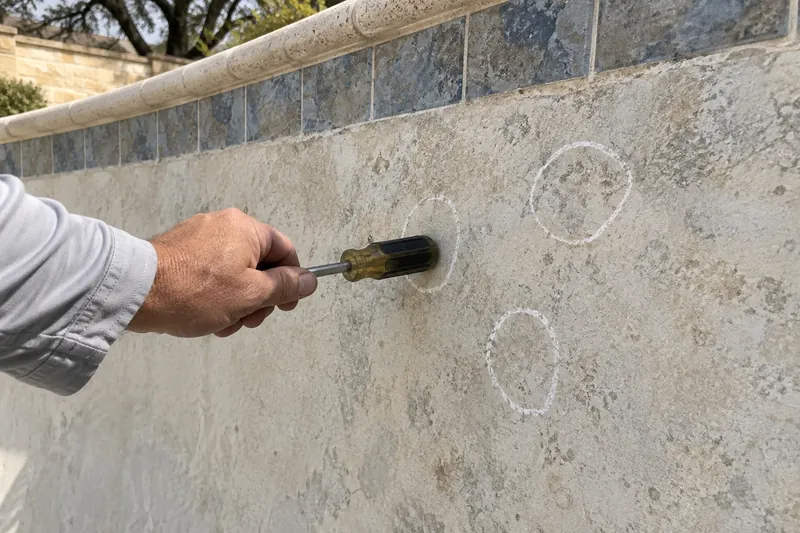
Patch or replaster: reading the damage
How far the hollow areas reach
Universal White Cement treats a handful of small, separate hollow spots on an otherwise good surface as the patchable case. Hollow areas that keep spreading, or that form a pattern, mean the bond is failing across the pool, and patching them may only put off a replaster; once the separation is widespread, a full replaster is the fix. Its order of urgency puts anything popping off with sharp edges or shedding debris into the system first, and it takes delamination in a young finish more seriously than in an old finish near the end of its life.
Signs the finish itself is worn out
A patch can't renew plaster that has worn out. The maker's end-of-life signs are roughness and pitting underfoot with aggregate showing across large areas, widespread etching or soft areas, large hollow or debonded sections, and deep stains that no longer respond to treatment. Mild mottling and light roughening on steps and benches it counts as normal aging. Cracks need a closer look as well: circular or spider cracks gathered around one patch go with hollow plaster, while a straight crack running through the shell is a structural matter covered under pool crack repair.
Pebble finishes and the maker's warranty
Pebble finishes come with their maker's own terms. Pebble Technology International's warranty does not count some loss of pebble and glass in the first few weeks, color variation, scale or cracking of any kind as defects. It covers the original residential owner for 5 years from installation, limited to repairing or replacing failed pebble, glass bead or pigment, without labor, and it excludes failures caused by improper chemical maintenance, negligence or structural failure. That warranty is the maker's, not an installer's.
How hollow plaster is cut out and patched
Sound the surface in a grid
Universal White Cement's check needs only a non-marring tool, such as the plastic handle of a screwdriver or a rubber mallet, tapped across the plaster in a grid. It can be done with the pool full, but a drained pool gives the clearest result.
Bring the water down for the repair
The National Plasterers Council wants an interior finish to stay fully under water for its service life, except for limited servicing or repair, so the water comes down only as long as the repair needs.
Cut 3 inches past the hollow area
SGM's manual saws a line 3 inches outside each hollow spot and takes out all the loose plaster inside the cut.
Clean back to sound material
Dust, laitance, paint, algae and scale all block a bond, Universal White Cement warns, so the cut-out is cleaned before any new material goes in.
Fill with patching cement
SGM fills the holes with patching cement. The finish can't be used to level an uneven shell beyond its maximum thickness, the National Plasterers Council adds, so plasterers bevel up or down to tile, pipes and lights that sit outside that range.
Get it back under water
For a new interior finish, the Council recommends full submersion as soon as practical, to limit shrinkage cracking and the risk of the finish debonding from the shell.
Call or request a free estimate any time, 24/7.
Get free estimates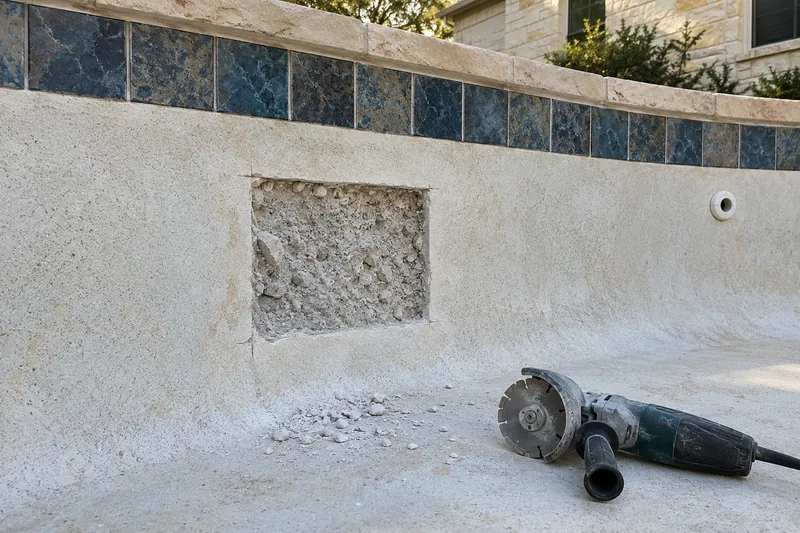
Etching and discoloration in plaster
Etching from water chemistry
The National Plasterers Council defines etching as material removed from within the finish surface, physically or chemically, and seen as pitting. Its etching bulletin matches each water problem to its damage: low calcium hardness dissolves calcium compounds and discolors the finish, low pH dissolves material generally, high cyanuric acid (stabilizer) dissolves and leaches it and fades the pigment, and salt, stabilizer, granular chlorine or shock left touching the surface can discolor it. On colored plaster, aggressive water can leach pigment up to 1/8 inch deep, first as faded, blotchy patches and in the end as white ones, and the Council calls that color loss irreversible.
Torching discolored plaster
For abnormal discoloration, the National Plasterers Council developed torching: heating a drained plaster surface with a propane torch. The Council's article on the method lists stains from inlet water, sprinklers and rain puddles, stopped-fill bathtub rings, drip marks, groundwater from behind the shell, soft fill water, hardened plaster dust, cleaner track marks and etched surfaces among its uses. The pool is fully drained and lightly acid washed first, then torched slowly over several days so the heat and carbon dioxide turn calcium hydroxide in the plaster into calcium carbonate and draw the moisture out. Flat plaster and white quartz are the best candidates; colored finishes take more steps, a torch can go over pebble only very delicately and can't safely touch glass bead at all, and the homeowner keeps clear of the pool while the work is done. The light wash that comes first is its own job, covered under pool acid wash.
Freezes and heavy rain: plaster in Killeen
Freeze-thaw damage at the waterline
The National Plasterers Council describes freeze-thaw damage in stages: first a white efflorescence just above the waterline, then a weakened, rough surface losing aggregate, and finally thin layers that crack, lift, spall or peel away. Steps, benches and sun ledges in the waterline zone are most at risk, so the Council recommends that at least 4 inches of water cover them, and it states that freeze-thaw damage is not a material or workmanship defect. Hard freezes are recent history at NOAA's station in Killeen: lows of 13°F and 12°F on December 22 and 23, 2022, lows of 13°F to 15°F on four straight days from January 14 to 17, 2024, and a high of only 23°F on January 25, 2026.
Water pushing from behind the shell
A finish can also be pushed off from behind. The Council warns that water collecting against the outside of the shell, from rain, irrigation or a leaking irrigation pipe, can build back pressure that debonds a bond coat or an interior finish, and that even a seasonal rain can create significant pressure. Universal White Cement adds that the voids behind loose plaster can become pathways for water and lead to structural or rust problems. NOAA's storm records for Killeen include more than 5 inches of rain in under 2 hours on June 28, 2010, with water up to car doors, and flash flooding that closed streets across the city on July 7, 2025.
Killeen Pool Resurfacing gives free estimates on plaster patches, hollow spots and discolored finishes, by phone or through the form.
Call or request a free estimate any time, 24/7.
Get free estimatesPool plaster repair questions
What are common swimming pool repair issues?
On a plaster pool, the ones Universal White Cement describes most are hollow or delaminated areas, which show as puffed-up spots or domes on floors and walls, often around lights, returns, tile lines, steps and benches; surface spalling; etching that leaves the finish soft, chalky or pitted; scale; and deep stains. Water chemistry is behind much of the etching and fading, the National Plasterers Council says, from low calcium hardness and low pH to high stabilizer levels.
How much does pool plaster repair cost?
National averages reported in 2026 cover a wide spread. A DIY patch kit for a coin-sized spot is often under $50; a professional patch repair is often around $150 to $400 as a planning range; an acid wash to freshen a stained surface may run around $450; and a professional replaster of an average 16-by-32-foot pool often lands around $5,000 to $9,000, depending on the finish, local labor and how much prep the old surface needs. These are published averages, not our prices.
What are the white bumps on my pool plaster?
Often calcium nodules. Universal White Cement describes them as small mounds or volcanoes that seep calcium, usually on floors or in micro-cracked areas, and says they may or may not sit over a true hollow void, so the area is worth sounding. A white crust can also be efflorescence, which the National Plasterers Council defines as soluble compounds, mostly calcium hydroxide, carried to the surface by moisture and hardened there. Orenda, a pool chemical maker, gives a quick test: real scale lands on every surface in the water, tile, plastic fittings and ladders included, so white calcium that shows only on the cement is something else.
Why is my pool plaster flaking or peeling?
Two different things look alike. Thin flakes of the top cream layer, with sound plaster underneath, are surface spalling, which Universal White Cement ties to water chemistry or freeze-thaw; the National Plasterers Council's final stage of freeze damage is thin layers that crack, lift, spall or peel. Thicker pieces that sound dull or drum-like when tapped are delamination, a bond problem the maker traces mostly to shell preparation and application. Sounding the area tells the two apart before a repair is chosen.
Can etched pool plaster be repaired?
Sometimes the look can be improved: the National Plasterers Council lists etched surfaces among the problems its torching method addresses. Pigment leached out of colored plaster, though, is gone for good, the Council says. When the etching or soft areas are widespread, Universal White Cement counts that among the signs a plaster finish has reached the end of its life, and the answer is a new finish rather than a repair.
Request a free pool plaster repair estimate
Killeen Pool Resurfacing answers calls and estimate requests about hollow, stained or etched plaster 24/7, in Killeen and nearby towns.