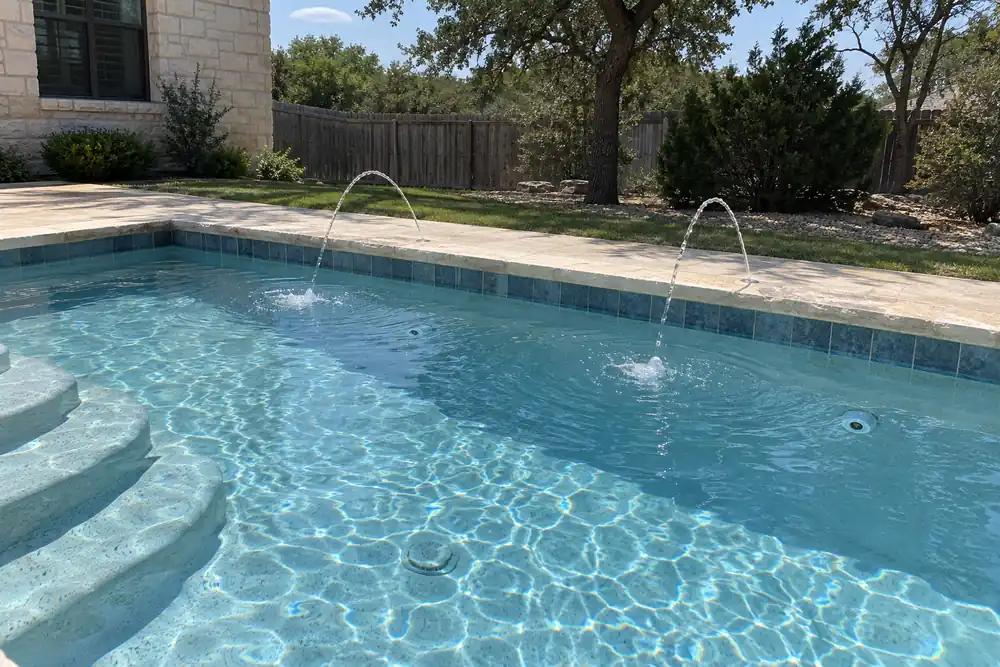
Pool Coping Replacement and Repair in Killeen, Texas
Killeen Pool Resurfacing handles pool coping replacement and repair in Killeen, Texas, from resetting loose stone or precast pieces to replacing a whole edge in brick, natural stone or poured concrete, along with the sealed joint where the coping meets the deck. Acme Brick, quoting the stone maker Eco Outdoor USA, describes coping as the edge that keeps water from getting behind the pool shell and, when it is set properly, sends splash water away from the pool toward the deck drains.
The waterline tile and the coping meet at the top of the wall, and Oceanside Glass & Tile calls for a flexible sealant rated for underwater use there, not grout; tile work itself is covered under pool tile replacement. At a free estimate we'll look at the coping, the mortar bed beneath it and the joint along the deck.
No charge · answered 24/7
Get free estimates
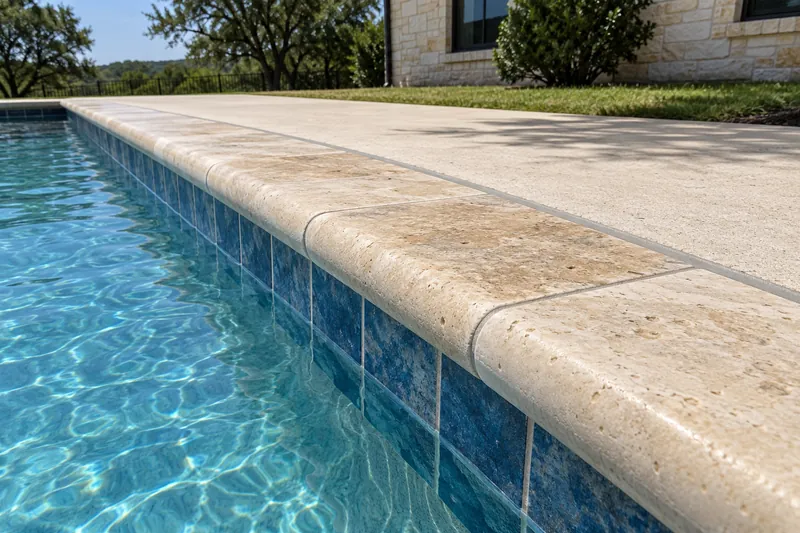
Pool coping types and materials
Poured and cantilevered edges
Three kinds of edge are common: concrete poured in forms right on top of the bond beam at the top of the pool wall; separately made pieces, such as stone or pavers, bedded in mortar on it; and a cantilevered deck, where one continuous pour makes both the deck and the edge. Stegmeier, a maker of cantilever deck forms, fixes its foam forms to the waterline tile of a gunite pool with double-faced tape and tie wires on the morning of the pour, then pulls them while the concrete is still wet enough to finish the edge. For a cantilevered deck the tile goes on first, bedded out level from the bond beam's high point, and 15-pound felt laid over the bond beam acts as a bond breaker so the deck can move without disturbing the tile; a coping-only pour gets no bond breaker, because that concrete has to bond to the pool wall. Leave the slip joint out, and the waterline tile can end up partly tied to the deck and crack horizontally, or the deck's movement can shear the top off the bond beam.
Travertine, limestone and other stone
The Natural Stone Institute says travertine, often sold as "travertine marble", is really a limestone formed on land, and that limestone and travertine are calcium-carbonate stones that mild acids attack, with water absorption from under 1 percent to over 10 percent. Relatively few limestone varieties have a proven record in outdoor paving, it adds, especially where it freezes, while dolomitic limestone is generally denser, absorbs less and resists abrasion better. Calcareous stones such as limestone, marble and travertine do best indoors or in controlled outdoor settings, in the Institute's view; in hot climates, long sun exposure can affect a stone's color and its movement joints, and even durable stone can fail if drainage, movement or the base beneath it isn't handled properly.
Brick coping
Marion Ceramics makes its brick coping from hard-fired clay, fired at close to 2000°F, and says it is colorfast, isn't faded by sun or bleached by pool chemicals, and has a lightly textured face for slip resistance. The maker says brick coping should be maintained like brick pavers, following the Brick Industry Association's recommendations.
Call or request a free estimate any time, 24/7.
Get free estimates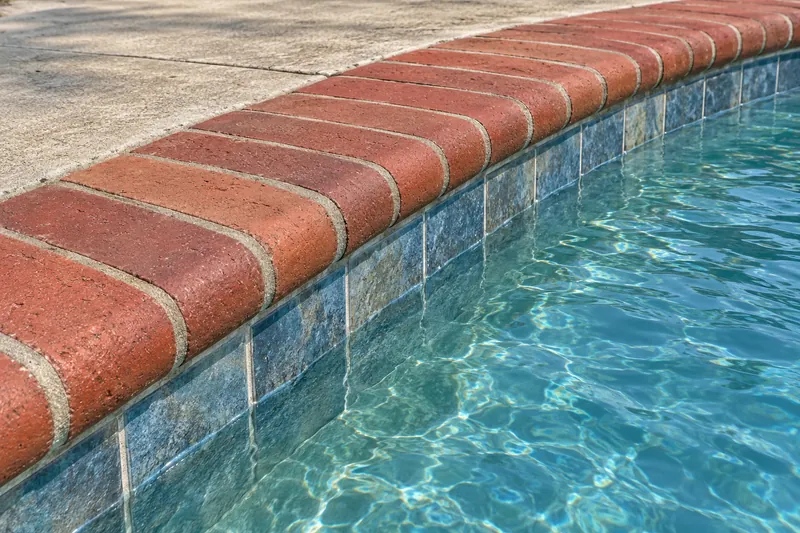
How to replace the coping around an inground pool
Lift the old coping and check the bond beam
The old pieces come off and the top of the wall is inspected; typical Texas pricing in 2026 names the amount of bond beam repair among the things that set the cost. Where an old bond beam has to be built back up to level, its surface has to be sound and clean, roughened by chipping, water-blasted and coated with cement paste or a bonding agent, and kept damp but not wet.
Roughen the top of the wall
Unilock's coping guide calls a concrete pool the easiest to cope because the wall itself carries the coping, and its first step is scarifying the top of the wall so the mortar and coping bond well.
Dry-fit the pieces, corners first
Pieces are laid out and cut before any are set, and every 90-degree corner is built first; Unilock says mitered corners look best, butt joints are easier, and coined corners need the least cutting. It recommends units up to 72 inches long on straight pools and none longer than 18 inches on a curve, so the edge flows.
Bond each piece in adhesive and mortar
Unilock puts concrete adhesive between the coping and the pool wall and a modified mortar bed, such as ARDEX X32 or X37 spread with a 1/4-inch notched trowel, under the rest of the piece: the bed lets each piece's slope be adjusted, and the adhesive gives the installation its longevity.
Set the overhang and slope
The makers differ here. Unilock overhangs the pool wall about 2 inches and slopes the coping 2 percent away from the pool; Belgard sets paver coping level with a steady 1-inch overhang, because the deck carries the slope, and uses construction adhesive rather than mortar under an automatic-cover track.
Grout between the pieces
Unilock recommends 1/4-inch joints filled with a flexible exterior tile grout, and mortar cleaned off the coping face as the work goes rather than left to cure there.
Leave a sealed joint at the deck
Belgard puts foam expansion material between the coping and the deck pavers to protect the bond seam, and Marion Ceramics, quoted by Acme Brick, leaves an open joint behind the coping that is sealed against moisture.
Resealing that joint on its own, without new coping, is pool expansion joint repair.
Call or request a free estimate any time, 24/7.
Get free estimates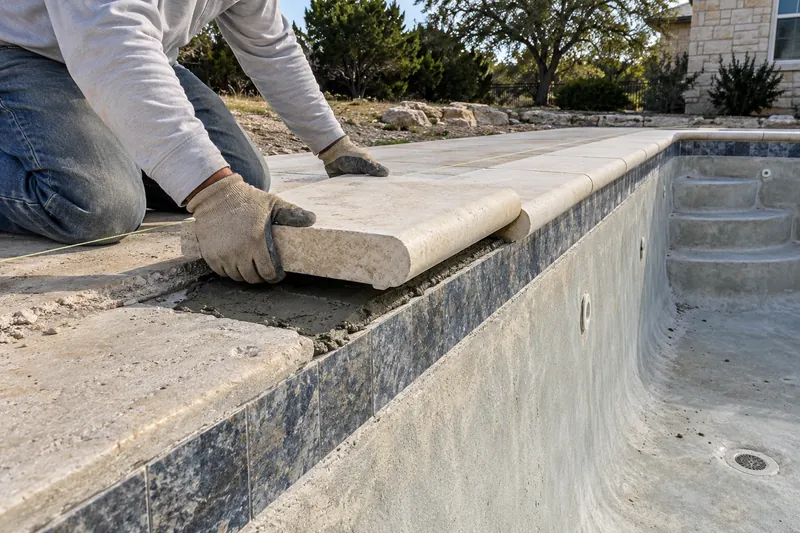
Why pool coping comes loose or cracks
Deck movement and the bond beam
The 2021 International Swimming Pool and Spa Code requires the isolation joint between coping and a concrete deck to be watertight and laid out so the deck's expected movement can't reach the coping or its mortar bed. Without a working joint, an expanding deck shoves against the pool shell, cracking or lifting coping and tile, and at worst cracking the bond beam. The flexible joint has to run the full depth of the deck, needs upkeep to keep working, and no steel should cross from the bond beam into the deck. Marion Ceramics, as Acme Brick quotes it, says installers often neglect expansion joints, which sun heat moves at different rates. Cracked, settled or recoated decks are covered under pool deck resurfacing.
Mortar that works loose
Mortar can work its way out of coping joints over time, Marion Ceramics notes, and some installers pour concrete all the way to the decking instead of leaving an open joint behind the coping, a different detail from the sealed gap it recommends.
Freezes on stone and brick
Marion says pool coping faces severe conditions, especially where it freezes, and the Natural Stone Institute counts few limestones with a proven outdoor record in freezing climates. Freezes reach central Texas too: NOAA describes the Great Texas Freeze of February 11–20, 2021 as the coldest winter storm for Texas since December 1989, with six to nine straight days of freezing temperatures across central Texas. The coldest quality-passed reading at NOAA's Killeen station is −2°F, on December 23 and 24, 1989, when the high on the 23rd was only 17°F.
Killeen Pool Resurfacing looks at the coping material, the joint and the bond beam at the free estimate.
Call or request a free estimate any time, 24/7.
Get free estimates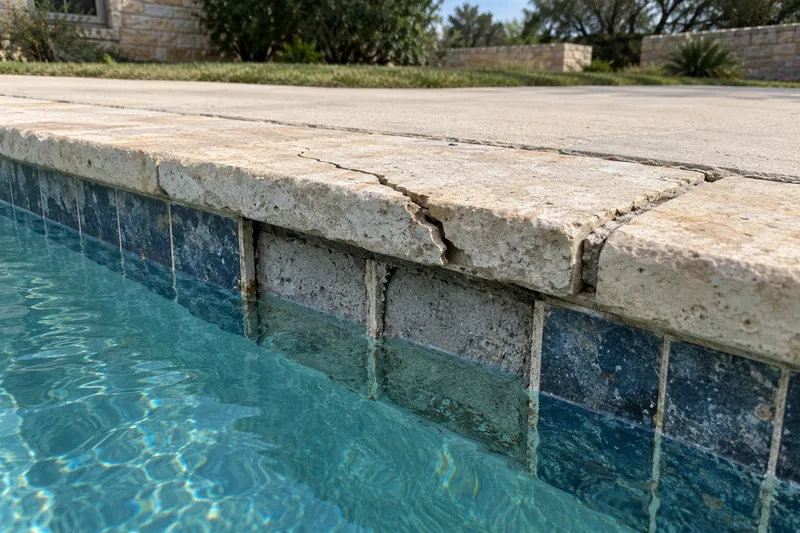
Pool coping replacement questions
What is the most durable pool coping?
It depends on what each material can take. Marion Ceramics' hard-fired clay brick is colorfast and isn't bleached by pool chemicals; the Natural Stone Institute rates dolomitic limestone denser and more abrasion resistant than ordinary limestone, but keeps calcareous stones such as travertine to interiors and controlled outdoor settings and notes that mild acids attack them.
How much does it cost to replace pool coping?
Typical Texas pricing in 2026 puts full coping replacement at $5,000 to $14,000, depending on the perimeter footage, the stone and how much bond beam repair is needed, and resetting individual pieces at $800 to $3,000. National averages reported in 2024 range from $6 to $55 per linear foot by material, with concrete the least costly at $6 to $12. Replacing existing coping costs more than installing new. These are published figures, not our prices.
Can coping go on a fiberglass or vinyl liner pool?
Yes. Acme Brick quotes Marion Ceramics that brick coping can be installed on gunite, fiberglass or vinyl-liner pools. Unilock calls a concrete (gunite) pool the easiest to cope, because the pool wall itself carries the coping.
Why is there white powder on stone pool coping?
That is efflorescence. The Natural Stone Institute says it comes from mineral salts carried up through the stone by water from below and left behind when the water evaporates, and that if it keeps coming back, the source of the moisture should be found and removed.
Does replacing pool coping need a permit in Killeen?
Ask before booking. Killeen's code calls for a permit before anyone alters or repairs a structure, and the 2024 pool code the City adopted exempts only replastering or resurfacing an existing pool, in the model code's words rather than the City's. Some homes with a Killeen mailing address sit outside city limits, where Bell County has no building permit or building code. Killeen Building Inspections, at 100 E Avenue C, can say which rules apply.
Request a free pool coping estimate
Killeen Pool Resurfacing answers calls and estimate requests for coping repair and replacement 24/7, in Killeen and nearby towns.