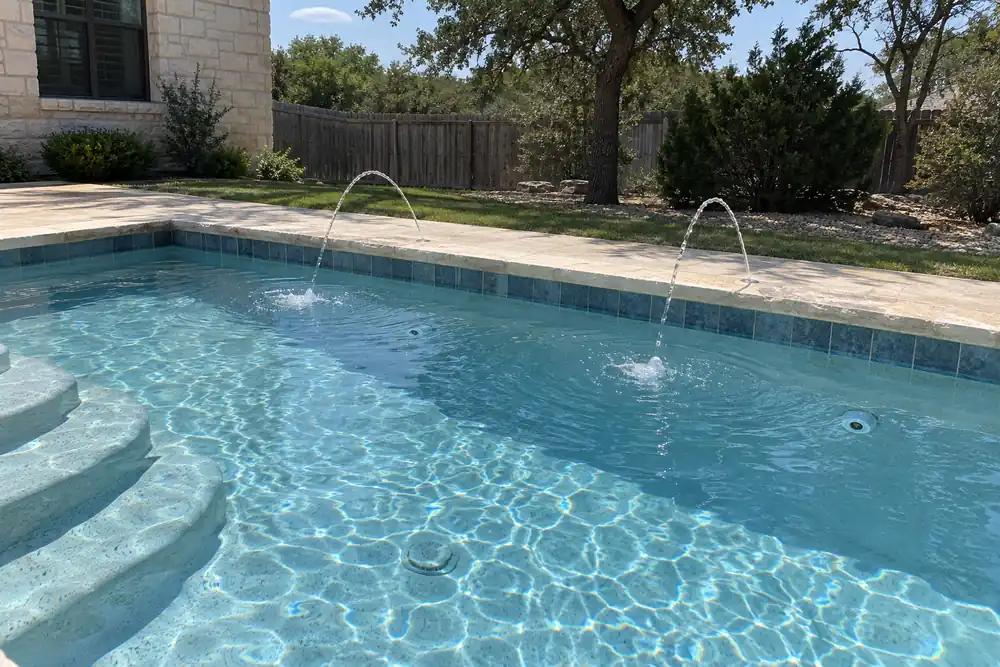
Plaster, Quartz or Pebble: Choosing a Pool Finish in Killeen
Killeen Pool Resurfacing compares the three cement-based families of pool finish used in Killeen, Texas, plaster, quartz and pebble, on what each is made of, how long it is rated to last, how it feels and looks, how it copes with water chemistry and what it costs.
Polished and glass-bead blends sit between them, and fiberglass and painted pools follow a different route, covered at the end. The ratings below are the National Plasterers Council's and the makers' own, each named; at the free estimate we'll talk through which one suits a given pool.
What each pool finish is made of
White and colored plaster
White plaster, which many people call marcite, is the simplest of the three: white cement, white marble aggregate and water, troweled by hand over the shell. It was the main option when backyard pools spread in the 1950s, NPT notes. The cement matters to the color: the white cement used in pool plaster typically holds 0.4 percent or less iron oxide, against 2.6 percent in gray cement, and that neutral base is what makes added pigments look brighter and cleaner. The National Plasterers Council adds that admixtures can help: pozzolan-based products tie up calcium hydroxide, plaster's weakest element, and have been shown to reduce etching, cracking and mottling, while silicone-based ones help the plaster repel water. They add cost and aren't fool-proof.
Quartz
Quartz finishes swap some or all of the marble for quartz, a silicate mineral that the Council describes as one of nature's hardest and unreactive with pool chemicals. Hard troweling and one of several exposure methods bring it out, so a quartz surface can run from smooth to textured, and the Council counts it as an affordable option. SGM traces the shift to the late 1980s, when it says spot etching and other plaster problems had reached epidemic proportions across the country; it brought out Diamond Brite in the early 1990s. Lines differ inside the family: Wet Edge Technologies calls its Luna Quartz an entry-level finish that may show trowel marks and color shading, and its Altima a fortified blend of marble and quartz. Brands, colors and start-up for this family are on the quartz pool finishes page.
Pebble
Pebble finishes combine small pebbles, glass and other materials, troweled hard, compacted and then exposed. Pebble Technology International sources tumbled stones from New Zealand to Chile and screens each for size so the texture comes out even, and NPT's StoneScapes blends quartz pebble, specialty aggregates, iron oxide pigments and white Portland cement. They are strong surfaces: Pebble Technology International's lab results put PebbleTec at 9,913 psi after 28 days, and NPT rates StoneScapes, mixed with its modifier, at 9,000 to 10,000 psi after the same 28 days. Textures and makers are compared on the pebble pool finishes page.
Polished and glass-bead blends
Polished finishes are smooth to the touch but look like exposed aggregate, because the mixed stones are revealed by polishing as the last step; NPT says its PolishedScapes can be polished again later in its life to restore the luster. At the far end, NPT's JewelScapes Classic series is made entirely of glass beads with white cement and colored pigment.
Call or request a free estimate any time, 24/7.
Get free estimates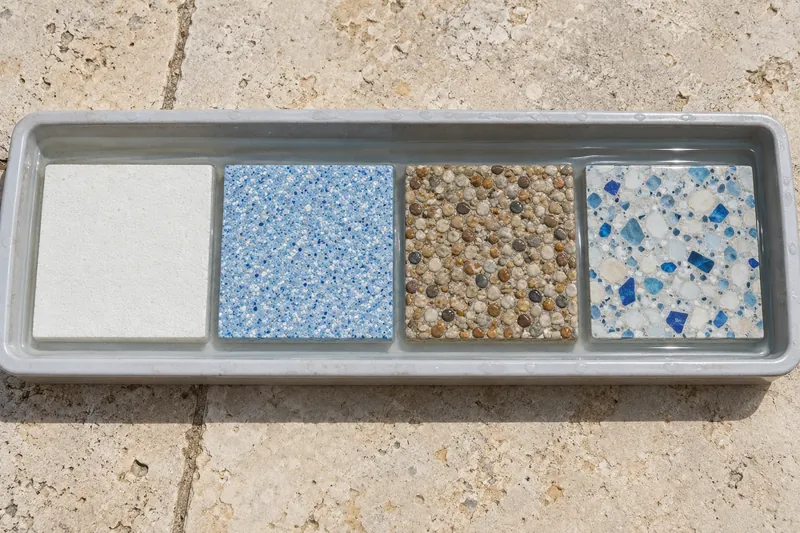
How long each pool finish is rated to last
The National Plasterers Council gives each type a surface life:
Other figures run longer, and they don't agree with each other. Even the Council's FAQ allows that plaster can reach 20 years with proper care, while Universal White Cement, a white cement maker, expects 15 to 20 years as routine where the materials, the application and the water care are all sound. SGM designs Diamond Brite for 8 to 12 years and cites unsourced "industry averages" of 10 to 20 years for exposed pebble, while national cost figures from 2026 give white plaster 7 to 12 years and pebble or quartz aggregate 15 to 25. Pebble Technology International sets its finishes against what it calls the "standard five-year lifespan" of most plaster. The Council's warning sits under all of them: a finish lasts only when proper materials, proper workmanship and balanced water are all present, and CL Industries points out that a cement finish takes up to a year to cure, so care counts most in the first 10 to 12 months.
How each pool finish looks and feels
Texture underfoot
Plaster is the smooth one; the Council describes white plaster as very smooth to the touch. Exposed-aggregate finishes are judged by texture instead, since the cement binder is taken away to leave raised sand or stone, and the trade hasn't yet set a tolerance for that texture. Pebble sizes change the feel: Pebble Technology International's original PebbleTec uses the largest stones, PebbleSheen slightly smaller ones and PebbleFina the smallest, and NPT's StoneScapes runs from Micro through Mini to Regular, whose pebbles are smooth but can be felt underfoot. Grip has been measured, too: in the Tile Council of North America's wet test, StoneScapes White Regular read 0.73, and a pebble blend with 25% glass bead 0.67.
Water color and how stains show
Of everything in a finish, its pigment sets the water's color most, by CL Industries' account, with white, blue, black and gray bases reading blue in the pool and green, brown and tan bases reading green. Premix-Marbletite adds that darker colors hold warmth while lighter pools stay cooler, and NPT notes that the water looks darker under shade from tall trees or buildings, while the shallow end looks lighter than the deep water. To preview a color, Premix-Marbletite suggests setting a sample in 6 inches of water. Stains show differently by family, and SGM, a quartz maker itself, says pebble's texture hides minor staining better, while a smoother, lighter quartz shows staining and mottling sooner.
Call or request a free estimate any time, 24/7.
Get free estimatesWater chemistry, acid washing and freezes
How each finish takes the water
By the Council's account white plaster is the soft one of the three, more at the mercy of water chemistry than newer finishes, and its look shifts over the years, from light shading or scale to staining, etching, cracking or delamination at worst. Colored ceramic quartz is much harder, the Council says, and stands up to swings in water chemistry far better, although it costs more and extreme chemistry can still mark it. River pebble is chemically inert, which is why the Council rates pebble the most durable surface available, with possible damage only under the most extreme chemistry. In Killeen, the fill water for any of the three is treated surface water from two lakes, Belton and Stillhouse Hollow, which the City buys from Bell County WCID No. 1 according to its 2025 report, and the Council asks for the fill water to be tested for pH, alkalinity, calcium hardness and metals, with the results recorded, whichever finish it fills.
Acid washes and stain repair
Acid washing treats the families differently. SGM rates Diamond Brite to take several acid washes in its lifetime with no permanent harm, while Universal White Cement warns that frequent drain-and-acid washes may whiten plain plaster for a while but strip years off it. Torching, the Council's slow heat treatment for abnormal discoloration on a drained pool, suits flat plaster and white quartz best; pebble can be torched only very delicately, and glass-bead surfaces not safely at all. Pebble Technology International also caps calcium chloride at 2% of the cement weight, warning that more can darken light colors and make dark ones blotchier.
Freezes and warranties
Killeen's NOAA station has recorded −2°F, on December 23 and 24, 1989. Pebble Technology International warns that PebbleTec isn't meant for use above the water and that its warranty excludes damage from freezing and thawing, and SGM's warranty likewise leaves freeze-thaw damage out. For any finish, the Council treats steps, benches and sun ledges in the waterline zone as the highest freeze-thaw risk and recommends keeping at least 4 inches of water over them.
Pool finish cost compared
The same sample pool, two finishes
One national report from 2026 prices plaster and quartz on the same 560-square-foot sample pool. White plaster, at $4 to $7 per square foot, averaged $3,080 there, and the report expects $3,000 to $4,000 all in for a straightforward job; quartz aggregate, at $7 to $12 per square foot, came to a budget of $5,000 to $6,500 for a mid-range job, and the same report calls lifespans of 15 to 20 years common for quartz with normal care. Pebble isn't priced on that sample pool; national figures for 2025 put pebble resurfacing at $7 to $15 per square foot. These are published averages, not our prices.
Fiberglass and painted pools
None of the three goes on a fiberglass pool. River Pools, a fiberglass pool maker, says gelcoat suits smaller repairs but isn't suitable for resurfacing a whole pool already in the ground, and recommends a sprayed coating instead. Paint is the other route for masonry pools: Ramuc says any unpainted masonry pool may be painted with rubber, epoxy or acrylic pool paint, while a fiberglass pool calls for epoxy, and Olympic's coatings give service lives of 2 to 3 years for acrylic enamel and for rubber paints, and 5 to 8 years for epoxy.
Killeen Pool Resurfacing looks at the shell, the old surface and the water before suggesting a finish, and the estimate is free.
Call or request a free estimate any time, 24/7.
Get free estimatesPool finish questions
Which pool finish is the smoothest?
Plaster, among the three main families: the National Plasterers Council describes white plaster as very smooth to the touch. Among the aggregate finishes, each maker names its own: Pebble Technology International puts its smallest natural pebbles into PebbleFina, while PebbleBreeze, buff-polished with glass beads and shell, is the smoothest of its line; NPT gives that title to its diamond-polished PolishedScapes and calls its all-glass JewelScapes smooth to the touch. Glass beads mixed into a pebble blend, Pebble Technology International says, add foot comfort as well as sparkle.
Can a new finish go over the old plaster?
Often, with the right preparation. SGM requires its Bond Kote bonding system when its finishes go over an existing finish, and Premix-Marbletite calls a bond coat absolutely mandatory on every renovation; Pebble Technology International describes stripping the existing surface first. Either way, hollow or delaminated old plaster is sounded out, cut back and patched before anything goes on. The Council caps a cement finish at an average of 3/4 inch thick and says it can't be used to level an uneven shell beyond that; no maker or body puts a number on how many layers can be built up before a full chip-out.
How long before a new finish shows its final color?
About a month at least. Pebble Technology International asks owners to give it about 28 days before they judge the final color of the water and the finish, and SGM says light mottling that appears during the cure usually evens out over the first six months. On dark plaster, CL Industries says the efflorescence caused by early curing usually stops after 28 to 60 days.
Does a pebble finish need a different brush?
It can take a tougher one than plaster or quartz. For PebbleTec, Sheen, Brilliance and Essence, its exposed finishes, Pebble Technology International is happy with nylon, polypropylene or a nylon-and-stainless mix, but its smoother PebbleFina and PebbleBreeze get nylon alone. SGM tells Diamond Brite owners to use a nylon brush, because a stainless-steel brush is meant for exposed pebble or bare concrete and will mark a quartz finish.
Choose a pool finish with a free estimate
Killeen Pool Resurfacing answers calls and estimate requests 24/7 across Killeen and nearby towns, and will compare finishes for your own pool.