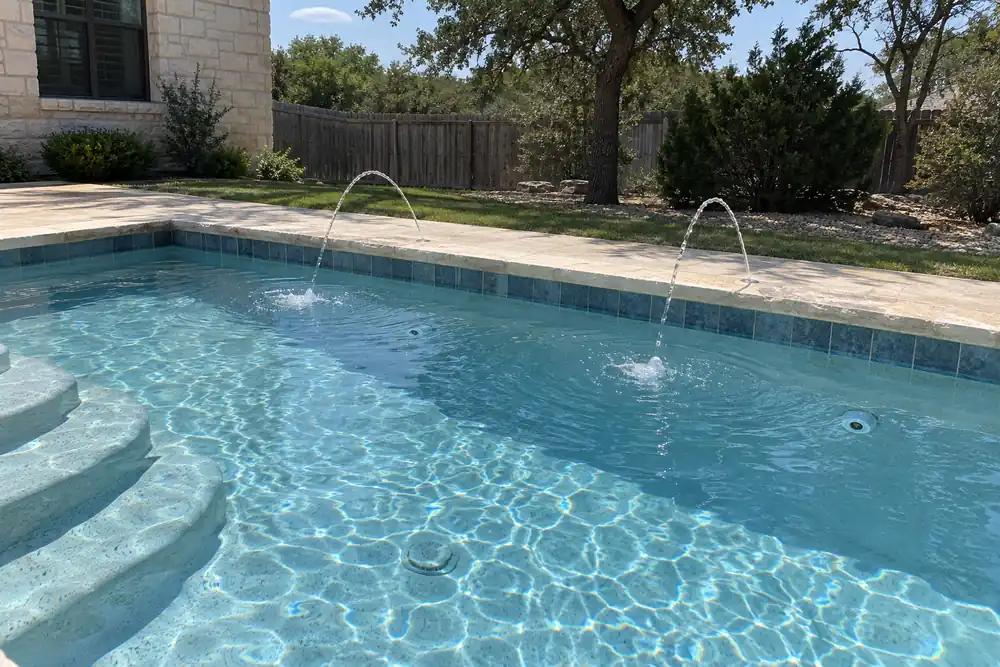
Pool Leak Detection and Repair in Killeen, Texas
Killeen Pool Resurfacing carries out pool leak detection and repair in Killeen, Texas: confirming that a pool is losing more than evaporation takes, finding where the water is going, and repairing the crack, fitting or line behind it. The search runs in order, from a simple bucket test to pressure tests on each plumbing line.
The EPA's pool guide finds leaks in liners and pump seals, in the piping and its joints, at the pool-to-pipe connection and along the pool edges, and it warns that small leaks can quickly turn into big ones. At a free estimate we'll go over how fast the level drops and any damp ground, air in the returns or climbing water bills you've noticed.
No charge · answered 24/7
Get free estimates
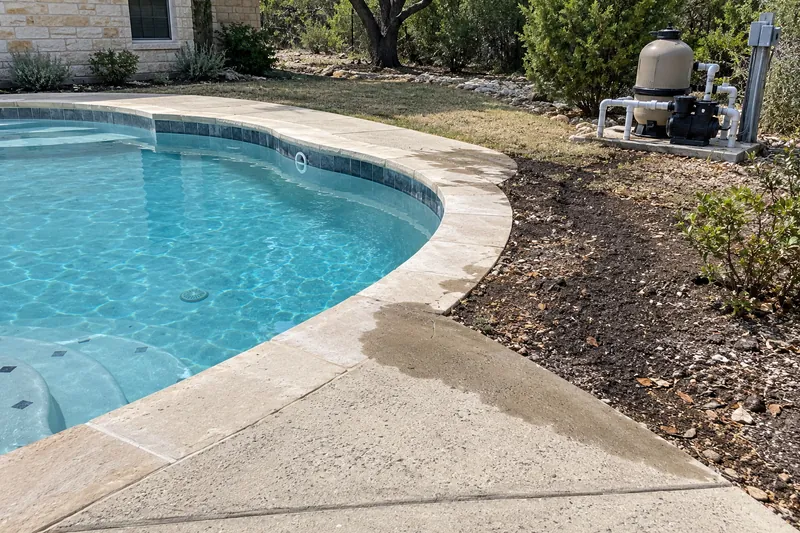
Leak or evaporation? Testing the water loss
The EPA bucket test
The U.S. Environmental Protection Agency's WaterSense guide gives a test any owner can run. Pick a day without rain or heavy wind, shut down every pool system, including the filter, cleaners and any automatic fill, and keep the pool closed for 24 hours. Fill a 2.5- to 5-gallon bucket to about 1 inch from the top, set it on a step so that at least two-thirds of it sits under water, and mark the water level inside the bucket and on the pool. If the pool has dropped more than the bucket when the 24 hours are up, the pool may have a leak.
How much loss points to a leak
As a rule of thumb, the EPA treats more than 2 inches of loss a week, or 3 inches in hot, dry places with high evaporation, as a likely leak. Anderson Manufacturing, a maker of leak-detection equipment, doesn't rely on one evaporation figure: its Evaporation Estimator works out a rate for a particular pool on a particular day from the weather and the pool itself, starting from a typical pool with 85°F water and a solid fence or windbreak about 20 feet from the edge. An automatic fill can hide a leak by keeping the level up, Anderson notes, and the EPA suggests switching the fill off for 24 hours once every three months to test, since a fill valve that sticks can send water straight to the overflow drain.
Evaporation in Killeen's dry years
In drought years, evaporation outruns rain by a wide margin. The Texas Water Development Board recorded 71.84 inches of lake evaporation in 2011 against 19.66 inches of rain in the one-degree block that contains Killeen, and 63.23 inches in 2022 against 22.03. Those are lake-evaporation figures for the whole block, not a measurement of any one pool, which is why the bucket test compares the pool with water standing in the same sun and wind.
Call or request a free estimate any time, 24/7.
Get free estimates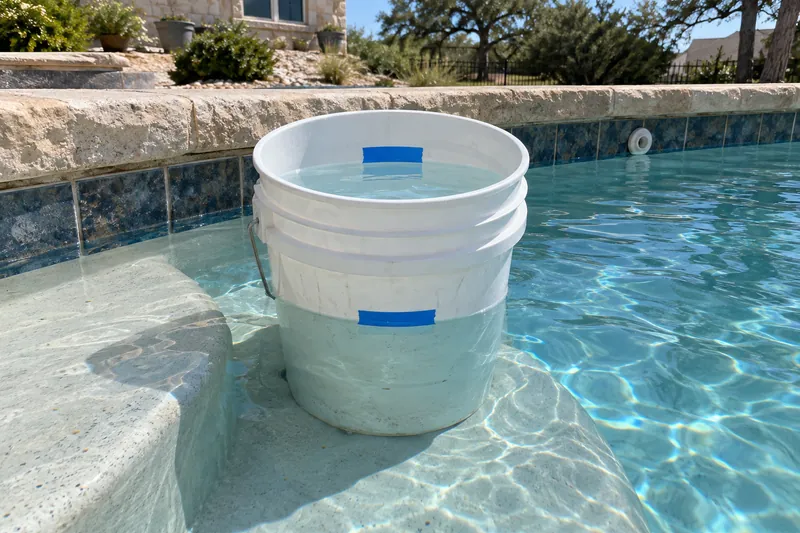
Signs a pool is leaking, and topping it up
A falling water line is only one sign. Anderson Manufacturing's list adds cracks or tile movement, since the ground around a leaking pool is unsettled by the extra water; soft, mushy patches or uneven grass growth in the yard; water bills that climb, or an autofill that seems to run constantly; standing water or corrosion at the pump and around the pipes; air or dirt blowing into the pool from the return jets, sometimes with a gurgling sound; and algae or swings in chemical use, because so much untreated water is being added. The EPA adds wet spots around the pool and air bubbles in the return line or the pump strainer.
Topping up under Killeen's drought rules
A leaking pool can't always be topped up on demand. Killeen's drought plan classes filling a pool as non-essential water use, and once the City declares Stage 2, adding water to any pool is limited to the address's two assigned watering days a week and to the hours before 10 a.m. or after 8 p.m.; Stage 3 keeps the same limit. The City's pages showed Stage 1, which has no pool rule, when read on October 4, 2026, so check the current stage before planning around it. Separately, the City's general water rules bar a continuous flow of water without special permission and require customers to keep hoses, valves and fixtures in good repair.
Call or request a free estimate any time, 24/7.
Get free estimatesHow pool leak detection works
Start with what the owner has seen
Anderson Manufacturing's logic-based approach begins with information from the customer and simple observation before any equipment comes out.
Dye-test the shell
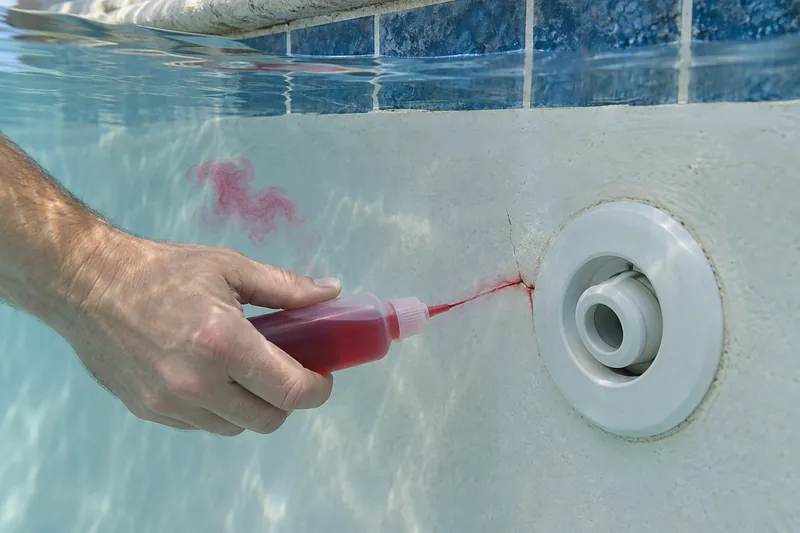
Dye testing checks the shell's common leak locations, to find a leak or rule one out: a concentrated dye that holds together under water shows whether the water is being drawn toward a crack or fitting.
Scan a vinyl liner
On vinyl liner pools, Anderson's LeakTrac 2400 scans electronically for pinholes too small to see.
Pressure-test each plumbing line
Lines are plugged and tested one section at a time with water, not air, because air compresses under pressure and can mask a real drop on a long run. The 2021 International Swimming Pool and Spa Code likewise tests circulation piping at 25 psi for at least 15 minutes and bars compressed air on plastic water piping.
Pinpoint an underground leak
Once a line is confirmed full of water, air is pushed in; it escapes from a leak faster than water and makes a bubbling or gurgling noise. Listening devices pick it up through a concrete deck, through a probe pushed into the soil, or through the pool wall with a hydrophone when the leak is close to the wall or in a main drain line under the pool.
Repair, or refer the repair
The last step in Anderson's sequence is to carry out the repair or pass it to the right trade.
A green or cloudy pool rules out reading a dye test by eye. Anderson's advice then is equipment that doesn't depend on clear water, such as the LeakTrac or a hydrophone, cleaned off straight afterward, plus pressure testing and electronic pipe-leak location. Where the water is clear but algae covers the shell, it says to look for a spot with no algae, because the water moving through a leak often washes the algae away right there.
Repairing what the test finds
Leaks through the shell
The American Shotcrete Association knows of no water-loss standard written for pools. It points instead to ACI 350.1-10, which allows a loss of 0.05 percent of the volume a day over a 72-hour test for open liquid-containment structures, with the structure filled and left to saturate for 3 days before measuring starts. When a shotcrete shell fails a watertightness test, the Association looks to placement problems such as sand pockets, overspray and rebound rather than the material, and suggests cores with petrographic analysis to investigate. Sealing cracks in the shell, from injection to hydraulic cement, is covered under pool crack repair.
Skimmers, drains and suction fittings
Skimmers and main drains are where the shell meets the plumbing, and opening one up brings in the code's safety rules. The 2021 International Swimming Pool and Spa Code requires suction entrapment avoidance under ANSI/PHTA/ICC 7 and suction outlet fittings listed and labeled to APSP 16, and requires pools to be kept in good repair. Pentair says main drain covers should be inspected regularly and replaced if cracked, broken or older than the design lifetime marked on them, and Custom Molded Products rates its Galaxy drain cover and screws for replacement every seven years. Leaks in the skimmer body and its ports are covered under pool skimmer replacement.
Buried lines, digging and permits
Repairing a buried line means digging, and Killeen's pool handout tells owners to call the Texas one-call line and the Killeen Water Department to have underground utilities located before any digging starts. The City's permit handout lists cutting into or installing plumbing pipes among work that needs a permit, while like-for-like fixture swaps don't; its examples are household fixtures and it doesn't mention pool equipment, so Killeen Building Inspections is the office to ask before a line repair begins.
Killeen Pool Resurfacing gives free estimates on leaking pools, by phone or through the form.
Call or request a free estimate any time, 24/7.
Get free estimates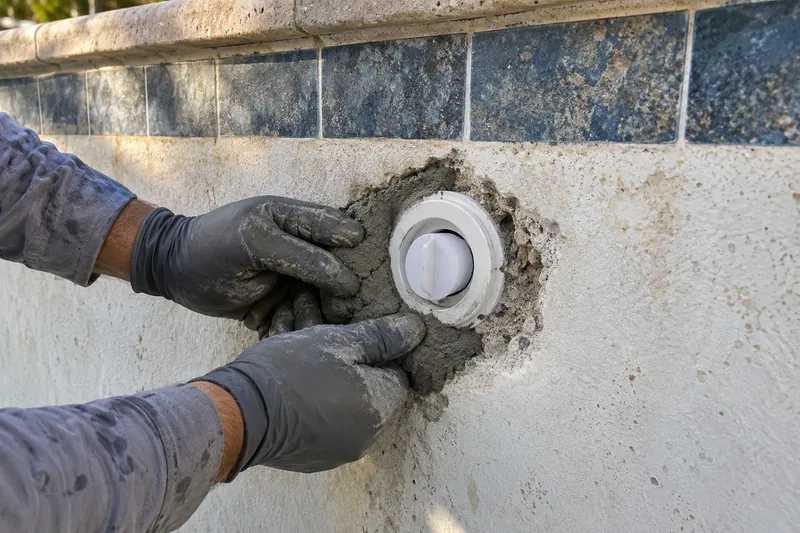
Pool leak detection questions
How do you detect a leak in a swimming pool?
From simple to specialized. The EPA's bucket test comes first: with every pool system off, a bucket of water on a step shows over 24 hours whether the pool is dropping faster than evaporation alone would take it. If it is, Anderson Manufacturing's sequence follows: dye at the shell's likely leak points, an electronic scan on vinyl liners, a pressure test on each plumbing line using plugs and water, and electronic listening to pinpoint any leak underground.
How much does it cost to fix a leak in an inground pool?
National averages reported in 2025 put inground pool leak repair at $500 to $1,500 for simpler repairs and up to $5,000 for extensive work, with advanced detection often adding $400 to $1,000; detection on its own averages $400 to $1,000 for an inground pool. Typical Central Texas detection pricing, with no data year stated, starts at $650 for a pool with a single pump, adds $150 for each extra pump or for an infinity edge's catch basin, and starts at $400 for testing an in-floor cleaning system of up to 20 heads. These are published figures, not our prices.
Is there something you can put in a pool to find a leak?
Yes: leak-detection dye. Anderson Manufacturing describes its Leakmaster dye as a specially concentrated formula that holds together under water, used with a dye tester and isolating fixtures so a technician can see whether water is escaping through a crack or fitting. It only works in water clear enough to watch; in a green pool Anderson switches to electronic equipment that doesn't need clear water.
Can a pool leak be in the plumbing instead of the pool?
Often. The EPA's list of leak locations includes the pump seal, the pool piping, the pipe joints and the pool-to-pipe connection, not only the pool itself. Anderson Manufacturing's plumbing clues are standing water or corrosion at the pump or around the pipes, soft, mushy spots or uneven grass around the pool, which it says may mean a plumbing leak, and air or dirt blowing in through the return jets. Finding a buried leak takes a pressure test on each line with plugs and water, then air pushed through the line so a listening device can hear where it escapes.
How much does a leaking pool add to a Killeen water bill?
Every gallon an autofill adds goes through the meter. Under the City's FY 2027 rate ordinance, from October 1, 2026 a home on a 5/8- or 3/4-inch meter inside the city pays $16.32 for the first 2,000 gallons, $3.66 per 1,000 gallons from 2,001 to 15,000, $4.68 per 1,000 from 15,001 to 30,000 and $6.13 per 1,000 above 30,000. Single-family sewer is billed on metered water as well, but only up to 10,000 gallons a month. Check your own bill for the rates that apply.
Request a free pool leak detection estimate
Killeen Pool Resurfacing answers calls and estimate requests about pools that keep losing water 24/7, in Killeen and nearby towns.