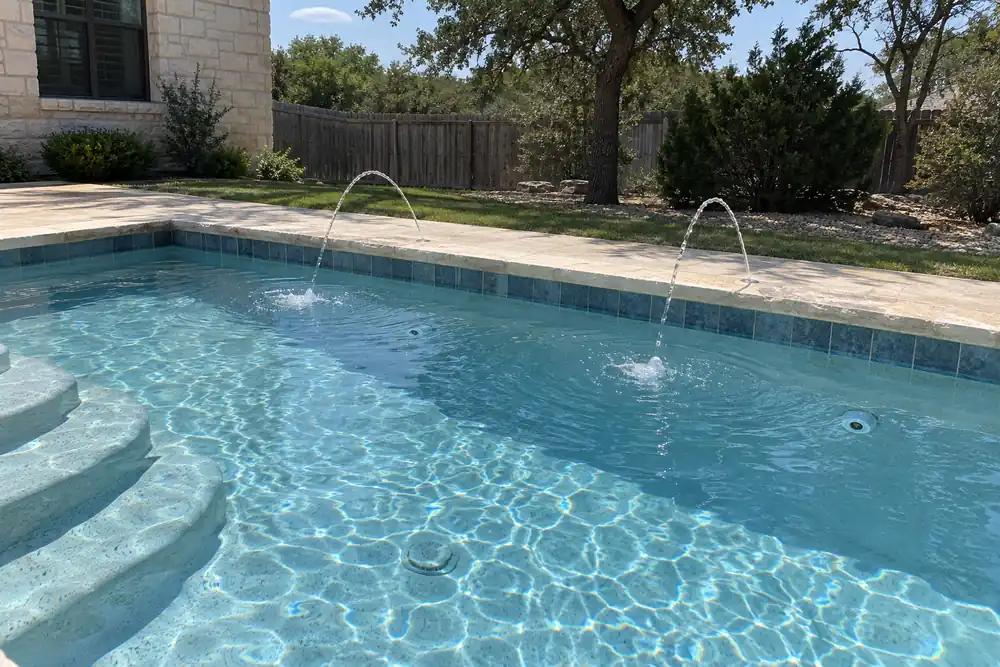
Diving Pool Conversion in Killeen, Texas
Killeen Pool Resurfacing handles diving pool conversion in Killeen, Texas, turning a pool built around a diving board into a nondiving pool with a shallower, reshaped deep end, then refinishing the shell. The International Swimming Pool and Spa Code's name for the result is a Type O pool, and the code bars diving boards and other diving equipment from it.
Much of Killeen's housing dates from the 1970s through the 1990s: of 65,793 housing units in the Census Bureau's 2020–2024 survey, 8,096 were built in the 1970s, 10,185 in the 1980s and 11,208 in the 1990s, and the median home was built in 1996. The wider remodel around a conversion is covered under pool remodeling. The estimate is free, and we'll look at the pool's depths, slopes, fittings and finish.
No charge · answered 24/7
Get free estimates
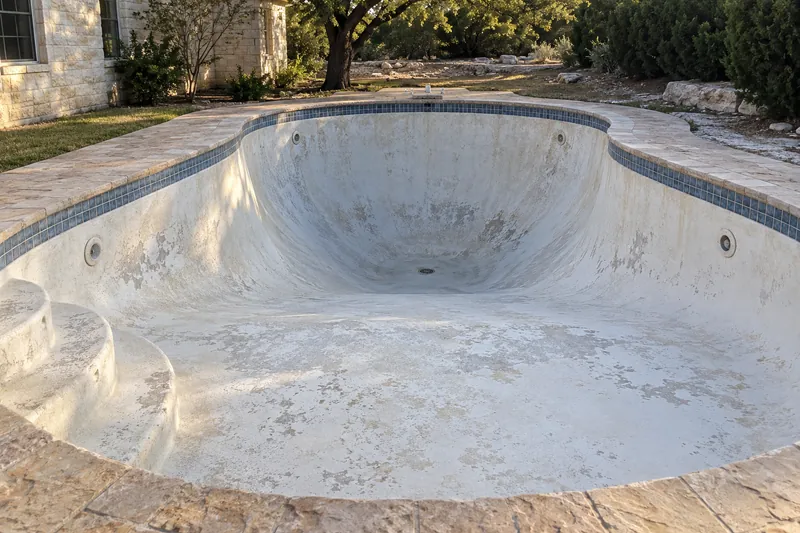
What a diving pool conversion changes
Diving boards and the water they need
A diving board belongs in the deep area of a pool built to give it the minimum water envelope, installed to its maker's instructions, and the 2021 code makes each board maker state the minimum water dimensions for every board and stand and which pool types each one fits. Diving equipment carries a permanent label with the maker's name and address, the date it was made, the minimum diving envelope and the maximum weight. S.R. Smith, a diving board maker, says the pool's water envelope must meet or exceed the ANSI/APSP/ICC-5 2011 standard for the board, warns that a board on an improperly sized pool may result in death or serious injury, and sets its mounting jig in concrete at least 6 inches thick.
The nondiving shape
Once the board is gone, the pool is reshaped to the residential rules. The shallow end must be no more than 4 feet deep and at least 33 inches, a minimum that beach, sloping-entry and architectural areas are exempt from, and the ANSI/APSP/ICC-5 2011 standard gives the same 2-foot-9-inch minimum. The change from shallow to deep comes no shallower than 33 inches and no closer than 6 feet to where the shallow end starts, the deep-end floor slopes no steeper than 1 in 3, and the walls stay within 11 degrees of vertical down to a transition point at least 33 inches below the waterline. Across the width of the pool, a float line anchored at the wall, coping or deck marks the break, set 1 to 2 feet on its shallow side.
Call or request a free estimate any time, 24/7.
Get free estimates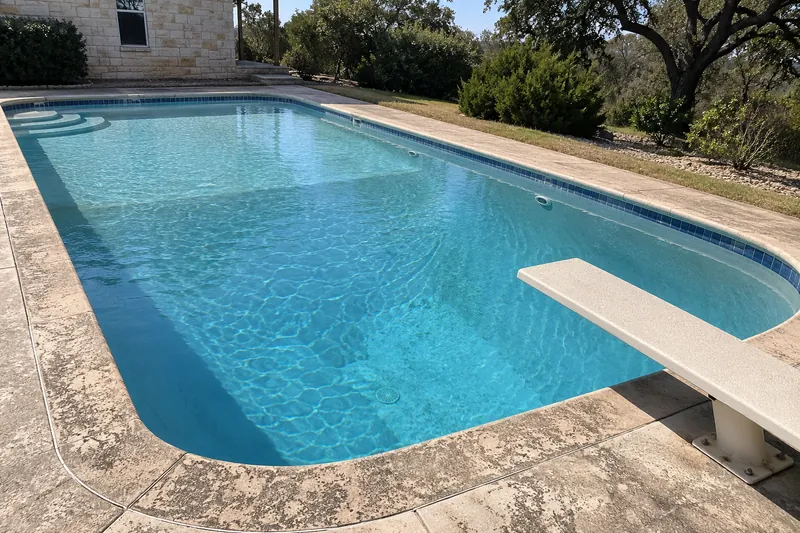
Reshaping the deep end
Placing new shotcrete in layers
Building up a deep end is structural work. Asked about reshaping a spa's interior, the American Shotcrete Association said it couldn't advise on the structure of a remodel and suggested a local engineer familiar with pools and spas. Its general guidance for new shotcrete against an old shell: roughen the old surface to about 1/16 inch or more with a water blaster of 5,000 psi or more or by abrasive blasting, then bring it to a saturated surface-dry state, damp to the touch with no water coming off on a hand. Shotcrete placed in several layers doesn't form cold joints when each layer is cleaned of loose material, overspray and laitance and brought to that same damp state, the Association explains. For strength it calls for gunite, the dry-mix form of shotcrete, reaching at least 4,000 psi after 28 days, shot by a nozzleman certified by the American Concrete Institute.
Drain covers and the new finish
The Consumer Product Safety Commission's rule requires every pool or spa drain cover made or sold in the United States to meet ANSI/APSP/ICC-16 2017, so any cover fitted during the work has to meet that standard. SGM, a plaster maker, wants new concrete fully cured for at least 28 days before a finish goes on; the refinish itself is covered under pool replastering.
Call or request a free estimate any time, 24/7.
Get free estimates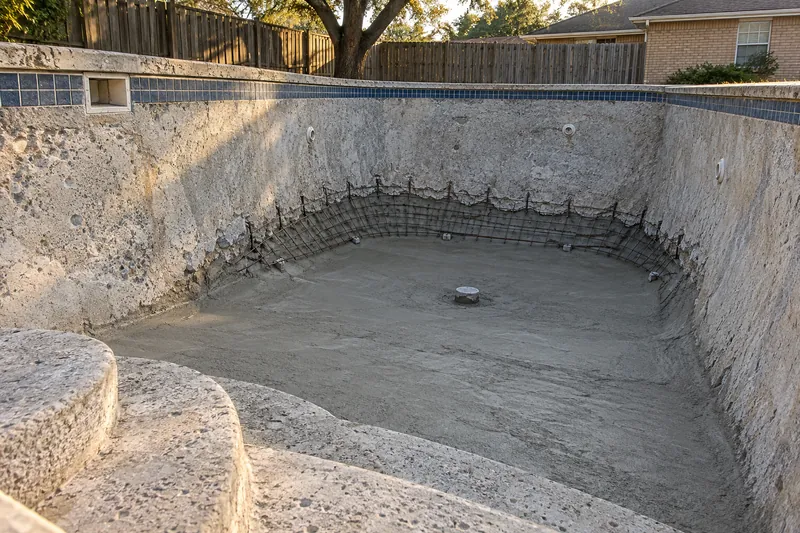
No-diving signs after a conversion
Backyard pools
The ANSI/APSP/ICC-5 2011 standard for residential pools includes an informational appendix on warning against shallow-water diving, and it says that where warning signs are used, they should follow the ANSI Z535 series for safety signs.
Apartment, HOA and other public pools
At public pools, the 2021 code likewise bans diving equipment on a Type O pool, and its diving envelopes for public pool Types VI to IX start at 7 feet deep for Type VI. Wherever a public pool is 5 feet deep or less, the code puts the "No Diving" symbol on the deck at intervals of no more than 25 feet, next to a depth marker.
Call or request a free estimate any time, 24/7.
Get free estimatesKilleen's pool form and refill rules for a conversion
The City of Killeen's pool permit form asks for the pool's type, its water height and its accessories, a diving board among them along with the deck, steps, ladder, pump, slide and underwater lighting. The application needs a plot plan showing the house's electrical service and the pool's location, and its site plan must show streets, all structures, property-line distances, easements and every overhead and underground electrical line. When the reshaped pool is refilled, Killeen requires backflow protection on the water supply used to fill a pool or spa and a vacuum breaker on every outside hose faucet.
Killeen Pool Resurfacing reviews a conversion's depths, fittings and City paperwork at the free estimate.
Call or request a free estimate any time, 24/7.
Get free estimatesDiving pool conversion questions
Can a diving board go back on a converted pool?
Not on a nondiving pool. The International Swimming Pool and Spa Code doesn't allow diving equipment on a Type O pool, and a board has to be installed in a deep area that gives the minimum water envelope its maker states for that board and stand. A pool reshaped to nondiving depths no longer has that envelope.
How deep does a pool need to be for a diving board?
It depends on the pool type and the board. For the two smallest residential diving types, I and II, the 2021 code's minimum diving envelope is 7 feet 6 inches deep at Point B and 6 feet at Point A, rising to 8 feet 6 inches and 9 feet for Type V, with no negative construction tolerance allowed. The board's maker must also state the minimum water dimensions for each board and stand.
Is it safe to dive into a pool after a conversion?
Head-first dives into shallow water are the risk. ANSI/APSP/ICC-5 2011, the residential pool standard, carries an informational safety appendix telling owners to allow no diving, jumping or sliding into shallow water, and its diving rules say never to go in head first where the water is 5 feet deep or less. A converted pool's shallow end is 33 inches to 4 feet deep under the 2021 code.
Does a diving pool conversion need a permit in Killeen?
Expect one. Killeen's adopted pool code, the 2024 International Swimming Pool and Spa Code, asks for a permit to build, alter or repair a pool and exempts only the replastering or resurfacing of an existing one, in the model code's words rather than the City's. The same code lets an existing pool stay in use when repairs follow its original design, and says an alteration must meet the rules for a new system without forcing the rest of the pool up to current code. The City's Building Inspections office, at 100 E Avenue C, is the place to confirm a conversion's permits.
Does a converted pool still need steps or a ladder in the deep end?
If the deep area is still more than 5 feet deep, yes: the 2021 code requires a means of entry and exit there too, with handholds allowed where an exit would be hazardous. Any shallow area deeper than 24 inches also needs one, which can be steps, stairs, a ladder, treads, a ramp, a beach entry, an underwater seat, a bench or a swimout.
Request a free diving pool conversion estimate
Killeen Pool Resurfacing answers calls and estimate requests about diving pool conversions 24/7, for Killeen and the surrounding towns.