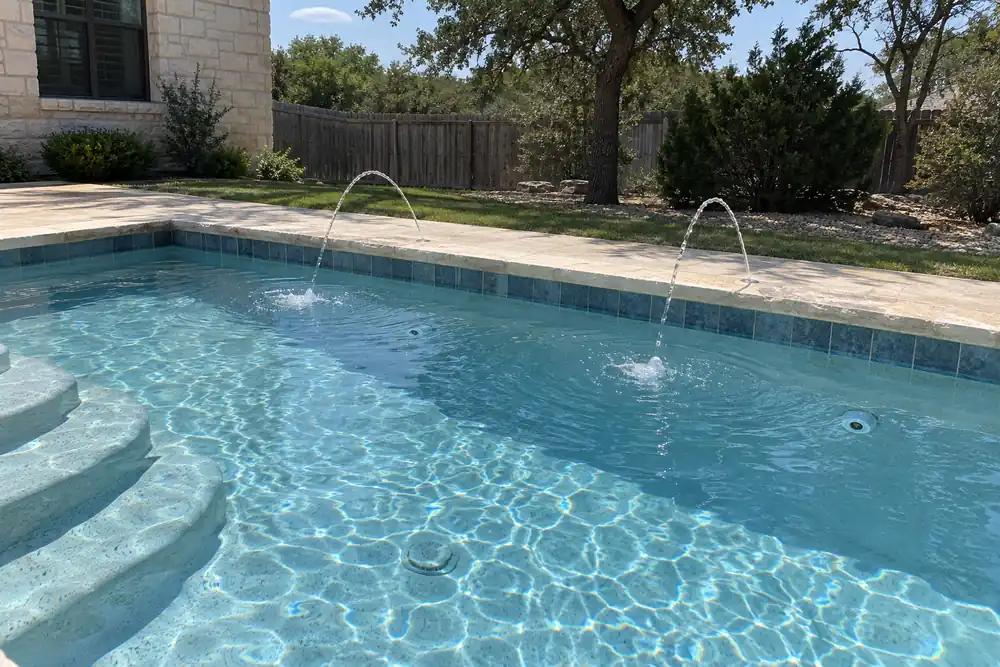
Apartment and HOA Pool Resurfacing in Killeen, Texas
Killeen Pool Resurfacing provides apartment pool resurfacing in Killeen, Texas, for apartment complexes, condominiums and homeowners associations, whose shared pools the state classes as Class C public pools. A pool kept for occupants or members and their guests counts as public under the Texas Department of State Health Services' rules whether it is publicly or privately owned, and whether or not anyone pays to swim.
Killeen's rentals are older than its owner-occupied homes: the Census Bureau's 2020–2024 survey puts the median rental's build year at 1991, against 2003 for homes lived in by their owners, and the Texas Real Estate Commission's database lists 12 property owners' associations with a Killeen address in Bell County. Hotels and other shared pools are covered under commercial pool resurfacing. The estimate is free, and we'll go through the finish, the closure and the paperwork with the manager or the board.
No charge · answered 24/7
Get free estimates
The rulebook for an apartment or HOA pool
Inspections and the pool's construction date
The state health department or the local regulatory authority may inspect a public pool at any reasonable time, without advance notice, and a local health authority's own standards may differ from the state's only by being equal or stricter. Several of the state rules turn on when a pool was built, which DSHS dates from the issue of its building permit; where no permit was needed, the date is when excavation or electrical service began, whichever came first. Pools built before the rules took effect follow the engineering practice of their original era unless the rules say otherwise.
Pool-yard rules under Chapter 757
Texas Health and Safety Code Chapter 757 governs the fences and gates around apartment and HOA pools. Where electrical service for the first construction of the building or the pool began on or after January 1, 1994, no door, sliding glass door or French door may open straight into the pool yard. A city may set its own pool-fence standards, but for an enclosure this chapter covers it must use the chapter's standards, with penalties of up to $1,000 and each day a separate offense. A tenant, an HOA member or a government body can sue an owner or association that doesn't comply, including for a civil penalty of up to $5,000 if the problem isn't fixed within a reasonable time after written notice.
Electrical work at a shared pool
The state pool rules require the electrical system of a public pool, and of the structures in its pool yard, to be installed, maintained, repaired or replaced by an electrician licensed under the Texas Electrical Safety and Licensing Act. Texas licenses electricians through the Texas Department of Licensing and Regulation, and non-exempt electrical work has to go through a licensed electrical contractor, so any work on the pool's lights or wiring during a resurface falls under that rule.
Call or request a free estimate any time, 24/7.
Get free estimatesPlanning a shared-pool resurface with the manager or board
Substantial and non-substantial alterations
The CDC's Model Aquatic Health Code, a model code rather than Texas law, sorts alterations by cost: work costing more than half the pool's replacement cost is a substantial alteration, and anything at 50 percent or less is non-substantial. Under that model, a substantial alteration can't start until the authority having jurisdiction has approved the construction plans.
Pool lifts and sloped entries
The Department of Justice's 2010 ADA Standards list five accessible ways into a pool: a pool lift, a sloped entry, a transfer wall, a transfer system and pool stairs, and at least one of the two entries a large pool needs must be a lift or a sloped entry. A lift has to sit where the water is no deeper than 48 inches, work without help from both the deck and the water, lower its seat at least 18 inches below the still water and carry at least 300 pounds. A sloped entry runs down to between 24 and 30 inches below the still water level, with at least two handrails 33 to 38 inches apart. The Department set January 31, 2013 for existing pools of public entities and public accommodations to comply as far as its rules require, and says accessible features such as lifts must be kept working whenever the pool is open. Its guidance doesn't say whether a pool used only by residents and their guests is covered, so that question belongs with the association's counsel or the regulator before the job is scoped.
The deck and the coping joint
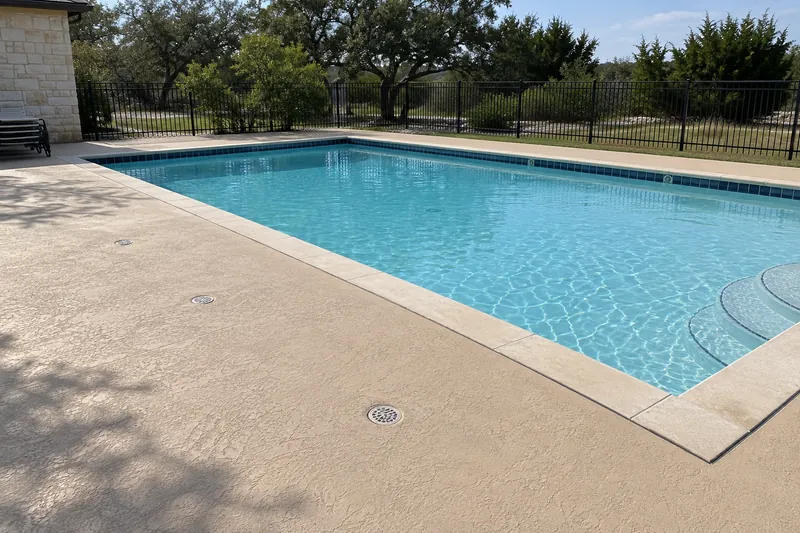
The Model Aquatic Health Code asks for an unobstructed perimeter deck at least 4 feet wide, flush with the pool walls or coping, and a continuous watertight expansion joint between that deck and the coping, built to protect the coping and its mortar bed from the deck's movement. It allows open joints in a deck no wider than 3/16 inch, treats a change in level of more than 1/4 inch as an edge condition, and lets caulk or sealant fill the joints for expansion and contraction. The state's own rule is shorter: no standing water on the deck of a Texas public pool, and deck drains kept clean so none collects.
Call or request a free estimate any time, 24/7.
Get free estimates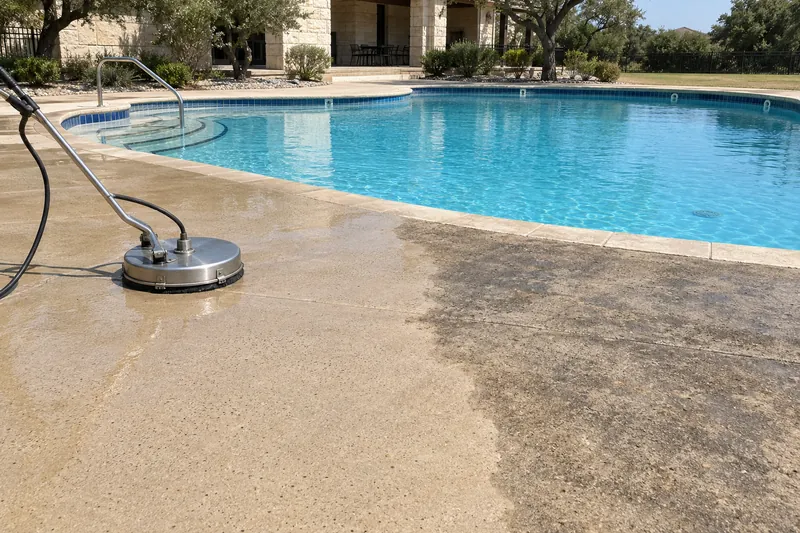
Checks after an apartment or HOA pool reopens
Water clarity and the reference tile
A Texas public pool's water must be clear enough to see an 8-inch black disk on the floor at the deepest point. The Model Aquatic Health Code puts a reference tile, or the main suction outlet, at that deepest point for checking clarity: a contrasting 4-by-4-inch tile in pools 10 feet deep or less and 8 by 8 inches in deeper ones, visible from anywhere on the deck up to 30 feet away.
Cracks the daily inspection watches
The model code defines a structural crack as a break or split in the pool surface that weakens the vessel, and it puts shell cracks on the daily inspection list: they are repaired once they change enough to raise the risk of leaks, trips, falls or cuts, or to make cleaning hard, while surface cracks under 1/8 inch wide are recorded and watched for movement, and any sharp edges are removed or repaired. Texas rules add that slime and biofilm come off every accessible surface, including steps, ladders, sidewall tile and depth markers.
Killeen Pool Resurfacing walks managers and boards through these checks at the free estimate.
Call or request a free estimate any time, 24/7.
Get free estimates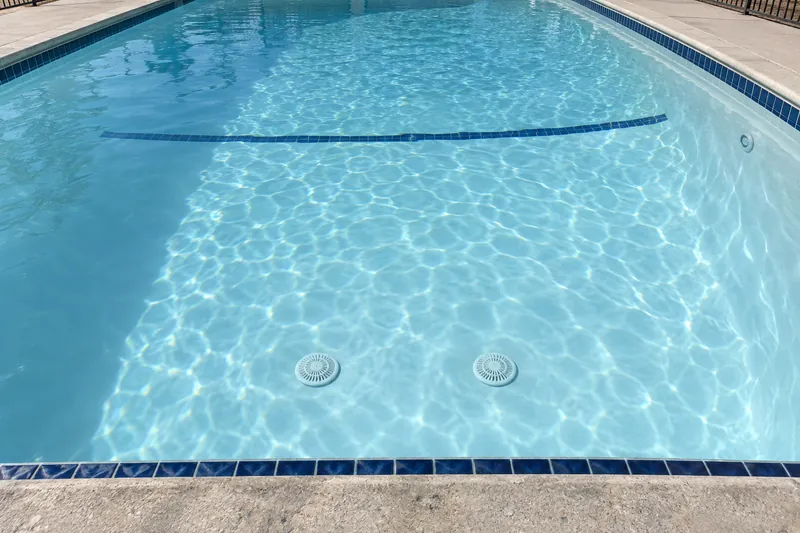
Apartment and HOA pool resurfacing questions
Is an HOA pool a public pool in Texas?
Yes, under the state health rules. DSHS treats only a pool on private property serving no more than two resident families and their guests as residential, and it classes pools run by property owner associations, apartments and condominiums, limited to occupants or members and their guests, as Class C public pools. For drain-cover purposes, federal law agrees: the Virginia Graeme Baker Pool and Spa Safety Act counts pools open only to an apartment complex's residents, or only to an organization's members, as public pools.
Which pools does the Texas pool-yard fence law cover?
Chapter 757 of the Health and Safety Code covers only pools owned, controlled or maintained by a multiunit rental complex or a property owners association, and only those deeper than 18 inches, including wading pools, hot tubs and spas. A house that isn't part of a condominium doesn't count as a rental complex, so a family's backyard pool is left to the city's pool code. For the pools it does cover, the enclosure stands at least 48 inches high, measured away from the pool, and chain link is banned for any new pool-yard enclosure built after January 1, 1994.
How much does it cost to resurface an HOA pool deck?
National averages reported in 2026 put HOA pool deck coating systems at $3 to $12 per square foot, depending on the system: $3 to $7 for basic concrete overlays, $4 to $10 for epoxy or textured acrylic, and $8 to $14 for rubber or premium systems, and say the coatings last 10 to 15 years. A typical 2,000 to 4,000 square foot HOA pool deck lands between roughly $6,000 and $48,000 per cycle. These figures are published averages, not our prices.
Who can operate an apartment or HOA pool after it reopens?
Every Class A, B and C public pool in Texas, every apartment and HOA pool included, has to run under a trained and certified operator. The operator doesn't need to be on site and may look after several pools. The state accepts the NRPA Aquatic Facility Operator, the PHTA Certified Pool Operator and the ASPSA Licensed Aquatic Facility Technician courses, or an equivalent the local regulatory authority approves.
Do pumps and filters cost more at an apartment or HOA pool?
Yes. Typical Texas pricing for apartment and HOA pools reported in 2026 puts commercial pump replacement at $1,800 to $6,500 or more for 3 to 7.5 horsepower, against $300 to $1,600 for a home pool, and filter replacement with labor at $1,500 to $2,600 or more, against $250 to $1,700. The same report gives $15,000 or more for resurfacing a large commercial pool. These are published figures, not our prices.
Request a free apartment or HOA pool resurfacing estimate
Killeen Pool Resurfacing answers calls and estimate requests from property managers, HOA boards and condominium associations 24/7.